
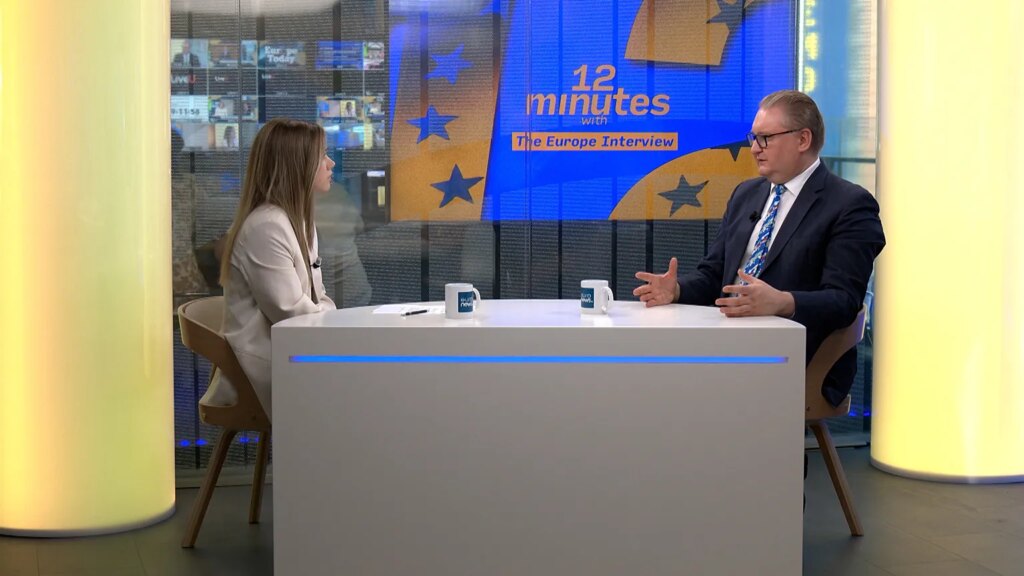
Brussels must accelerate the EU accession process, and complete membership remains the sole option, Ukraine’s Deputy Prime Minister for European and Euro-Atlantic Integration, Taras Kachka, tells Euronews.
For Kyiv, «there are no alternatives to a rapid, merit-based, yet full membership in the European Union,» stated Taras Kachka, Deputy Prime Minister of Ukraine for European and Euro-Atlantic Integration, in an exclusive Euronews interview.
 ADVERTISEMENT
  ADVERTISEMENT
Earlier this month, German Chancellor Friedrich Merz suggested that Ukraine might first become an «associate member» of the EU prior to achieving full member state status.
Kachka dismissed this notion, labeling it «unacceptable if considered as an alternative to full membership.»
He emphasized that Ukraine requires a «swift, comprehensive, and standard accession process culminating in the signing of an accession treaty under Article 49 of the Treaty on European Union.»
According to him, anything else «is irrelevant.»
Ukraine’s accession timeline
In a renewed push to hasten its EU accession, Kyiv urges Brussels to launch all of Ukraine’s negotiation clusters already in June this year, advancing the previously planned July schedule.
«We are confident that all six clusters can open by June,» Kachka told Euronews on Tuesday. «Our timeline indicates that we are already behind.»
Kachka’s comments follow European Commissioner for Enlargement Marta Kos’s statement that the first negotiation cluster could open in June during Cyprus’ EU presidency, with the remaining five expected by July as Ireland assumes the role.
Negotiation clusters correspond to essential reform areas necessary to comply with EU criteria, covering matters such as the rule of law and judicial reforms.
Each benchmark set must be accomplished by the candidate, with the final endorsement requiring unanimous consent from all 27 EU member states.
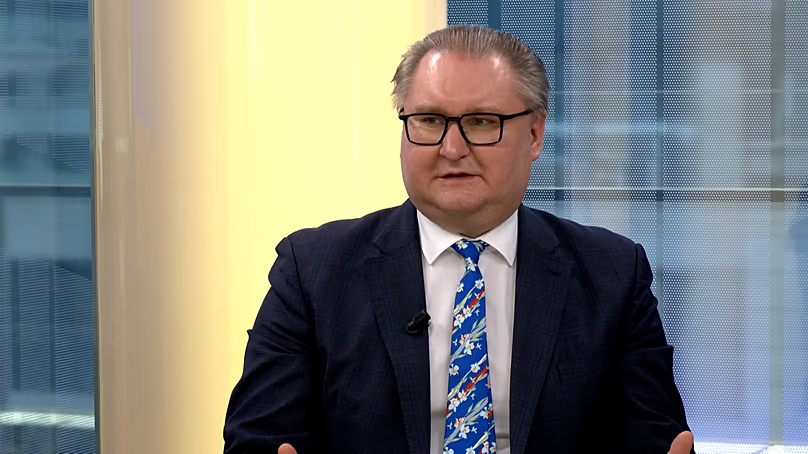
Kachka stressed that Ukraine has already fulfilled the essential groundwork, signifying that the formal initiation of accession clusters will not constitute a new beginning for the country.
«Therefore, all preparations are done, which is why we are already behind schedule,» the deputy prime minister asserted.
He added that a «certain bias» exists regarding the timing and conditions of Ukraine’s accession process commencement.
«For Ukraine, this process began about 15 years ago, or even prior, during negotiations of the association agreement,» he noted. «All benchmarks defined by the European Union can be fulfilled within the next 12 to 18 months.»
Ukraine’s accession was long obstructed by a Hungarian veto, which Kyiv now anticipates will be revoked under the new Hungarian prime minister, Péter Magyar.
Hungary ‘will not block anything’
Following years of strained relations, Hungary and Ukraine have initiated discussions on the rights of the Hungarian minority within Ukraine, a historic source of tension and a major cause for Budapest’s veto of Ukraine’s EU accession.
Kachka affirmed that «Ukraine treats the Hungarian community with full respect.»
«They are seen as a fundamental part of Ukrainian society, with respect to their national identity,» he emphasized.
«We currently operate nearly 100 schools serving the Hungarian community that meet all educational standards. This allows every child wishing to learn in Hungarian or study Hungarian alongside Ukrainian to do so.»
Kachka explained that Kyiv is presenting Budapest with the same proposal previously offered to former Prime Minister Viktor Orbán: «to adjust legislation transparently to ensure that this favourable atmosphere remains unchanged.»
Nonetheless, Kachka suggested Budapest should not delay lifting its veto on Ukraine’s accession, clarifying that «the dialogue on national minorities between Ukraine and Hungary will continue indefinitely.»
Could other countries impose vetoes?
Although Hungary’s veto on Ukraine’s EU accession may be removed soon, concerns persist that other member states might obstruct Kyiv’s progress.
Poland is among the countries that may pose such challenges.
«It is widely known that Polish agriculture views Ukrainian agriculture as a competitor,» Kachka remarked on Tuesday.
He indicated that Kyiv is already consulting with Warsaw, alongside other European capitals, regarding potential sector-specific concerns.
«We observe no intention to block the opening of the clusters but perceive goodwill to find solutions to these delicate and complex issues with Poland, neighbouring countries, and other member states. However, this scenario will be the most sensitive.»