
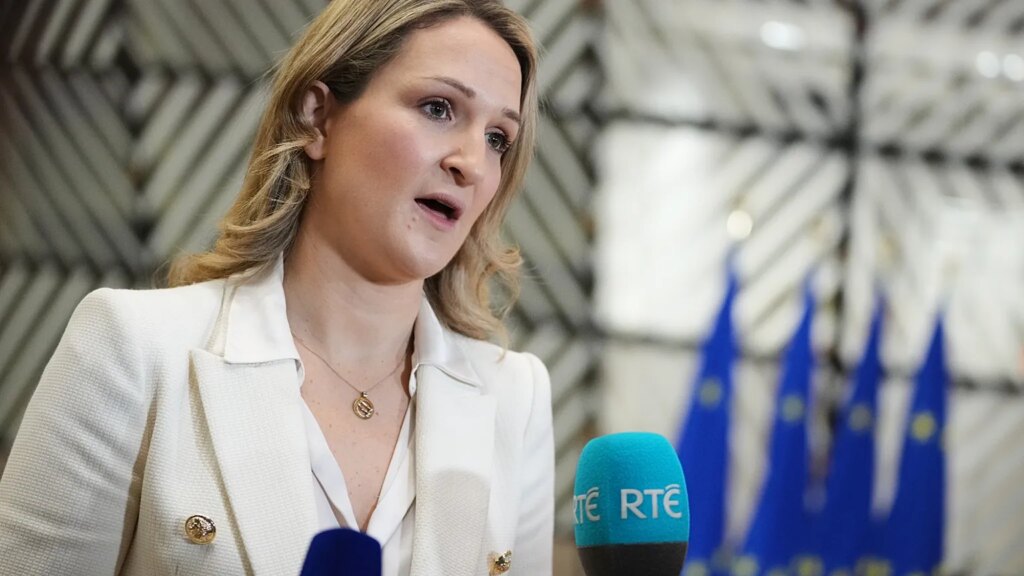
Helen McEntee, Ireland’s foreign minister, cautioned that offering «associate membership» to Ukraine might trap the country in uncertainty regarding its goal of full EU membership, following the unprecedented proposal by German Chancellor Friedrich Merz.
According to Helen McEntee, Ireland’s foreign minister, bestowing «associate membership» on Ukraine could result in the nation being stuck in a state of uncertainty, potentially hindering its progress toward achieving full membership status.
 ADVERTISEMENT
  ADVERTISEMENT
These comments respond to German Chancellor Friedrich Merz’s groundbreaking suggestion to establish a customized status for Ukraine, which McEntee fears could create a dual-tier system in the EU accession process.
«It is crucial to ensure that accession is applied equally to all nations and that a two-tier system does not arise,» McEntee stated on Friday during a press briefing attended by Euronews.
Her viewpoint is particularly significant as Ireland prepares to assume the presidency of the EU Council in July, thereby managing the negotiations on Kyiv’s EU membership bid.
«Ukraine faces a challenging situation, and we have consistently supported advancing its accession,» she continued, emphasizing that an associate membership could diminish the impetus for Ukraine to fully integrate into the EU.
«Could this lead to associated members finding themselves caught in a sort of limbo?» McEntee questioned, highlighting specific areas like the rule of law and judicial reforms where candidate countries often stagnate due to insufficient pressure.
«Does this reduce the urgency, causing countries to remain in a partial membership status without natural progression?» she added.
Brussels and EU member states are currently reviewing the letter sent by Merz to other leaders, intended to break the two-year deadlock concerning Ukraine’s EU accession.
In the five-page letter, seen by Euronews, Merz suggests granting «associate membership,» which would allow Ukraine participation in decision-making bodies but without voting rights or portfolios, as well as access to certain EU-funded programs incrementally.
Furthermore, he proposes that Ukraine could invoke assistance from other member states under Article 42.7 of the EU treaties if faced with armed aggression, providing what he terms a «significant security guarantee» intended to deter Russian threats.
«It is clear that completing the accession process promptly is unrealistic, given the numerous challenges and political complexities linked to ratification in various member states,» Merz explains.
«It is now essential to advance Ukraine’s EU integration through innovative and immediate measures.»
The European Commission welcomed discussions on «innovative solutions,» while emphasizing that enlargement must adhere to a «merit-based» approach.
The Commission has stated it will weigh in on the legal aspects of Merz’s proposal only after the heads of state and government finalize their discussions. However, diplomats remain highly skeptical about the plan’s viability.
Meanwhile, Ukrainian Foreign Minister Andrii Sybiha reaffirmed the country’s commitment to securing «full-fledged membership» within the EU.
«We recognize ongoing efforts to identify pathways toward this membership. Such measures might have a role, but they cannot replace our core strategic objective,» he remarked on Friday.
President Volodymyr Zelenskyy has not yet responded to Merz’s plan but has consistently rejected any proposals for «symbolic» accession.
The German proposal emerges as the EU sees a potential opening to end Hungary’s veto on Ukraine’s accession, which has blocked progress for two years. Hungary’s new government has initiated talks with Kyiv concerning the rights of the Hungarian minority in Ukraine, a delicate political matter.
Brussels hopes sufficient progress will be achieved to lift the veto in June, allowing the launch of the first negotiation cluster with Ukraine, known as «fundamentals,» while the remaining five clusters could be cleared throughout the rest of the year.