
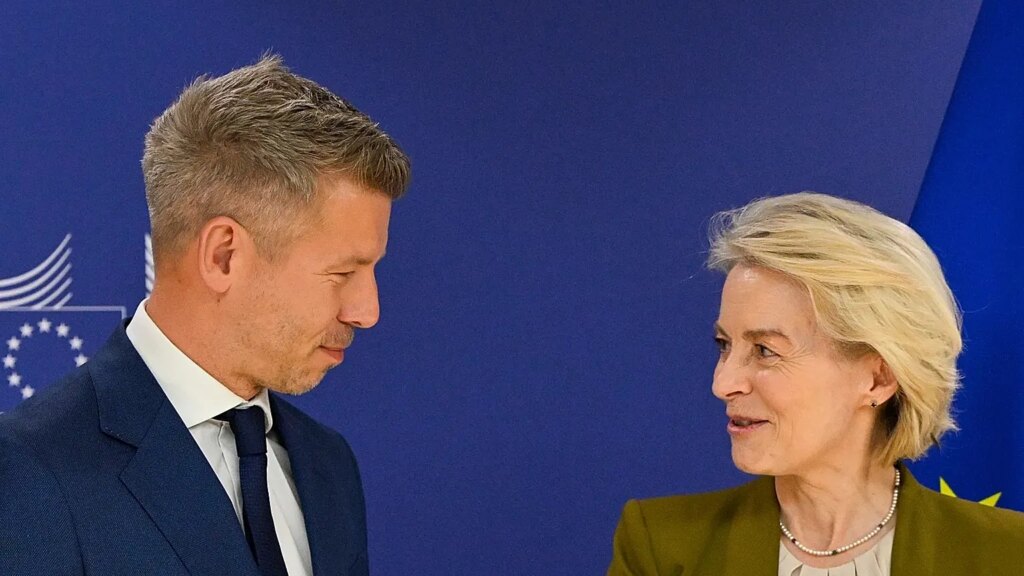
Péter Magyar is resisting EU demands regarding pension and tax reforms, complicating efforts to unlock €17 billion in frozen funds before the August deadline. Yet, progress on resolving the Erasmus+ educational programme issue appears imminent.
Pension and tax changes have become the primary obstacles in talks between Budapest and Brussels aimed at releasing billions of euros in EU funding for Hungary, according to Euronews sources.
 ADVERTISEMENT
  ADVERTISEMENT
European Commission officials report that Hungary’s newly appointed prime minister, Péter Magyar, opposes both sets of reforms, emphasizing the extra strain they would place on the nation’s budget.
Engaged in talks with the European Commission, Magyar’s administration seeks to unlock €17 billion in EU funds that had been frozen during Viktor Orbán’s former government over concerns about rule-of-law and corruption.
If Hungary misses the August 31 deadline required to access this money, it risks losing €10.4 billion in recovery funding. While Commission representatives have mentioned the possibility of easing some requirements, they have decisively ruled out extending the deadline.
Officials from Magyar’s government concede that implementing extensive sector-specific reforms before the late August deadline for releasing post-COVID Recovery and Resilience Facility funds may not be feasible.
For Magyar, pension reform carries significant political weight: during his electoral campaign, his Tisza party pledged to raise minimum and below-average pensions.
Hungary’s agreed recovery plan contains measures aimed at enhancing the pension system’s sustainability and fairness, alongside initiatives to streamline the tax code.
The Hungarian government has communicated to Brussels that while committed to pension reform in theory, the country’s fragile fiscal status and limited time frame make rollout before the deadline practically unachievable.
Over the past weekend, Magyar sent a letter to Commission President Ursula von der Leyen outlining his non-negotiable positions prior to the negotiations, though the letter’s content remains undisclosed.
Regarding taxation, Magyar has openly rejected removing windfall taxes imposed on Hungary’s energy and financial sectors.
“The European Commission expects, for instance, gradual elimination of some special taxes. While advantageous for the Hungarian economy, under current budget conditions, the government cannot undertake this,” he stated last week.
The Commission’s response is yet to be determined. Hungary could potentially replace the disputed reforms with alternative commitments.
A substantial EU delegation in Budapest
On Monday, more than 20 European Commission experts arrived in Budapest to discuss how to release the frozen funds, with their visit planned to end on Friday.
A Commission official, speaking anonymously due to the matter’s sensitivity, noted that the delegation’s size reflects von der Leyen’s personal involvement. The Hungarian negotiation team was described as “highly constructive.”
The discussions have centred on Recovery Funds, with specialists evaluating feasible achievements before the end of August.
Brussels has recommended that Hungarian negotiators prioritise securing the €6.5 billion non-repayable grant portion of the funds while foregoing the €3.9 billion loan component, pointing out that additional borrowing would worsen Hungary’s already precarious fiscal situation.
A political agreement anticipated in Brussels next week
Magyar is expected to travel to Brussels next week to sign a political agreement with von der Leyen outlining a roadmap for releasing the frozen funds. The exact date for this meeting has not been announced.
Inside sources from the Commission indicate that the “political agreement” primarily holds symbolic value, as Hungary must satisfy all conditions to access the recovery funds.
The process is complex, they emphasise, since unlocking the funds depends on Hungary completing 27 “super milestones” along with over 368 individual milestones.
According to one official, the political agreement would involve von der Leyen and Magyar publicly affirming the start of a new phase in EU-Hungary relations.
They are likely to concur on a timeline for necessary steps and reaffirm Hungary’s dedication to joining the European Public Prosecutor’s Office and adopting the euro.
Erasmus+ dispute close to resolution
A tangible outcome may be a joint announcement addressing the long-standing Erasmus+ conflict involving Hungary.
In 2022, 21 Hungarian universities, restructured as public interest asset management foundations under the acronym KEKVA, were suspended from EU funding due to governance-related corruption concerns.
This suspension has considerably limited opportunities for Hungarian students to engage in exchange programmes.
The ongoing issue has increasingly frustrated Brussels officials, as it disproportionately affects young, pro-European Hungarians, many of whom backed efforts to unseat Viktor Orbán.
Resolving this will require Hungary to tackle governance issues surrounding the KEKVA foundations, although the Commission has clarified it does not insist on their complete dissolution. Budapest has yet to decide on its approach.
Another significant hurdle remains Hungary’s ongoing non-compliance with a previous European Court of Justice ruling concerning the treatment of asylum seekers, which has resulted in a daily fine of €1 million.
This penalty currently applies to Hungary, and Péter Magyar has indicated efforts are underway to find a resolution.