
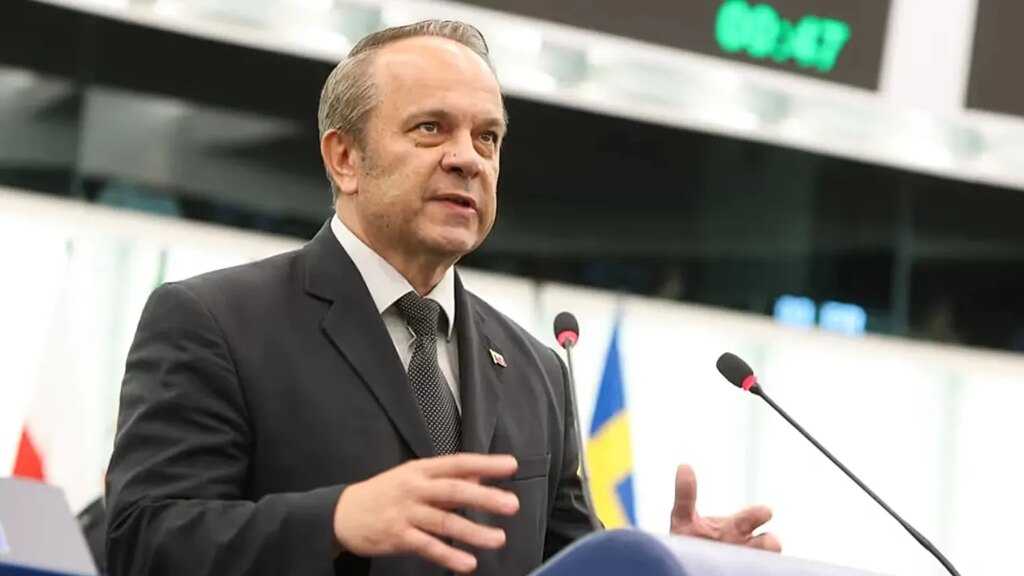
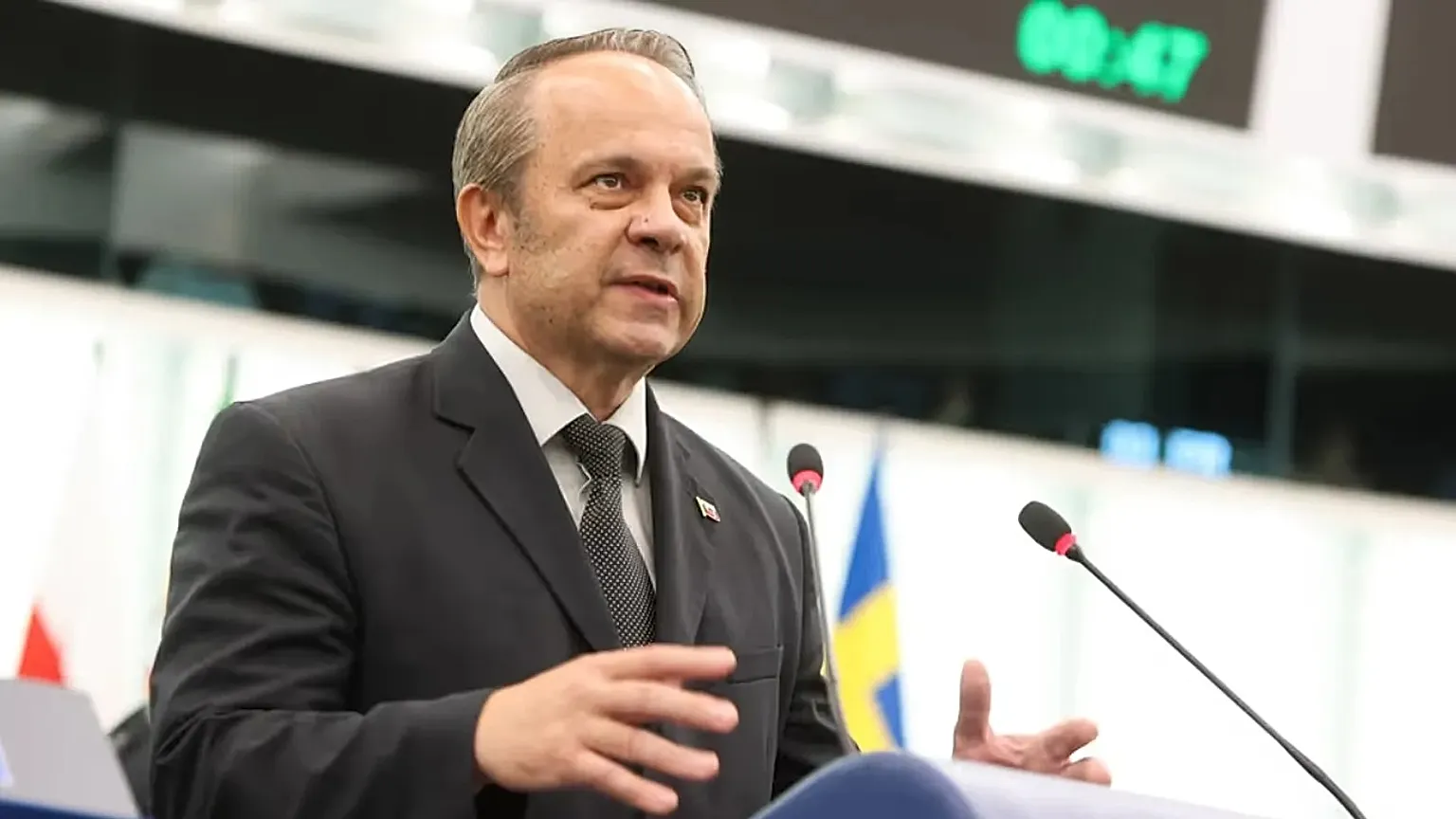
The European People’s Party contemplates imposing penalties on its MEP Branko Grims following his participation in an event with far-right parliamentarians. “It is the most normal thing,” he told Euronews, highlighting the increasing consensus on migration issues among right-wing factions.
The principal center-right faction in the European Parliament seeks to prevent its members from publicly joining far-right representatives, despite occasional alignment in parliamentary votes.
 ADVERTISEMENT
  ADVERTISEMENT
Representatives of the European People’s Party have revealed that the group, led by German Manfred Weber, is mulling over sanctions against Slovenian MEP Branko Grims after his involvement in an event featuring members of the far-right Patriots for Europe (PfE), Europe of Sovereign Nations (ESN), and the right-wing European Conservatives and Reformists (ECR) factions.
Sources from the EPP indicate that Weber has requested the group’s presidency to develop a formal sanction proposal targeting Grims. These potential sanctions may vary from limiting his speaking opportunities during plenary sessions to his complete exclusion from the faction.
No definitive decision has been reached yet; the next Presidency meeting is scheduled for mid-June. However, this incident may cause discomfort within the group. Grims has continuously acted against the group’s stance by promoting collaboration with far-right parties—a boundary clearly set by the EPP leadership.
An EPP insider told Euronews that Grims «has been inviting sanctions.» They added, «There is concern that this might boost his standing among his electorate, as he enjoys being perceived as censored.»
Last week, Grims attended a conference titled “Towards a Right-Wing Majority in the European Parliament,” where he advocated for tighter cooperation between mainstream conservative and sovereignist parties throughout the Parliament, a viewpoint conflicting with the EPP’s official policy.
The MEP’s position aligns with the hard-right fringe of the EPP: he has employed stringent rhetoric against migrants in his Parliamentary work and social media, and previously endorsed cooperation with extremist right-wing groups.
Manfred Weber has reiterated his preference for alliances with traditional partners, including the Socialists and Democrats (S&D) and the liberal Renew Europe group.
He has also publicly emphasized upholding the “cordon sanitaire”—a political barrier intended to block cooperation with extremist parties—and described combating far-right populism as the primary challenge ahead for the party.
Conversely, Grims cited recent agreements between centre-right and far-right lawmakers on migration legislation as a model of collaboration meriting expansion.
“I personally reject the politics of exclusion,” he told Euronews.
“Engaging in politics to defend essential human and civilizational values is the most natural aspect of political life,” he stated, criticizing the label “far right” applied to nationalist factions in Parliament as “offensive and illogical.”
The Slovenian MEP noted that at the conference he joined lawmakers supporting the “return regulation”—a contentious proposal intended to speed up the deportation of migrants, which he termed “the foundation for remigration.”
When the Parliament approved the law in March, controversy arose over collaboration between the EPP and far-right groups during the bill’s drafting in committee through a private WhatsApp chat.
This issue was especially sensitive in Germany, where the CDU/CSU, an EPP member party, rejected any association with the far-right Alternative for Germany, part of the ESN group. Chancellor Friedrich Merz subsequently stated that Weber «bears responsibility» for ending any such cooperation.
Although the EPP leadership has consistently ruled out any formal alliance with the far right, the group’s voting record shows near-total convergence on migration-related dossiers, frequently passed by a coalition consisting of the EPP, ECR, PfE, and ESN.
“Typically, the EPP adopts firm stances on migration, which far-right groups can support without explicit coordination,” a Parliament official explained to Euronews. “They essentially cooperate quietly.”