
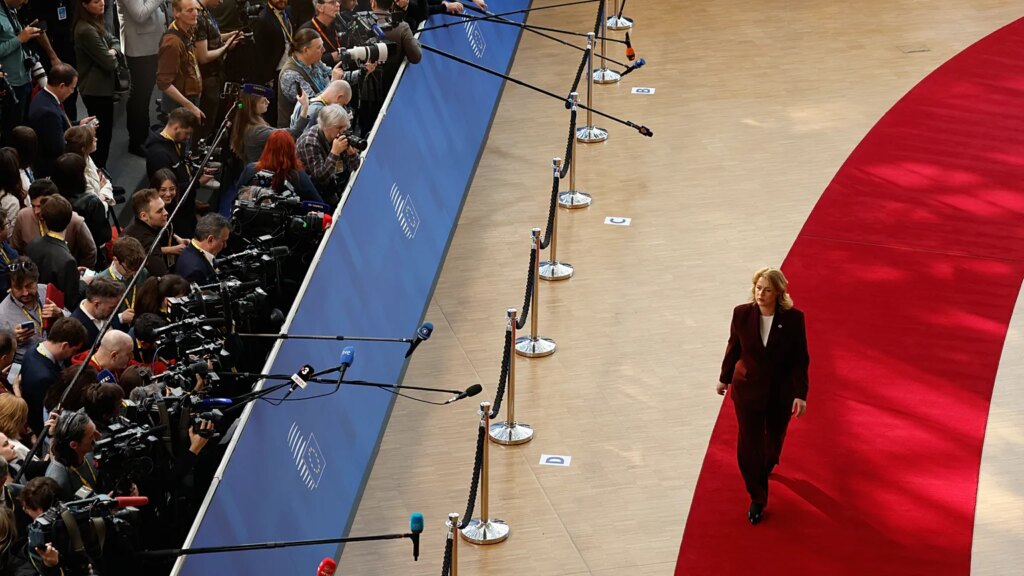
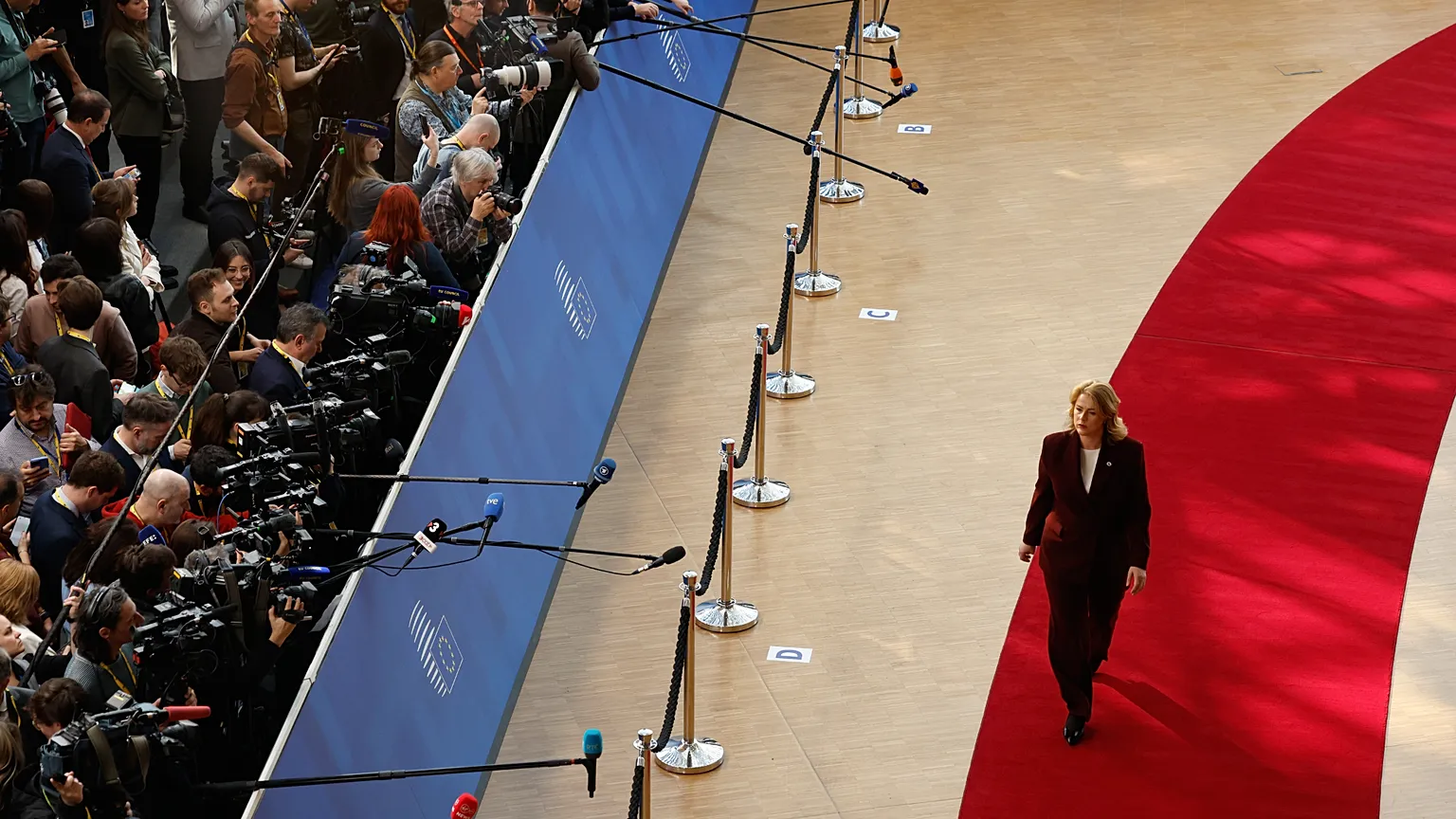
Latvia is grappling with a significant drone incursion last week that led to the resignation of the prime minister and the dismissal of the defence minister. As the nation addresses critical issues related to its air defence capabilities, Europe closely monitors the conclusion of Trump’s visit to China.
Good morning from Brussels. This is Maïa de la Baume and Angela Skujins reporting Friday’s newsletter from the Belgian capital, where EU officials have already started their long weekend.
 ADVERTISEMENT
  ADVERTISEMENT
Breaking: Latvia’s former defence minister Andris Sprūds, who stepped down on Sunday, stated on the Europe Today programme that he had “always acknowledged the difficulty in handling drones that have lost their course.”
Sprūds is amid a political crisis that culminated in the fall of Latvia’s Prime Minister Evika Siliņa on Thursday, following the collapse of the coalition over a drone-related security controversy near the Russian border.
Reminder: Last Thursday, several drones intruded into Latvian airspace and crashed in Latgale’s eastern region, near the towns of Balvi and Ludza, close to the Russian border. One drone struck an oil depot, causing a minor fire. No casualties were reported, but local residents noted that emergency alerts were issued nearly an hour after the event.
This incident ignited significant debate in the Baltic state, resulting in Sprūds’s resignation, while Siliņa remarked that it had “unequivocally shown that the political management of the defence sector failed to uphold its commitment to secure airspace over our nation.”
Latvia’s authorities hold Russia responsible for electronically diverting Ukrainian drones into Baltic airspace, whereas internal critics blame Sprūds for leaving the country exposed.
Over recent weeks, multiple drones, believed to be targeting Russia, have crossed into the airspace of Latvia, Lithuania, and Estonia, raising alarms about the Baltic states’ preparedness against military threats.
The most recent incident occurred earlier today in Finland, where President Alex Stubb thanked authorities on X for their prompt response to the morning drone alert, emphasizing that “there is no immediate military threat to Finland.”
Sprūds himself told Euronews that his country must now prioritize bolstering its resilience against imminent crises “that are ahead.”
Meanwhile, Latvia is finalizing a €3.49 billion defence loan from the European Union (EU) under the Security Action for Europe (SAFE) initiative.
Read more in the exclusive interview by Angela Skujins, along with a detailed investigation into the failures that occurred.
In other developments, U.S. President Donald Trump held a second day of talks with Chinese leader Xi Jinping on Friday, concluding his state visit to China. The leaders are set to have tea today, followed by a diplomatic lunch, before Trump departs for Washington.
After touring the Zhongnanhai leadership compound adjacent to Beijing’s Forbidden City, Trump posted on his Truth social account, stating, «Hopefully our relationship with China will be stronger and better than ever before,» adding that Xi praised him for «so many tremendous successes in such a short period of time.»
The visit reportedly resulted in a Chinese proposal to assist in reopening the Strait of Hormuz, along with a warning from Beijing that mismanagement of Taiwan could spark conflict.
According to the White House, both parties agreed that the Strait of Hormuz must remain accessible to ensure the uninterrupted flow of energy, while U.S. President Donald Trump affirmed that Chinese leader Xi Jinping assured him China would not supply military equipment to Iran.
The most contentious issue remains Taiwan, with Xi cautioning the U.S. that disputes over the self-governed island—which China claims as its territory—could escalate into confrontation or conflict.
However, the visit’s primary focus has been on stabilizing U.S.-China relations and maintaining the fragile truce established late last year.
In October, Washington agreed to reduce tariffs on all Chinese goods, while Beijing consented to suspend its restrictions on rare earth exports.
More coverage from Evelyn Ann-Marie Dom.
Poland makes history with first same-sex marriage registration following EU court ruling
Poland’s capital, Warsaw, recorded its first same-sex marriage on Thursday, implementing court decisions mandating the country to acknowledge same-sex marriages registered abroad.
In November, the European Union’s top court mandated Poland to register same-sex unions performed in other EU nations, even though Polish legislation does not currently permit such marriages.
Three months later, according to reporting by Aleksandra Galka Reczko and Gavin Blackburn, Poland’s Supreme Administrative Court referenced that ruling when ordering authorities to recognize the marriage of two Polish men registered in Germany.
“This morning we completed the first transcription of a marriage certificate for a same-sex couple, in line with court rulings,” Warsaw Mayor Rafał Trzaskowski announced.
The mayor also pledged the city would proactively recognize other Polish same-sex marriages registered elsewhere in the EU, even without specific court orders.
Read more.
How the EU intends to tackle the new energy crisis
Prior to the conflict in the Middle East, the EU was already confronting an energy crisis domestically, with prominent industrial sectors calling for “urgent and decisive” actions to rapidly reduce electricity costs.
The war initiated by the US and Israel against Iran has further aggravated this issue. Under mounting pressure from member states, the European Commission is preparing a comprehensive revision of grid fees and taxes associated with electricity to ease the burden on households and citizens facing soaring energy prices, according to a document reviewed by Euronews.
The draft shows that combined grid fees and taxes often surpass the cost of electricity consumption itself. For households, network charges made up 27% of the electricity bill, while for businesses it was 21%. National taxes and levies added another 24% for residential consumers and 16% for companies.
The Commission’s emphasis on taxation is expected to generate the most politically sensitive reforms. The plan proposes to reverse the existing pricing approach, so that electricity—largely generated from renewables—would be taxed less than fossil fuels.
For energy-intensive sectors, EU members would have the flexibility to reduce electricity taxes to zero, an effort aimed at maintaining the competitiveness of European manufacturing. More details will be revealed in the forthcoming package, with Marta Pacheco providing a thorough breakdown.
More from our newsrooms
Pope decries rise of AI-directed warfare, saying it leads to a spiral of annihilation
Pope Leo XIV condemned on Thursday the increasing investment in artificial intelligence and advanced weaponry as driving the world toward a “spiral of annihilation,” urging peace efforts in the Middle East and Ukraine during a visit to Europe’s largest university. Cecilia Attanasio Ghezzi and Gavin Blackburn report the latest.
Hungary’s Orbán-era wartime state of emergency ended, PM Péter Magyar says
Hungary’s government has officially ended the state of emergency that was in place, a move the new Prime Minister Péter Magyar described as a return to “normalcy.” Ferenc Horvath and Gavin Blackburn provide further details.
We’re also keeping an eye on
- European Commissioner for Democracy, Justice, the Rule of Law and Consumer Protection Michael McGrath will engage in a roundtable with civil society organisations in Prague, Czechia.
- European Commissioner for Enlargement Marta Kos is set to meet Albulena Haxhiu, acting President of Kosovo, in Pristina, Kosovo.
That concludes today’s newsletter. Contributions from Marta Pacheco are gratefully acknowledged.