
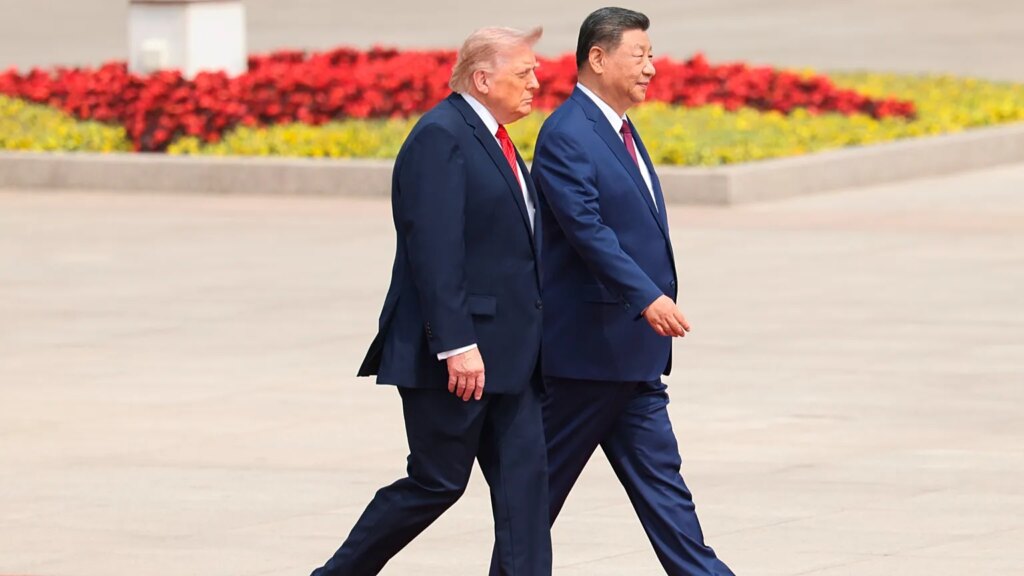
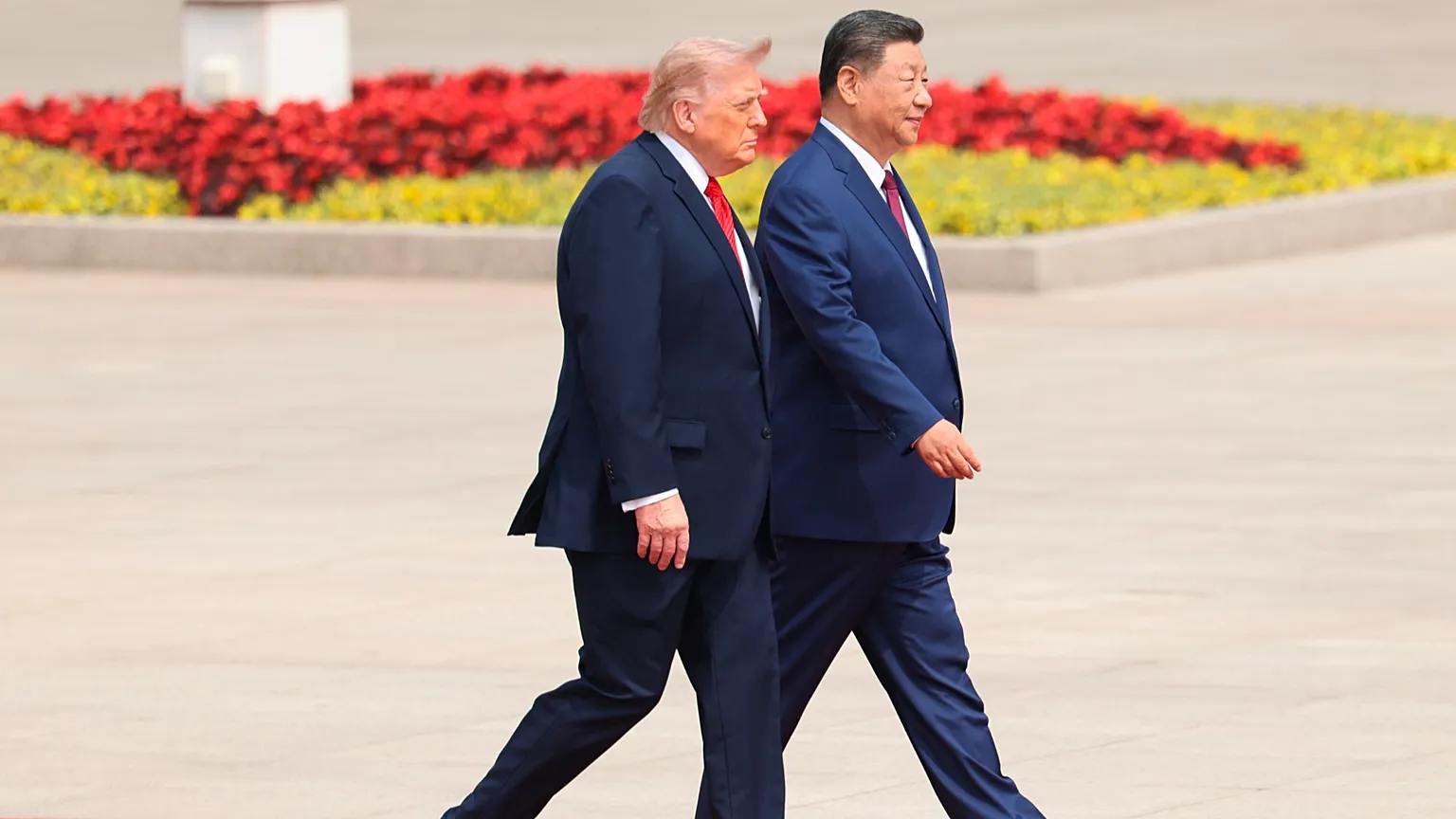
While US President Donald Trump undertakes a closely monitored visit to Beijing to discuss trade and security issues with Chinese President Xi Jinping, Europe watches anxiously, trying to determine its role in any outcomes.
Good morning. Angela Skujins writes this Thursday’s newsletter from Brussels, where it can be said with reasonable certainty that those not observing the public holiday are closely following events unfolding almost 8,000 kilometres east.
 ADVERTISEMENT
  ADVERTISEMENT
Prior to departing the White House on Tuesday for nearly a 14-hour flight to Beijing, US President Donald Trump clearly stated the significance of this journey. “We are the two superpowers,” he said without hesitation.
“We possess the world’s most powerful military. China ranks second,” Trump added.
Upon arrival, both leaders shared hopes that the summit — viewed as the most important bilateral meeting of 2026 — would produce progress on the Iran conflict, trade issues, and Taiwan.
However, Xi cautioned about how external observers might interpret the meeting, questioning whether the nations could overcome the ‘Thucydides Trap’ and «create a new framework for major power relations.”
This refers to the theory that a rising power challenging an established one often leads to conflict. “It’s an honor to be with you and to be your friend,” Trump responded.
As Stefan Grobe notes, Europe views these developments from the sidelines, contemplating how, or whether, it will be caught between these two superpowers.
The key point of contention revolves around rare earth elements, with China controlling 17 critical rare earth minerals vital for key technological production. Beijing has the capability — and has exercised it — to abruptly cut off supplies. Similar to Brussels, Washington covets access to these minerals.
Europe’s worst-case scenario envisions Trump arriving in Beijing amid severe economic challenges within his political career and striking a deal that sidelines the European bloc. This remains a plausible outcome according to experts.
“Realistically, the Trump-Xi discussions have become highly bilateral,” explained Jonas Parello-Plessner, a visiting fellow at the German Marshall Fund’s Indo-Pacific program. “One certainty is that Trump will solely represent his own interests.”
Michael Bloss, a member of the European Parliament involved in Brussels-Beijing relations, recently told Europe Today that Europe must acknowledge its absence from the negotiation table potentially shaping its future — and that the continent’s survival depends on unified, strong representation.
“China employs a divide-and-conquer approach,” he said, “but the critical question is how Europe can enhance its autonomy and sovereignty.”Watch.
Debate about dependency is intensifying within Europe as well.
As Marta Pacheco reports, Cypriot energy ministers met on Wednesday to address Europe’s reliance on China’s dominance in power storage.
Chinese companies dominate over 80% of Europe’s residential battery energy storage market and nearly 88% of lithium-ion battery imports, according to data from global research firm Wood Mackenzie.
Analysts argue that Europe can reduce strategic reliance on China in clean energy sectors, yet entirely replacing Beijing across the full supply chain over the next decade is unlikely.
An EU Institute for Security Studies report notes, «Although investments by Chinese energy firms have declined since the late 2010s and scrutiny of Chinese foreign direct investment has increased, the legacy of Chinese influence in the energy system remains.»
EU Commission plans delegation to Budapest as it considers Hungarian bank for EU funds
The European Commission is exploring methods to help Hungary access billions in EU funding, with officials preparing to visit Budapest next week as deadlines approach.
Brussels cautions that Hungary may face difficulties obtaining the full €10 billion in recovery funds before the August cutoff, indicating that while grants may be fully available, loans might not be. Still, the Commission will send senior representatives to evaluate the situation more comprehensively with the current government.
As Sandor Zsiros and Luca Bertuzzi report, one option under consideration involves channeling the funds through Hungary’s Exim Bank, but Brussels worries this could reduce oversight — a critical concern given that rule-of-law issues are behind the funding obstacles.
Currently, Hungary will receive upfront payments only if it meets the Commission’s set criteria, with time running short. Using the Hungarian investment bank for upcoming projects could allow fund disbursement even if all conditions aren’t initially met.
Brussels calls for immediate end to ‘barbaric’ conversion practices in EU countries
The European Commissioner for Equality, Hadja Lahbib, urged EU member states to act swiftly to halt “barbaric” and “shameful” conversion practices targeting LGBTQI+ individuals, following a citizens’ initiative that amassed over one million signatures.
As Jorge Liboreiro and I report, such practices include interventions like psychotherapy, medication, electroshock, and exorcism aimed at altering sexual orientation, gender identity, or gender expression.
These often entail abuse, violence, and humiliation. “It’s torture — both physical and psychological harassment that can lead to severe depression or suicide,” Lahbib told Euronews. A formal recommendation is scheduled for release next year, although it falls short of the EU-wide ban requested by the initiative.
Lahbib acknowledged the lack of consensus among member states. According to Article 19 of the EU treaties, unanimity is required to pass anti-discrimination laws, including on sexual orientation. The equality directive has been stalled since 2008.
“We didn’t want to endure decades of debate like with the Equal Treatment Directive,” Lahbib said.
“Instead, we prefer to build on goodwill, awareness, and the shared belief that if this union stands for freedom, expression, and equality, then these practices must be banned.”
Read more.
Additional news from our reporters
Lost 9th-century manuscript containing oldest known English poem discovered in Rome library
Researchers at a Roman library have uncovered a 9th-century manuscript believed to be the lost copy of the earliest English poem. Theo Farrant explores the significance of this literary find.
Ryanair issues strong criticism of German airport operator, urging end to ‘monopoly’
Budget airline Ryanair has accused German airport operator Fraport of retaining a Greek government tax cut and is calling on Athens to dismantle “Fraport’s monopoly.” Ioannis Karagiorgas provides details.
Also on the radar
- European Commissioner for Defence Andrius Kubilius is scheduled to visit Zagreb, Croatia, to finalize the country’s €1.7 billion EU defence loan.
- European Commissioner for Enlargement Marta Kos will meet UK Minister for Europe and North America Stephen Doughty in London.
That concludes today’s update. Contributions came from Marta Pacheco and Jorge Liboreiro.