
Latvia was thrust into a national security crisis last week when multiple drones breached its airspace, sparking not only a fire but also a political upheaval that ended with the defence minister stepping down and revealing serious gaps in the Baltic state’s military preparedness.
Riga is working urgently to rebuild public confidence and protect its vulnerable airspace.
 ADVERTISEMENT
  ADVERTISEMENT
On Thursday last week, a number of drones entered Latvian airspace in the vicinity of Balvi and Ludza, picturesque towns located near the country’s eastern border, about an hour’s drive from Russia.
Within hours, the Latvian Defence Ministry reported that two of these unidentified drones crashed, while another triggered a minor fire at an oil storage facility. Although there were no casualties, residents noted they only received a notification about the drones an hour after the incident.
Latvia’s political figures have confirmed that the drones originated from Ukraine but were diverted into Latvia from Russian territory. They also acknowledged significant failures by the defence ministry in detecting and responding to the threat.
“This drone incident clearly revealed that the political leadership overseeing defence has not lived up to its commitment to ensuring secure skies over the nation,” Latvian Prime Minister Evika Siliņa stated in a Sunday post on X.
The episode sparked a political uproar in the country of 1.83 million residents, culminating in the resignation of Defence Minister Andris Sprūds, who had served since 2023. In his resignation message on X, he wrote: “Is there still much work ahead? Certainly. But today, the Latvian military, alongside its allies, stands prepared to defend the nation.”
Mārtiņš Staķis, Latvian Member of the European Parliament, indicated that the pre-election climate influenced Sprūds’ resignation. The prime minister is affiliated with the centre-right Unity party, whereas the former defence minister represents the left-wing Progressives.
Nevertheless, Staķis, a Greens MEP and member of the EP’s Security and Defence Committee, emphasized that restoring public trust in Latvia’s crisis management is essential and central to national security. “Ukrainian drones aimed at legitimate military objectives in Russian territory were diverted to Latvia as a consequence of Russian actions,” he explained.
“The priority now is to ensure uninterrupted efforts to enhance Latvia’s defence capabilities.”
A political reckoning
Latvia’s Ministry of Defence has informed Euronews that a formal investigation has been launched to review the internal handling of the drone breach, with particular focus on the performance of the cell broadcast warning system. The National Armed Forces have been instructed to promptly update border airspace defence protocols and increase operational alertness.
Glen Grant, a defence and reform analyst who previously served as a British Army Lieutenant Colonel and defence attaché in Latvia, attributed the air defence shortcomings to multiple factors.
Latvia’s 64,000-square-kilometre territory faces geographic constraints, especially its flat landscape. “Standard ground-based radars operate mainly on line-of-sight, which means low-flying objects remain undetectable until the last moment,” he noted.
Grant also criticized Latvia’s crisis response infrastructure for years of neglect. “Development has been incredibly slow because the system was not prioritized appropriately in recent years,” he remarked.
“Various components—including technological systems, warning signals, and sirens—fall short of the necessary standards,” Grant added.
Moreover, a significant factor arises from Riga having diverted much of its air defence resources to Ukraine following Russia’s full-scale invasion in 2022. Latvia supplied Kyiv with most of its portable detection equipment normally used at battalion and brigade levels to identify drones.
“Latvia possesses limited radar coverage, especially since drones flying at low altitude remain below radar detection,” Grant said.
He concluded that Latvia’s substantial defence contributions have left it under-equipped.
NATO’s next move
On Tuesday, Latvia’s Minister of Foreign Affairs Baiba Braže met with NATO headquarters in Brussels.
According to a statement, her discussions with NATO Secretary General Mark Rutte revolved around bolstering Latvia’s air defence capabilities by integrating advanced technologies and enhancing coordination among allied nations.
Latvia is finalizing a €3.49 billion defence loan from the European Union under the Security Action for Europe (SAFE) initiative.
This program forms part of the EU’s larger effort to strengthen its military posture amid intelligence warnings from multiple European agencies about potential threats from Russia by 2030.
Although the loan has yet to receive formal cabinet approval in Riga, it aims to reinforce air defences through investments in drones, guided missiles, and anti-drone systems, according to Latvia’s Ministry of Defence.
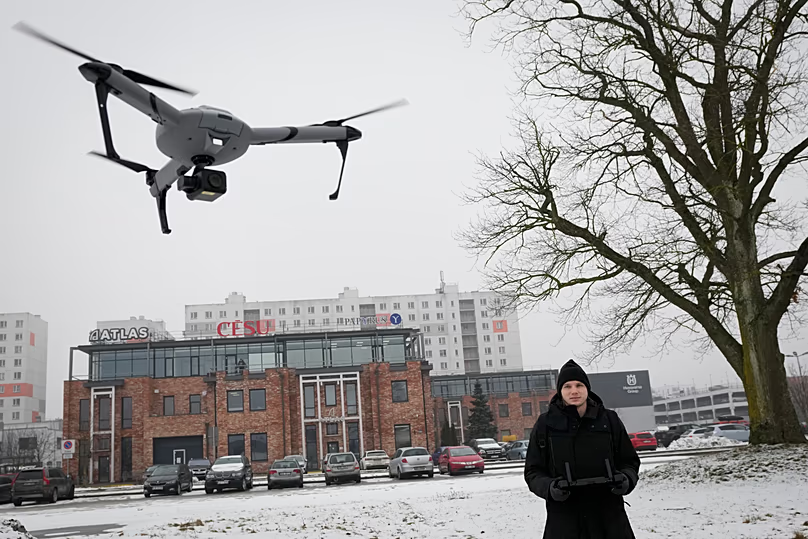
A significant element of this package is the acquisition of “Blaze” interceptor drones, crafted to swiftly neutralize airborne threats.
“Investing in such state-of-the-art technology markedly improves Latvia’s capacity to identify and counter drone intrusions going forward,” a defence ministry representative stated to Euronews.
By the end of 2025, Latvia pledged to allocate 5% of its GDP to defence spending, aligned with NATO standards.
The majority of these resources will focus on developing a multi-layered air defence network, including the purchase of coastal defence missile systems. Plans also encompass procuring infantry fighting vehicles, along with artillery, ammunition, and other essential gear.
Gerlinde Niehus, former NATO Deputy Director for Defence and Security Cooperation, remarked that Latvia has made strides in strengthening its defences and increasingly involving civilians in the process.
Nevertheless, she highlighted continuing challenges with fragmented markets and bureaucratic hurdles across the Baltics and wider Europe.
“We often innovate and regulate, but fail to deploy effectively,” Niehus commented.
“Industry representatives have conveyed that roughly seventy-five percent of their efforts are spent navigating regulatory complexities when employing drones,” she added.
Europe’s defence bottleneck
Following a high-level defence ministers’ meeting on Tuesday, EU foreign policy chief Kaja Kallas expressed shared frustration with the sluggish pace of procurement and production within Europe’s defence industry.
“The industry reports inconsistent regulations across member states, complicating operations,” Kallas said.
“Moreover, varying national standards result in different specifications for each order, hindering streamlined production,” she explained.
The European Commission has proposed a defence package intended to simplify acquisition and production rules, with discussions scheduled between the European Parliament and European Council on 18 and 19 May.
Whether these measures will be adopted swiftly remains uncertain.
“Russia is closely monitoring this situation,” Niehus warned. “They take every opportunity to slow our progress, sow division, and disrupt our efforts.”