
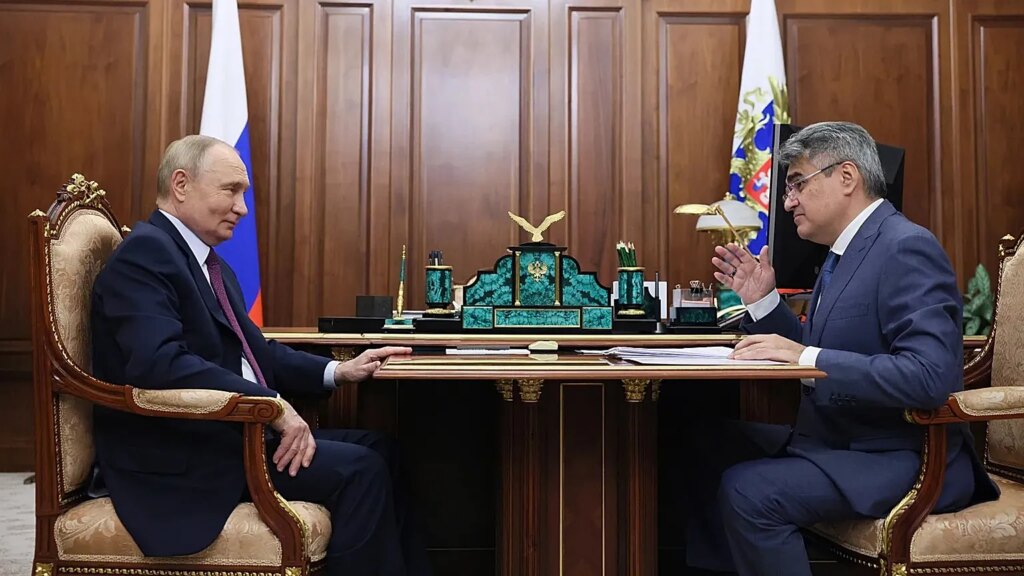
New People, established by the Kremlin as a controlled platform for dissent, has doubled its backing to 13.4% amid internet blackouts intensifying public dissatisfaction with the Russian government.
A political party formed in 2020 under Kremlin endorsement as a channel for protest votes has surged into second place in official polls, as internet shutdowns and wartime grievances drive Russians toward the sole political alternative that offers even mild state criticism.
 ADVERTISEMENT
  ADVERTISEMENT
According to VTsIOM, Russia’s official polling agency backed by the state, New People now holds 13.4% support—twice the 6.6% recorded twelve months earlier.
The Communist Party remains behind at 10.9%, while the Liberal Democratic Party—once led by ultranationalist Vladimir Zhirinovsky until his passing in 2022—receives 10.1% backing.
For the first time, New People outpaces the traditional systemic opposition by a margin of 2.5 percentage points.
United Russia, effectively led by President Vladimir Putin, has seen its support shrink from 36% to 27.7% since April 2024.
Putin’s personal approval rating stood at 65.6%, as per data released on 24 April—the lowest level recorded since the launch of the full-scale invasion of Ukraine.
Data from VTsIOM, a government-operated body, cannot be independently confirmed, and strict wartime censorship likely pressures respondents to provide socially acceptable responses.
However, political analyst Andrey Pertsev told Euronews that there was no evident motive for VTsIOM to exaggerate New People’s ratings, suggesting the party’s actual support might surpass official figures.
Internet curbs as a driving force
Following the invasion, Russian authorities began imposing systematic digital restrictions. Facebook and Instagram were blocked in spring 2022.
YouTube faced throttling in August 2024, and by March, WhatsApp and Telegram—each with over 90 million Russian users—became nearly inaccessible.
Mediascope’s 2024 statistics indicate that Telegram reached 74% of Russians aged 12 and above monthly, with half of the population using it daily. For many, it served as a work platform, advertising venue, and primary news source.
Frustration culminated in March when mobile internet vanished from central Moscow for three weeks. Only Kremlin-approved websites—including large banks, the Yandex network, and state media—remained reachable.
This blackout meant Muscovites could not hail taxis or pay electronically; public restrooms stopped functioning since payments required internet access. Kommersant reported the city’s economy lost between 3 billion and 5 billion rubles (€35 million to €60 million) just within the first five days.
New People swiftly seized this emerging political space. Deputy Duma speaker and former presidential contender Vladislav Davankov initiated a petition opposing Telegram restrictions, collecting over 1 million signatures despite critiques regarding the voting system permitting multiple entries.
During the party congress in March, the term «VPN» was prominently displayed on stage. Party leader Alexei Nechaev proclaimed, «We came to embody a new Russia—one that desires to live free from bans and coercion while addressing internal issues.»
«We opposed restrictions and prohibitions. We stood against raising the conscription age, full internet surveillance, and violence,» Nechaev asserted.
Political expert Abbas Gallyamov described this rise as indicative of mounting anti-system sentiment.
«In a situation lacking options, even a crayfish counts as a fish,» he told Euronews. «With limited choices available, people select from what exists. This isn’t a victory of the party but a reflection of the system’s poor ratings.»
Pertsev noted that many Russians seek a secure method to express discontent, viewing New People as a legitimized form of protest.
«Despite the absence of genuine democracy, public politics remains alive. People face issues and turn to anyone who at least addresses these problems and mildly criticizes government actions,» he commented.
Redirecting public sentiment
Founded on 1 March 2020, the nominally centrist New People party is, according to Pertsev, a Kremlin strategy to channel urban protest voters into a controllable framework, steering them away from non-systemic opposition.
In the 2021 parliamentary elections, the party attained 5.32% of votes and 13 Duma seats—the first time in 14 years that Russia’s parliament consisted of five parties.
The party’s founder, Nechaev, is a businessman and owner of the cosmetics firm Faberlic. Meduza previously reported that Nechaev contacted Yuri Kovalchuk—a close Putin ally—to organize and finance the initiative.
Despite the party’s relatively neutral or somewhat supportive stance toward Putin, as opposed to its vocal criticism of United Russia, Nechaev has denied any Kremlin ties.
In a New York Times interview from February 2021, Nechaev revealed three unwritten rules for Russian parties: avoid criticising Putin or his inner circle, refrain from organizing protests, and reject foreign funding. He confirmed New People abides by all.
In practice, New People’s parliamentary behavior has been consistently cautious or aligned with the ruling party’s policies.
Their deputies often voted alongside United Russia on bills they later publicly criticized. Almost the entire party supported legislation allowing regions to cancel mayoral elections despite promoting local democracy.
Vedomosti reported that Davankov assisted in drafting legislation prohibiting gender transition procedures. The party has also remained uncritical of Moscow’s full-scale invasion of Ukraine in 2022.
In spring 2022, alongside other parliamentary factions, New People voted to criminalize spreading «fake news» about the Russian military.
During his presidential campaign, Davankov cautiously appealed to anti-war voters without explicitly mentioning «war» or calling for Russian troop withdrawals from Ukraine.
The day after the March 2024 presidential election, he congratulated Putin, stating, «only Putin can win the (war) and ensure lasting peace.» Regional New People branches continue to send support to Russian soldiers at the frontlines.
The party’s nominal liberalism has limits. While advocating for internet freedom, New People urged Russians to sign a letter requesting Telegram open a Russian office—a move requiring user data storage accessible to Russian security services.
Moreover, the party has selectively criticized restrictions without identifying responsible entities. According to The Bell, internet controls are now under the FSB’s Second Service, the division associated with poisonings of opposition figures Alexei Navalny and Vladimir Kara-Murza.
What lies ahead from the Kremlin
As the parliamentary elections approach in September, New People is ramping up its campaign with potential to secure second place at the national level.
Gallyamov explained that Kremlin divisions have created maneuvering space for the party within tightly controlled limits.
«One faction wants Telegram blocked, another opposes it,» he said. «New People recognizes this disagreement, understanding it permits limited dissent.»
Russian media indicate Kremlin officials are already planning ways to curb the party’s popularity.
Pertsev noted that domestic policy authorities led by Sergei Kiriyenko might prefer positioning New People as the system’s second force, replacing the increasingly ideological Communist Party.
Whether this unfolds depends on whether Putin personally heads United Russia’s candidate list.
«If Putin leads the list, United Russia will need to achieve very high official results,» Pertsev said.
«If not, and economic difficulties deepen, diverting protest votes toward New People could be portrayed as safe for the regime,» Pertsev added, suggesting that a Kremlin-backed coalition between the two parties has also been under discussion.