
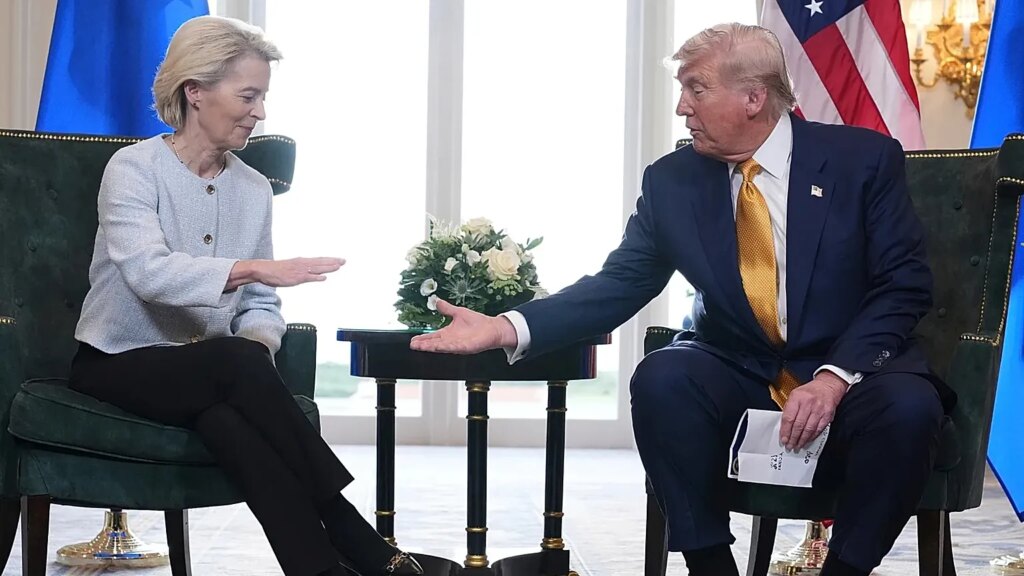
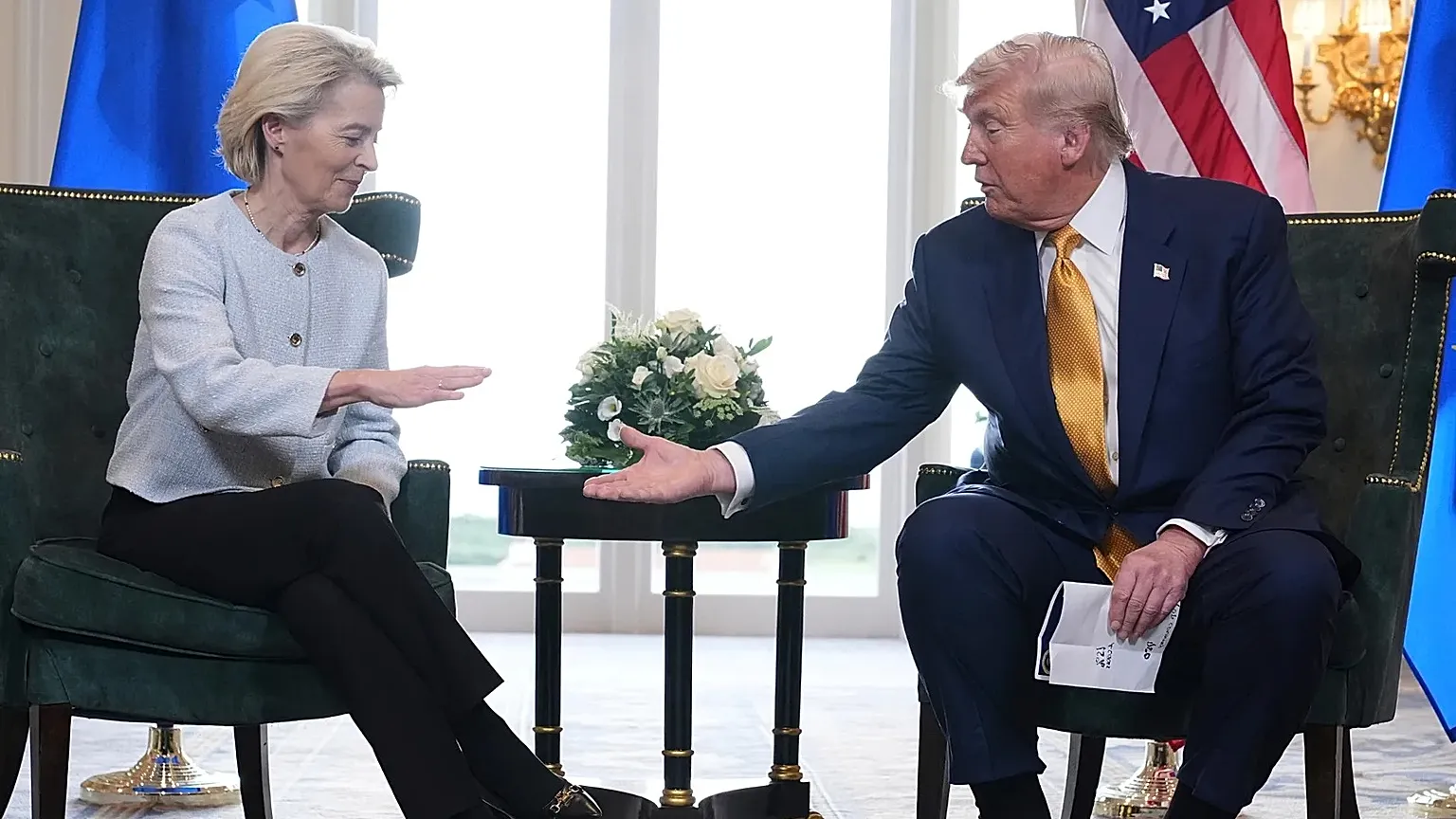
Nine months subsequent to the EU and US reaching a contentious trade agreement, talks remain stalled as MEPs resist exerted pressure to accelerate approval without protections against potential future American threats.
On Thursday, the European Commission emphasized that “progress” had occurred during late-night discussions with MEPs and member state representatives regarding the implementation of last August’s EU-US trade agreement, affirming that the procedure stayed “entirely aligned with standard legislative practice”.
 ADVERTISEMENT
  ADVERTISEMENT
Nonetheless, inside the room, considerable disagreement persisted over what remains necessary.
Nearly nine months after the controversial pact was finalized on the Turnberry golf course between Brussels and Washington, the agreement remains caught in tense negotiations among MEPs, the Commission, and EU member states. Divisions have hardened as Donald Trump escalates pressure on Europe through renewed tariff threats.
The arrangement would eliminate EU tariffs on US industrial products and cap US tariffs at 15%, but over the weekend, Trump, frustrated by the delays, threatened to impose a 25% tariff on European cars and trucks should the EU fail to implement the deal.
Despite this, the trilogue talks on Wednesday night involving EU Trade Commissioner Maroš Šefčovič, MEPs, and EU national governments broke down after six hours amid strong opposition from multiple political factions in the European Parliament. Although Šefčovič described the atmosphere as “constructive,” the impasse led to scheduling a new meeting for 19 May.
While the Commission alongside most EU countries push for swift ratification, MEPs stood firm in their refusal to concede during negotiations, insisting on safeguard provisions in the event Washington breaches the agreement with new tariffs. The parties also did not reach consensus on the MEPs’ request for a suspension clause, which would enable the EU to immediately freeze the agreement if Trump threatens EU territorial integrity, similar to his earlier suggestion of annexing Greenland.
MEPs additionally sought protections against a surge of US imports that could disrupt competition within the EU’s Single Market. The Parliament’s lead negotiator, German MEP Bernd Lange, conveyed that the EU required a sunset clause, which would cause tariff relief to lapse automatically at the end of March 2028 unless explicitly renewed.
MEPs resisted demands to merely approve the deal without scrutiny, asserting they would not be rushed despite combined pressure from governments, the Commission, industry, and the US. They argue that Trump’s own threats and unpredictable conduct only reinforce the need for these safeguards.
“They are not here to be intimidated. The process takes time, but this is the standard EU legislative procedure, and constructive work is ongoing,” a S&D source told Euronews.
“Parliament is not obstructing the deal; it is actively engaged in its implementation,” Greens/EFA MEP Anna Cavazzini stated to Euronews.
Nonetheless, officials from the Parliament expressed confidence to Euronews that the agreement could be approved within two weeks, with MEPs considering convening an extraordinary session next week to expedite the process.
“The sooner the trial of negotiations concludes, the sooner clarity can be provided for businesses and, indeed, greater predictability in an unstable environment,” European People’s Party MEP Jörgen Warborn, one of the deal’s negotiators, told Euronews.