
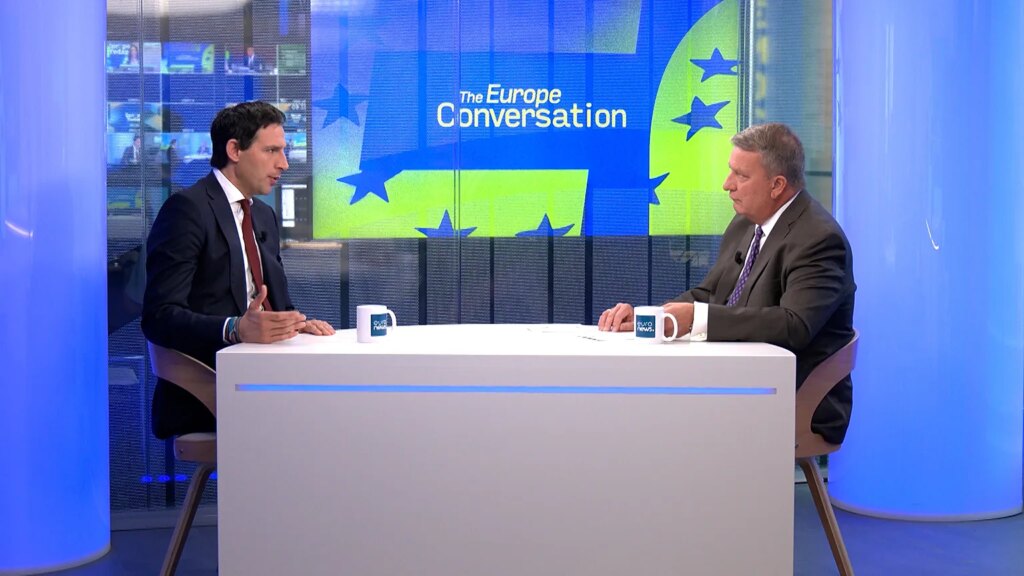
The sole solution to energy crises driven by conflicts in Iran and Ukraine lies in domestic energy production, EU Climate Commissioner Wopke Hoekstra told Euronews. «It is a responsibility we have towards our citizens and businesses.»
Amid the intensifying energy crises, EU Climate Commissioner Wopke Hoekstra emphasized the necessity for the EU to accelerate its shift to alternative energy sources across the European Union.
 ADVERTISEMENT
  ADVERTISEMENT
«This involves expanding electrification, increasing renewable energy, deploying more heat pumps, enhancing interconnectors among member states, and augmenting nuclear power,» Hoekstra stated during his interview on Euronews’ The Europe Conversation. «All these elements combined are essential.»
Tracing back to the oil crises of the 1970s, Hoekstra noted Europe’s exposure due to its limited energy resources.
«The takeaway from prior crises is that we should have acted more decisively and proactively; that mindset is imperative now,» the Commissioner remarked.
«Currently, we remain dependent on external sources. Although cutting off Russian gas was a smart move, it was substituted with increased usage of American, Qatari, and other LNG supplies. Is that an entirely secure strategy? Likely not, as doubts remain,» he added.
Hoekstra suggested Europe might encounter further geopolitical instability and insisted the bloc «owes it» to its populace and enterprises to shield them from steep price increases in future crises. «Whether this occurs in three, five, or ten years is uncertain. This challenge must be addressed.»
As of early May 2026, Brent crude oil prices surpassed $100 (€about 85) per barrel amid ongoing geopolitical tensions in the Middle East.
This increase led to Europe’s «third oil shock,» causing substantial spikes in energy and electricity costs, severely impacting businesses.
Higher fuel costs are also pressuring European households, raising expenses not only for gasoline and heating but for nearly all agricultural and manufactured goods.
Moreover, the European Commission has highlighted that elevated energy prices are worsening the risk of energy poverty, prompting measures to reduce bills and safeguard vulnerable consumers.
Hoekstra cautioned that fossil fuel dependence will persist for some time.
«Gas will remain a transitional fuel for years ahead, and energy demand is expected to grow, influenced by developments in Artificial Intelligence, despite all energy efficiency efforts we plan to implement,» he explained.
Billions required for charging infrastructure and power grids
When queried about the EU’s slow infrastructure upgrades, Hoekstra admitted, «There is still significant work to be done.»
Substantial investments are necessary to expand electric vehicle charging stations and to upgrade power grids.
«We have not yet reached our goals,» he noted. «Therefore, we must adopt the most proactive stance possible because every euro directed to this transition is a valuable investment, especially given our vulnerabilities.»
Regarding current global climate politics, Hoekstra lamented the US’s total withdrawal from international cooperation during President Donald Trump’s tenure.
«The reality is that the US disengaged from this issue, which is regrettable,» he observed. «However, one must confront the world as it exists, not as desired.»
Conversely, Europe has strengthened partnerships with like-minded nations like Norway, the United Kingdom, Canada, and Australia, Hoekstra highlighted. The EU also collaborates closely with Latin America and selected countries in Africa and Asia, particularly Japan.
At the 2023 Climate Conference in Dubai, Hoekstra stated, «We succeeded in forming a broad coalition that bridged the North-South divide, which, I believe, represents the path forward.»