
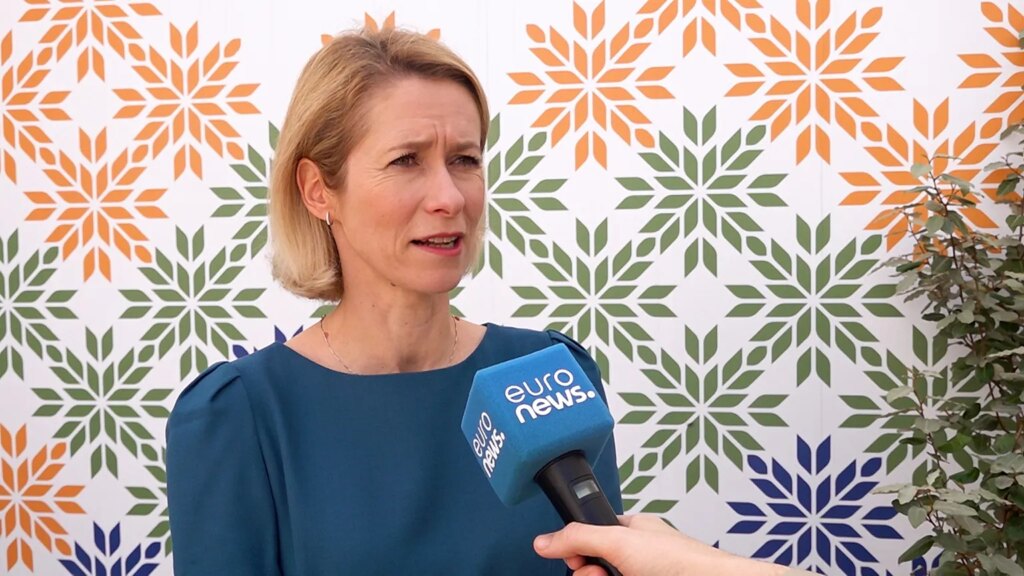
“In this geopolitical environment, credibility is essential — to achieve that, unity and decisiveness are required,” High Representative Kaja Kallas explained to Euronews, as the union anticipates the post-Orbán period.
The misuse of veto rights compromises the democratic foundations of the European Union by subordinating the interests of 26 member states to those of a single dissenting country, High Representative Kaja Kallas told Euronews during an exclusive interview.
 ADVERTISEMENT
  ADVERTISEMENT
Kallas reflected on the conclusion of Viktor Orbán’s 16 years in continuous leadership, a period during which the Hungarian prime minister frequently obstructed his peers through almost constant overlapping vetoes.
«It must be recognized that EU treaties actually do not provide for a veto. These treaties are founded on the principle of unanimity — meaning everyone must agree,» Kallas stated during an interview conducted on the sidelines of an informal EU leaders’ summit in Cyprus.
«Recently, when 26 states agree on a matter but one opposes, the outcome often reflects the position of that single nation rather than the majority of 26 countries. This situation cannot truly be called democracy.»
EU treaties do allow for a transition from unanimity to qualified majority voting, yet this change paradoxically demands unanimous approval.
«It is also crucial to reevaluate our decision-making processes for greater effectiveness, because in today’s geopolitical landscape, credibility depends on unity and the capacity to make decisions,» she added.
In her capacity as the EU’s foreign policy chief — a domain needing unanimous consent — Kallas has firsthand experience with many of Orbán’s vetoes. On occasions, she was compelled to release statements individually after collective declarations proved unattainable.
Following this challenging era, the High Representative expressed optimism for productive collaboration with the incoming government led by Péter Magyar, who secured victory in Hungary’s elections by promising to rebuild relations between Budapest and Brussels, currently strained at unprecedented levels.
Magyar has indicated that the veto remains a «valid option» when employed constructively.
«It is premature to speculate. Initially, the new Hungarian government must take office, expected by mid-May,» Kallas noted.
«Subsequently, there will be an opportunity to reconsider previously blocked decisions.»
‘A geopolitical choice’
This week marked the removal of two Hungarian vetoes: one concerning a €90 billion loan to Ukraine and another regarding the 20th sanctions package against Russia.
Nonetheless, Orbán appears determined to maintain his veto on Ukraine’s accession process, which has been in place for nearly two years, effectively preventing Kyiv from initiating any chapter negotiations.
The incoming prime minister has voiced opposition to accelerating talks with Kyiv, a stance shared by other member states, who fear that fast-tracking could undermine the credibility and integrity of the enlargement framework.
Meanwhile, Ukrainian President Volodymyr Zelenskyy continues to advocate for a «clear date» for accession under an expedited timeline. He has also dismissed proposals offering limited membership rights as a substitute for full EU integration.
«Ukraine does not require symbolic EU membership. It is defending itself — and by extension, Europe. This is not a symbolic effort — lives are genuinely at stake,» Volodymyr Zelenskyy declared this week before attending the EU leaders’ summit in Cyprus.
«We are safeguarding common European values. I believe full membership is deserved.»
Kaja Kallas, a firm supporter of Ukraine’s EU ambitions, emphasized the importance of engaging both public opinion within member states and Ukraine’s legal reforms, alongside reframing the narrative around candidate nations to underscore their contributions to the union.
«The conversation must focus on the benefits these countries bring by joining,» she said.
«An enlarged Europe means a stronger Europe in defence terms, accompanied by a larger single market that advantages our businesses — collectively, these factors enhance our geopolitical standing globally,» she added. «This is fundamentally a geopolitical decision.»
Kallas highlighted that Ukraine possesses by far the largest military in Europe, which implies that «Europe would gain strength if Ukraine were part of the union.»