
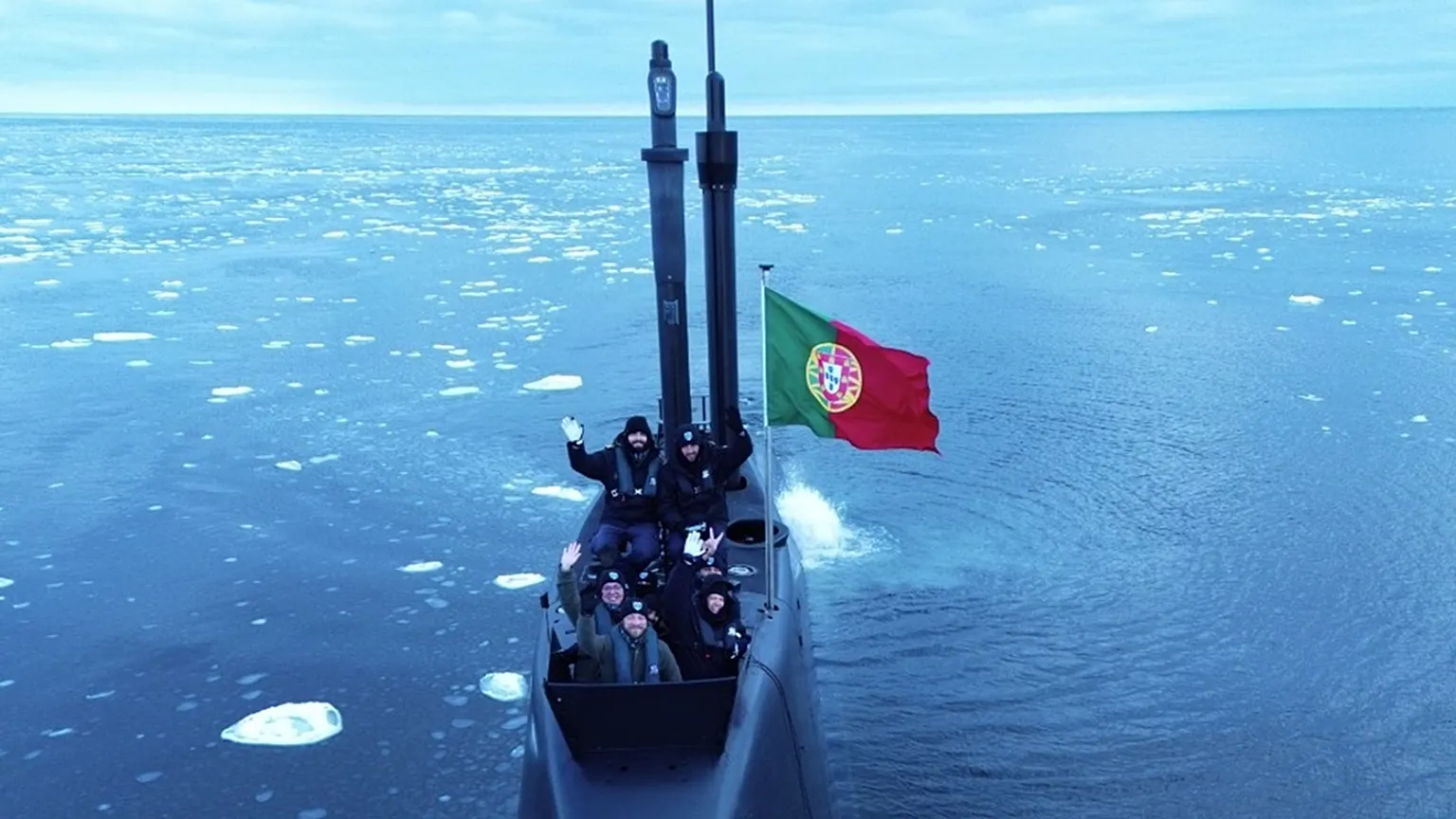
Portugal is the first nation in recent history to deploy a conventional submarine beneath Arctic ice. The Navy’s mission adaptations are under review by Canada, which plans to integrate them into its forthcoming fleet. Arpão has broadened the «tactical possibilities» for underwater operations in the far north.
Arctic sea ice, monitored by satellites since 1978, has been significantly diminishing over recent decades. On March 22, with winter concluded—the period of greatest ice build-up—the peak extent for 2026 is estimated at 14.33 million square kilometres, according to the US National Snow and Ice Data Center (NSIDC). This represents the lowest maximum on record, marking the second consecutive year of such a low peak.
 ADVERTISEMENT
  ADVERTISEMENT
Given that this region warms nearly four times quicker than the global average, numerous nations see new maritime routes and economic prospects emerging, attracted by the Arctic’s isolation and climate conditions which favor scientific inquiry, but importantly also due to its abundant natural resources, spanning from hydrocarbons to critical minerals.
The most recent Arctic Council report (source in Portuguese) indicates a 40% rise in the count of individual ships operating in the area over the past 12 years, while the nautical miles traveled surged by 95%, from 6.1 million to 11.9 million. This data includes vessels from the eight Arctic states (United States, Canada, Iceland, Norway, Sweden, Finland, Denmark, and Russia) as well as ships flying flags of observer states within the Polar Code region.
Although climate change–induced melting makes the area more accessible to naval, commercial, and cruise vessels, navigation in high latitude regions remains extremely challenging. “In many ways, spaceflight is less demanding than maneuvering ships in polar waters,” notes Ekaterina Uryupova, an Arctic Institute researcher (source in Portuguese).
Besides the hazards from increased ship traffic, global warming thins sea ice, causing greater ice fragmentation and iceberg formation. Summer seasons exacerbate this, as melting is intensified by rising temperatures.
Sea-ice floes drifting unpredictably, when pushed by wind or ocean flows, accumulate on the surface as “ridges” and underwater as “keels,” some extending dozens of meters below. This poses significant risks for Arctic submarine missions. Submarines with conventional propulsion face heightened dangers, due to their limited underwater endurance, because surfacing in thick ice-covered zones is difficult or impossible.
Submarine ArpãoSubmarine Arpão
Risks also include flooding and, more frequently, fire outbreaks. In an interview with The War Zone (source in Portuguese), US Navy veteran and submariner Eric Moreno (2001–2008) explains that the more internal volume a submarine has, the greater the atmospheric capacity to “absorb” fire, which allows the crew “additional time to respond”. Conversely, smaller traditional submarines, with limited space, tend to accumulate heat and smoke faster, complicating emergency management.
Due to its extreme conditions, under-ice navigation in the Arctic has traditionally been restricted to nuclear-powered submarines since the late 1950s—large, fast vessels over 100 meters long with near-unlimited endurance. Portugal’s Navy, however, surpassed doubts, including those of NATO allies, and from April to June 2024 deployed the NRP Arpão beneath these icy waters, becoming the first in recent history to do so using a conventional submarine.
A crew of about 30 sailors, led by frigate captain Taveira Pinto, operated under the Greenland ice sheet for four days on a trailblazing mission, both in operational skill and breaking boundaries long seen as insurmountable. Portugal thus joined the US, UK, and Russia in a select group able to operate under polar ice caps, countries with the advantage of nuclear submarines.
“Distinct operational capability”
The NRP Arpão departed Lisbon Naval Base on April 3, 2024, as part of NATO’s Brilliant Shield operation. The 78-day mission—supported by US, Canadian, and Danish navies—included several phases, accumulating 1,800 hours at sea, with 1,500 submerged.
Following a 22-day initial patrol for procedure testing and updates, the vessel refueled and resupplied in Nuuk, Greenland. The journey proceeded north, crossing the 66º33’N parallel marking the Arctic Circle boundary, accompanied by the then Chief of the Navy, Henrique Gouveia e Melo, who had envisioned the expedition over ten years prior.
Former Navy Chief of Staff Gouveia e Melo aboard the submarine Arpão in the ArcticFormer Navy Chief of Staff Gouveia e Melo aboard the submarine Arpão in the Arctic
After 39 hours and 30 minutes submerged beneath the ice, the crew began surveying the ice sheet, mapping natural openings for potential emergency surfacing and assessing the ice cover’s thickness and density.
This achievement was enabled by the air-independent propulsion (AIP) system integrated into Arpão—a hydrogen and oxygen fuel cell that recharges batteries without atmospheric air, producing power underwater and extending submerged time significantly, up to two or three weeks depending on speed, allowing feasible under-ice patrols with conventional diesel-electric submarines.
The Navy told Euronews that the mission’s confidence arose from “a thorough technical review confirming the platform’s compatibility with this [Arctic] environment.” Yet, success depended on “extensive preparation” over seven months, including “detailed regional study” and “specific material modifications” following a system overhaul.
In the mission documentary, Gouveia e Melo recounts encountering “ice mountains extending ninety meters below” the surface. These obstacles contribute to what the Navy describes as a “complex set of challenges,” from “fast ice, loose ice, icebergs” to “acoustic conditions markedly different from open seas” and “severe constraints during onboard emergencies.”
Risk reduction included installing a high-frequency sonar, with support from the Hydrographic Institute (source in Portuguese), alongside sensors for ice detection, thickness measurement, and enhanced navigation safety. Protective elements were designed and fitted by Arsenal do Alfeite S.A. to shield sensitive masts like the periscope and optronic mast from direct ice contact.
Highlighting that “sensors, engineering, training, and doctrine were tailored for this specific, segregated theatre,” the Navy asserts it demonstrated to allies that “Portuguese submarine capability is technologically advanced, able to rapidly assimilate and adapt (…) in highly challenging environments.”
Initial guidance came from US Ice Pilots expert in under-ice operation, but the Portuguese largely managed area study, emergency scenario planning, crew training, and tactical sensor use themselves, showing “national competence in meteorological and oceanographic analyses, allied knowledge absorption, and development of autonomous operational capability,” says the Navy.
The first Western submarine mission since WWII
Marginal Ice Zone in the ArcticMarginal Ice Zone in the Arctic
Submerged navigation at periscope depth within the so-called Marginal Ice Zone (MIZ) further emphasized Portugal’s mission achievements.
This maneuver, which impressed NATO partners, according to Commander Taveira Pinto in the documentary, was the mission’s highlight. The MIZ where solid ice meets open sea is subject to powerful storms and massive waves, leading to rapid breakup and unpredictable drift of ice blocks.
Since WWII, no Western submarine has operated in this “highly challenging” and “uncertain” zone. The Navy notes that here “both detection and maneuvering become more complex” due to “fragmented ice, variable floe sizes, intense ambient noise, and marine presence, which hampers sonar—submarines’ primary safety sensor.”
Operating instruments in this volatile environment poses significant physical risks, given that large ice floes may deeply damage structures if contact occurs.
“Hence, the technique developed by NRP Arpão for safely surfacing to periscope depth was decisive, transforming a traditionally avoided area into one where safe operation is attainable,” the Navy argues, emphasizing that this maneuver increased “operational freedom” and improved Arctic submarine flexibility.
Submarine Arpão in the Marginal Ice ZoneSubmarine Arpão in the Marginal Ice Zone
Beyond showing operational capacity in polar oceans, Arpão delivered “practical tactical innovation”, demonstrating adaptability in a “theatre where access, endurance, and stealth depend on finely tuned decisions”. In doing so, Portugal generated “operationally valuable knowledge for its allies”, compiled into an Arctic navigation manual—a thorough guide easing future missions in this harsh environment.
Having navigated uncharted waters and undertaken risks unbacked by dedicated Arctic technology, Portugal codified this experience into a “doctrinal tool” detailing lessons learned from real operations.
The guide addresses multidisciplinary preparation, acoustic dynamics interpretation in unfamiliar settings, ice evaluation, and procedural safety adaptations.
Canada, a NATO ally with 40% of its territory and over 70% of its coastline in the Arctic, is adopting these insights as it adapts its new submarine fleet for northern operations.
Arpão’s adaptations as a reference model
“What most impressed me was the calm, professional, and meticulous approach of the NRP Arpão’s crew and Portuguese Navy,” Harrison Nguyen-Huynh told Euronews, a Canadian Navy commander who served aboard Arpão during the 2024 operation as a liaison officer.
Harrison Nguyen-Huynh, Deputy Commander of Canada’s Submarine ForceHarrison Nguyen-Huynh, Deputy Commander of Canada’s Submarine Force
Praising the Portuguese submariners’ cooperation and professionalism, Commander Nguyen highlighted this NATO exercise as a key opportunity to “understand challenges involved with northern operations.”
Observing Arpão in “operations on, near, and beneath the ice,” the Deputy Commander adds this experience will assist Ottawa in modernizing its submarines, especially given that “one of the core requirements” of the ongoing procurement is Arctic operational capability.
The program began in 2021 to analyze operational environments, then define specifications and technology for Canada’s future submarines, intended to replace four Victoria-class boats acquired second-hand from the UK in 1998, planned for decommissioning in the late 2030s.
Former Canadian Prime Minister Justin Trudeau considered nuclear propulsion but it was ultimately rejected for its significantly higher costs.
An August 2025 statement (source in Portuguese) from the government led by Mark Carney affirmed the plan to acquire up to 12 submarines boasting “extended range and endurance, offering stealth, persistence, and lethality.” Canada, with the world’s longest coastline of over 202,000 kilometres, needs capabilities to “detect, track, deter, and if necessary defeat adversaries” across its “three oceans.”
Though conventional submarines are the focus, the scale and ambition of this project demands significant investment. Estimates range from 60 billion dollars (~51 billion euros) up to around 100 billion dollars (~85 billion euros), according to the Ottawa Citizen (source in Portuguese).
Reports suggest this could become Canada’s largest military procurement ever. The government aims to expedite the process with a potential contract signing this year, though full operational capability for the first submarine is expected only by 2037.
The new boats will initially lack full Arctic under-ice navigation abilities, revealed Royal Canadian Navy Vice-Admiral Angus Topshee in The Globe and Mail. This highlights Portugal’s role: Arpão’s modifications and upgrades will inform post-delivery outfitting, both structurally and with specialized equipment.
Commander Nguyen emphasizes security as a priority. Protective installations shielding masts and reinforcing the sail—key Portuguese adaptations—are considered crucial to prevent damage and ensure safe ice surfacing in emergencies.
ArpãoArpão
Another important factor for Nguyen is effectiveness, achieved significantly during the 2024 mission via the specialized sail-top sonar used to map overhead ice and locate open water. Arctic operations require dual-dimensional awareness (above and below), and Arpão’s enhanced glacier “ceiling” monitoring provided much improved situational maritime awareness.
The Portuguese experience offers vital guidelines for future Arctic diesel-electric submarine missions regarding static maneuvering and understanding Marginal Ice Zone characteristics, where ice movement noise and fresh-saltwater mixing can alter sonar effectiveness, the NATO Association of Canada (source in Portuguese) notes. Portuguese recordings will be invaluable for distinguishing false ice echoes and enhancing detection.
The Navy told Euronews that Arpão’s achievements received “extremely positive feedback” from allies, with multiple subsequent meetings to share insights and plan future strategies.
“Sharing knowledge and best practices with allies boosts joint capabilities and operational efficiency,” says Commander Nguyen, underscoring Canada’s view of northern campaigns as essential to safeguarding sovereignty.
Conventional submarines as tools for under-ice warfare
Currently, no further Portuguese Arctic submarine missions are planned due to other priorities, says Navy spokesperson Ricardo Sá Granja in an interview with Euronews. Nevertheless, Portugal remains alert to regional developments amid growing geopolitical competition.
The Arctic’s militarization is intensifying. Russia’s Kola Peninsula, bordering Norway and Finland, hosts one of the world’s largest nuclear weapon concentrations, along with submarines capable of carrying multiple warheads.
Russian submarine activity near the GIUK gap—a key North Atlantic choke point between Greenland, Iceland and the UK—is reportedly increasing, with NATO commanders claiming current levels may surpass those of the Cold War.
China declared itself a “near-Arctic state” in 2018 and is investing in the “Polar Silk Road”, aiming to establish new commercial Arctic shipping routes to reduce travel time between Asia and Europe to 18 days.
Amid such escalation and contestation, Portugal’s Navy commits to the “collective effort promoting stability” in the far north, while emphasizing that “Euro-Atlantic deterrence and defense cannot be abstract concepts.”
Arpão in the ArcticArpão in the Arctic
The Arpão mission demonstrates that Portugal and other nations with conventional submarines, despite limitations, can play more active roles in undersea warfare, including beneath ice.
Although these vessels have restricted speed and submerged endurance, they can operate with low acoustic signatures when running silently on batteries. This discretion offers advantages for surveillance, intelligence, and similar operations amid growing threat levels.
Navigating the North Atlantic “requires capabilities to detect, track, and, if needed, counter submarine threats,” demanding “proficiency across combat dimensions,” notes Sá Granja. In the Arctic, where “stealth, endurance, and unpredictability are crucial,” submarines have “important operational roles” and can “expand tactical possibilities and complicate adversaries’ challenges,” he adds.
Politically, Portugal has established itself as a “credible alliance contributor” beyond its immediate region, extending to “geographical areas distant from mainland territory but integral to Atlantic security.”
ArpãoArpão
“As NATO increases focus on the High North, countries with proven Arctic operational skills become especially valuable partners,” Sá Granja states, noting that Portugal’s “strategic value stems not just from asset scale but from unique expertise it offers the Alliance.”
The Navy will continue monitoring Arctic developments and is “prepared, if called upon, to contribute again in similar contexts,” especially within NATO frameworks.