
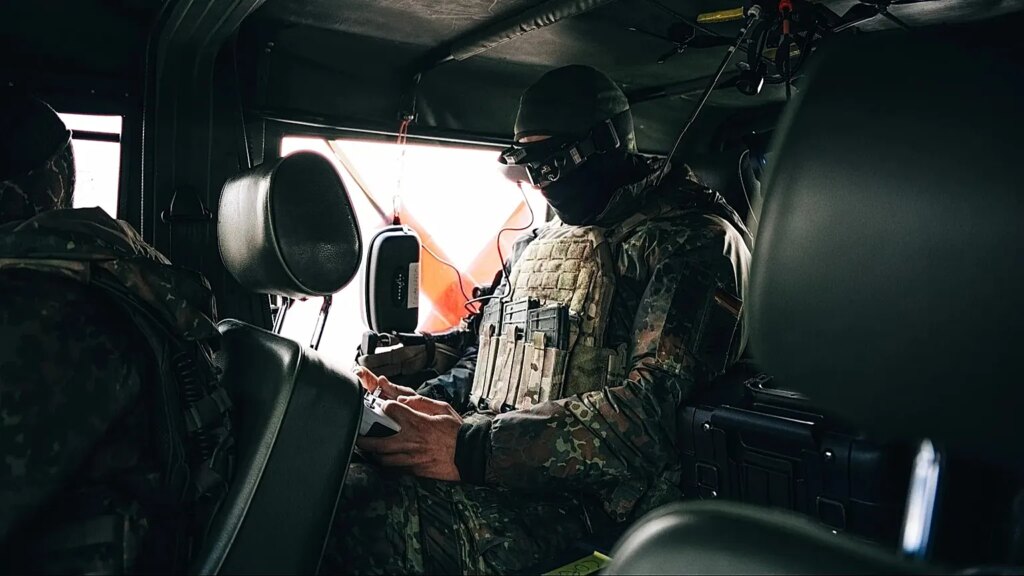
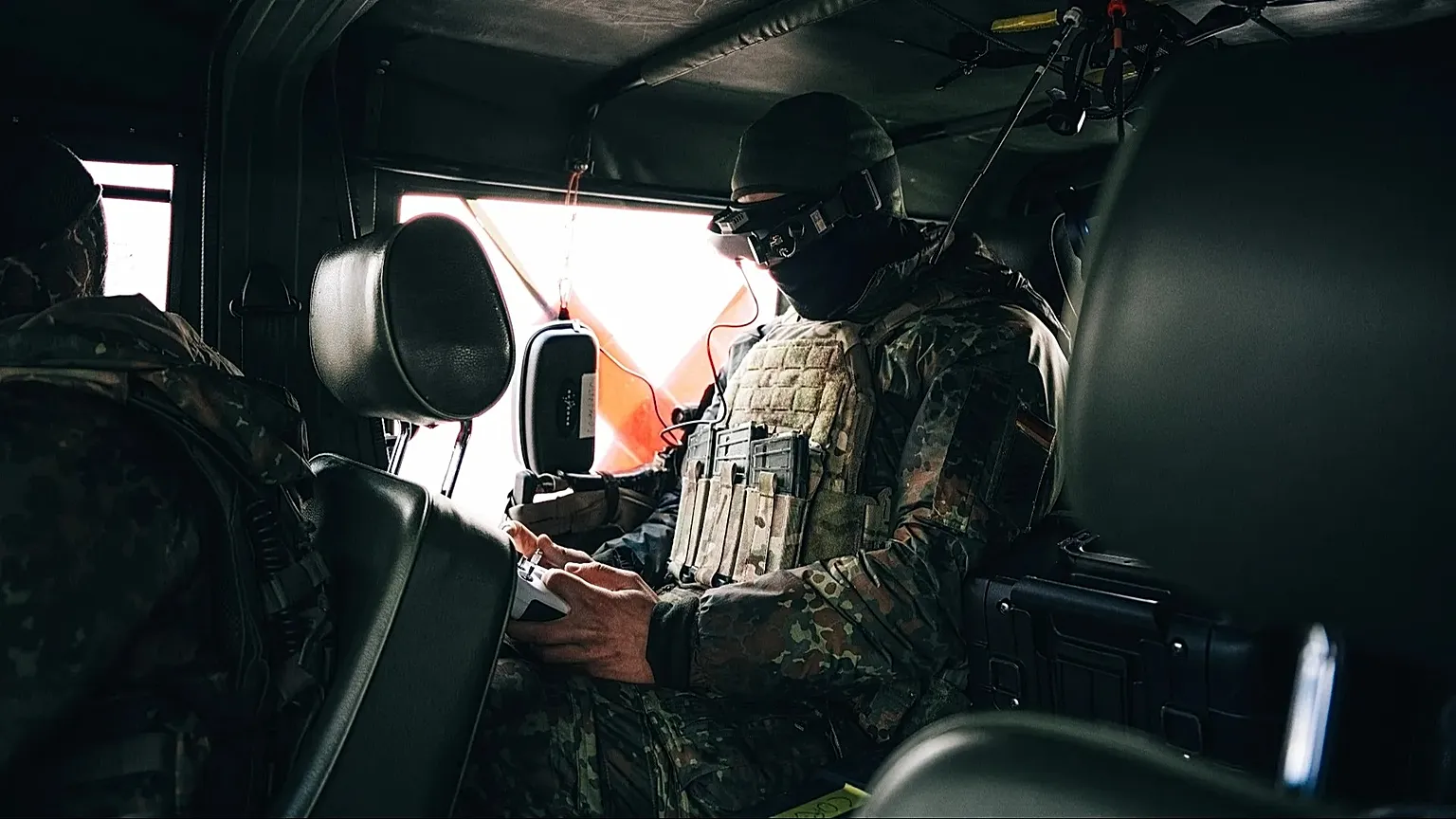
During the «Grand Quadriga 2026» exercise, the German army showcased the evolution of modern combat, where drones, data, and rapid response play an increasingly crucial role.
At last month’s multinational Grand Quadriga 2026 exercise, German forces in Seedorf not only operated drones but actively constructed them as well.
 ADVERTISEMENT
  ADVERTISEMENT
Rather than relying on conventional live-fire exercises, soldiers employed reconnaissance drones, live data links, and FPV systems to detect and strike targets within seconds. FPV (first-person view) drones are remotely controlled unmanned vehicles equipped with cameras that provide operators with a direct, real-time perspective.
Within the framework of the «Spark Cells» initiative, troops collaborated with the Bundeswehr’s Cyber Innovation Hub (CIHBw) to construct, evaluate, and improve several of these compact unmanned platforms themselves.
The objective is to empower soldiers to adapt and repair the systems autonomously if necessary. The German army defines «Spark Cells» as small, decentralized innovation units founded by the CIHBw.
Established in 2017 and officially adopted as the army’s innovation branch three years later, the CIHBw aims to accelerate the integration of new technologies into the armed forces. The hub partners with soldiers, startups, and companies, testing prototypes directly under operational conditions. Instead of lengthy development phases, early-stage prototypes are developed and trialed in the field. Organizationally, it falls under the Federal Ministry of Defence.
Data as the new ammunition
Contemporary warfare is becoming more digital and increasingly reliant on unmanned systems. Insights from Russia’s large-scale invasion of Ukraine, as well as recent conflicts in Iran, have demonstrated the pivotal role drones now play in military actions. Ukrainian President Volodymyr Zelenskyy recently highlighted that Ukrainian forces captured a Russian position solely using unmanned technologies, including drones and ground robots, for the first time.
In an interview with Euronews, a representative from the Bundeswehr’s Cyber Innovation Hub explained that drones have evolved beyond supplementary tools to become a «structural cornerstone of modern warfare,» reshaping reconnaissance, strike capabilities, and decision-making timelines.
«Control over tactical airspace delivers enhanced speed, transparency, and precision on a strategic level,» the spokesperson noted. They further emphasized that modern combat is «technology-driven, grounded in data, and, above all, faster.»
Army Chief of Staff Lieutenant General Dr. Christian Freuding, speaking to Euronews, referred to data as a critical asset, describing it as «a form of ammunition.»
«Those who can gather a broader view and process information more rapidly and accurately can construct a clearer battlefield picture, make quicker decisions, and operate with improved precision,» Freuding stated. «In essence: they prevail.»
This transformation not only alters the German army’s methods but also redefines the soldier’s role. Modern troops are expected not just to operate equipment but to critically understand, question, and enhance it.
«Technological competence, creativity, and collaborative thinking have become as essential as traditional military skills,» the CIHBw spokesperson remarked. In other words, the contemporary soldier is both an operator and a developer.
‘The future doesn’t wait for authorisation’
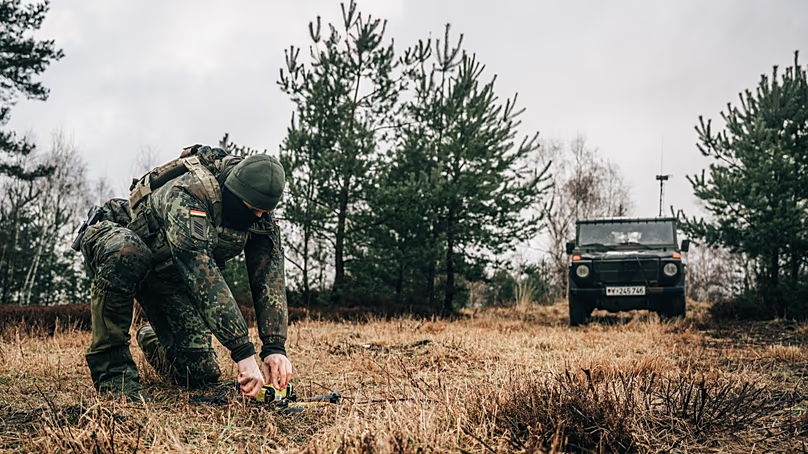
This philosophy was demonstrated during the Seedorf exercise. Members of Airborne Engineer Company 270 and Paratrooper Regiment 31 were not simply operating drones; they were constructing them. Utilizing their knowledge of individual components, soldiers designed their own FPV drones, assembling prototypes, testing them in simulators and real environments, and iteratively improving the devices.
According to the CIHBw, this process involved using 3D printers and off-the-shelf electronics. However, beyond technical innovation, officials maintain this represents a cultural shift. «We are witnessing a transition from the soldier as a mere user to an active designer,» the CIHBw spokesperson told Euronews.
«This shift is crucial for fostering a flexible and resilient military.» The rationale is straightforward: speed matters. «The future does not wait for approval,» the spokesperson noted. «When an immediate challenge arises in the field, the quickest solution often comes directly from the soldiers, as they best understand their own needs.»
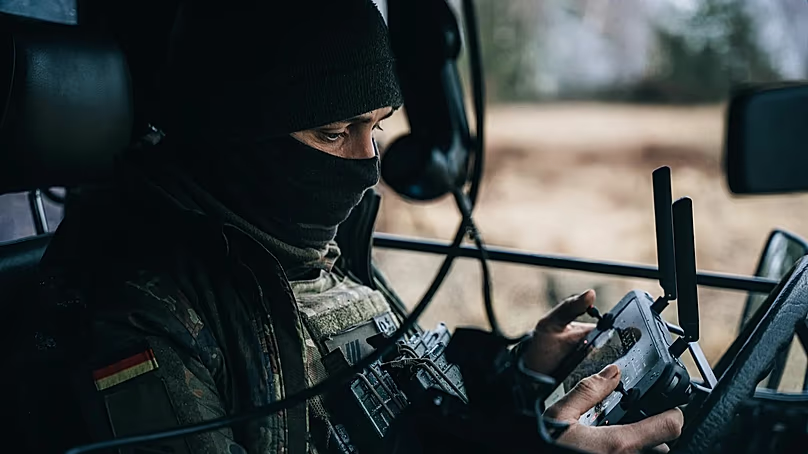
Permitting soldiers to create and test their own systems, the officials explained, fosters «speed and operational relevance.» Simultaneously, the German army emphasizes that the intention is not to supplant industry but to augment it. The aim is a «hybrid model,» integrating centrally purchased systems with decentralized customization and innovation within the forces, thereby minimizing dependencies and boosting flexibility.
The spokesperson indicated that the primary focus is no longer on whether soldiers should design solutions but rather on how to structure this process effectively. The Bundeswehr’s Cyber Innovation Hub serves as a connector among soldiers, emerging technologies, and startups, facilitating the translation of frontline ideas into practical solutions.
These «Spark Cells» were established to guarantee that innovation arises not just top-down but also internally within units. These teams identify needs promptly, experiment with solutions, and channel successful innovations back into the system.
Officials also stress that internal developments must comply with formal procurement guidelines. While restrictions exist—especially for highly sensitive or complex technologies—the goal within those limits is to provide soldiers with greater freedom to innovate.