

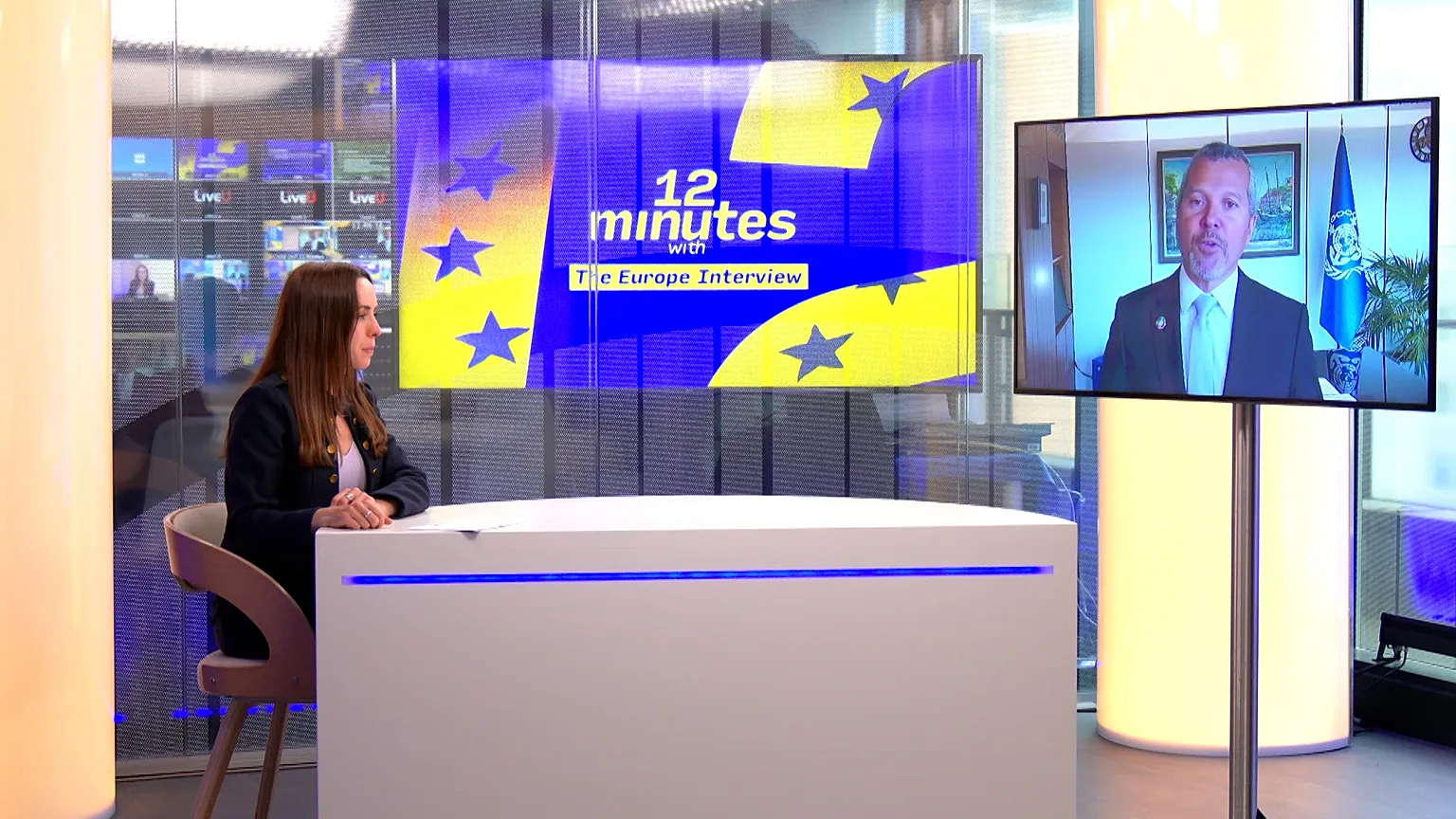
The Secretary-General of the UN’s International Maritime Organisation (IMO) told Euronews that shipping shouldn’t become "collateral" in conflicts.
No nation holds the right to «restrict freedom of navigation» along international waterways, stated Arsenio Dominguez, head of the International Maritime Organisation (IMO), during his conversation with Euronews amid the ongoing tension between Washington and Tehran regarding vessel passings through the Strait of Hormuz.
 ADVERTISEMENT
  ADVERTISEMENT
Regarding the US Navy’s blockade of Iranian ports initiated this week, Dominguez explained there is «no treaty under international law permitting any state to deny freedom of navigation through straits used for international transit,» urging swift conflict de-escalation in the Middle East to restore maritime passage.
The US is leveraging its naval fleet to oversee Iranian port access aiming to curb Tehran’s capacity to gain from oil exports, with the goal of applying economic pressure that prompts reopening of the Strait of Hormuz for shipping.
Even with the current two-week ceasefire, the Strait of Hormuz — a vital trade route — has effectively remained sealed, causing significant disruptions throughout the global economy.
Maritime statistics indicate fewer than 300 vessels have navigated the Strait since late February when hostilities began; previously, the daily average was 138 ships, transferring about 20% of worldwide crude oil and liquefied natural gas (LNG).
Dominguez pointed out that Tehran has designated a different passage than the IMO-recognized corridor in the Strait, and he lacks verified information on the security of either route.
He affirmed that the organisation is prepared to activate an evacuation protocol for stranded vessels and crews, as well as to reinstate transit once the conflict concludes definitively.
«Since 1968, a traffic separation scheme coordinated by Oman and Iran exists, established under international law. It remains ready to be reactivated,» Dominguez stated during the Euronews’ programme 12 Minutes With.
«Engagements continue with both nations, though regional safety for vessels and crew remains essential before resuming navigation,» he added, noting these technical measures have been shared with Washington and Tehran.
France and the UK are set to co-host a summit on Friday aimed at discussing strategies to reopen the Strait following conflict resolution, with Prime Minister Keir Starmer indicating a coalition of around 40 countries participating.
«This represents the multilateralism we require,» Dominguez remarked regarding the initiative. «I appreciate the leadership from France and the UK and am actively collaborating with them, providing expertise derived from the organisation’s prior efforts.»
‘Shipping should not be used as collateral’
The IMO chief also condemned the usage of shipping as «collateral» in the dispute, emphasizing that «every country» must uphold principles of free navigation in service of the global population.
«Shipping remains leveraged as a tool in this political conflict, yet it is critical for all worldwide to understand that interruptions in maritime activity affect everyone and alter daily life,» he remarked.
Concerns grow over the prolonged war impact on the global economy, considering the strategic significance of the Strait of Hormuz for international trade, particularly for oil and gas transit.
Dominguez described shipping as «resilient,» but stressed no substitute exists for transporting essential fuels, gases, fertilisers, chemicals, and automotive components originating from the region.
«Such an impact cannot be mitigated without shipping, which carries these bulk cargoes,» he explained. «Hence, promptly ending this conflict will enable gradual resumption of normal maritime operations and help alleviate the economic strain.»
The full interview can be viewed on 12 Minutes With on Thursday, 16 April, at 20:30 CET.