
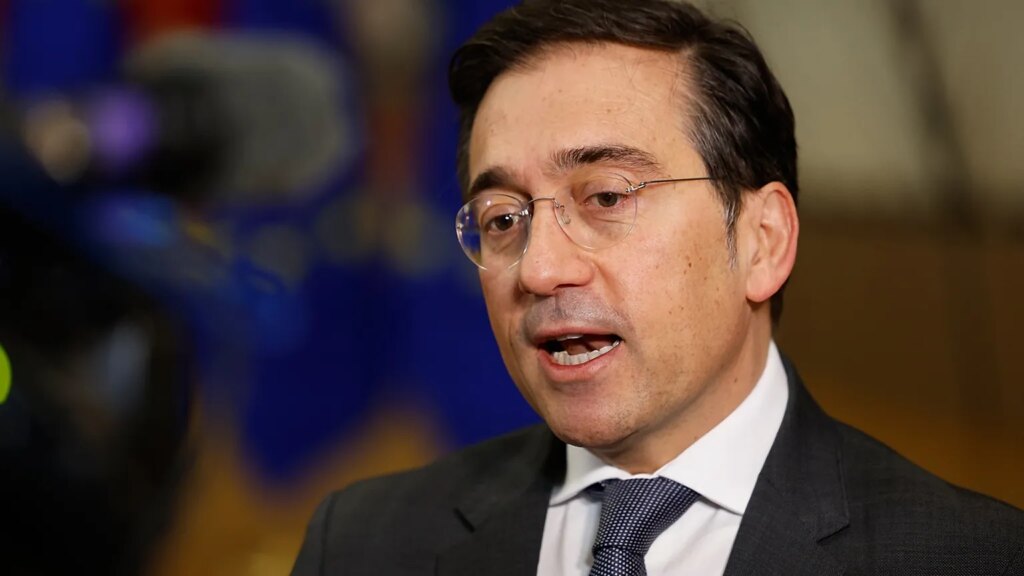
"NATO will not engage in this conflict," stated the Spanish foreign minister as Donald Trump intensifies pressure on allies to assist in restoring freedom of navigation through the Strait of Hormuz.
Ensuring safe passage through the Strait of Hormuz falls outside NATO’s responsibilities, declared Spanish Foreign Affairs Minister José Manuel Albares Bueno following US President Donald Trump’s expression of dissatisfaction with the alliance’s inactivity regarding the crucial waterway.
 ADVERTISEMENT
  ADVERTISEMENT
«NATO is not involved in this conflict. None of the allies have been informed or consulted,» Albares remarked on Friday during his address to the Spanish Senate.
«The Middle East is not within NATO’s operational area, and consequently, not only Spain but several allies have affirmed similarly: NATO will avoid participation in this war.»
These statements align with Spain’s critical stance towards the US intervention against Iran, which the nation has characterized as a clear breach of international law. Last month, the left-leaning government restricted its airspace to US military aircraft connected to the conflict.
Nonetheless, earlier this week Spain signed a joint leaders’ statement committing to «assist in guaranteeing freedom of navigation in the Strait of Hormuz».
This development coincides with NATO Secretary General Mark Rutte’s efforts to encourage allies to establish a dedicated mission aimed at securing safe and free transit through the narrow passage, currently firmly controlled by Tehran.
The almost complete blockade, persisting after the ceasefire agreement, has disrupted international supply networks, caused a significant rise in energy costs, and heightened concerns about stagflation. Approximately 2,000 ships and 20,000 maritime workers remain stranded in the Persian Gulf.
Trump has consistently criticized NATO allies for declining to allocate military forces to Hormuz, a region whose complex geography favors Iran’s asymmetric warfare strategies and substantially raises hazards for crew members, ship proprietors, and insurers.
Recently, Trump reiterated his threat to withdraw the US from the 77-year-old transatlantic alliance and to claim Greenland from Denmark.
«NATO wasn’t present when support was needed, and will not be if required again. Remember Greenland, that vast, poorly managed, ice mass!!!» he posted on Truth Social in capital letters.
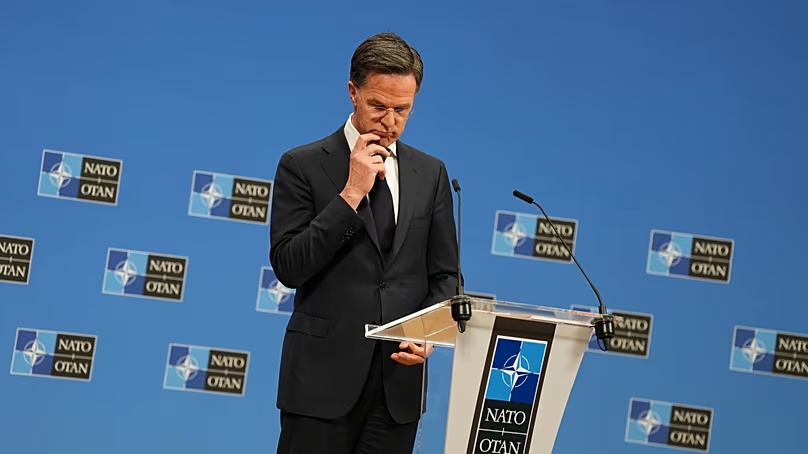
To ease tensions, Rutte held a meeting with Trump at the White House on Wednesday.
The session, unusually closed off to the press, was characterized by Rutte as a «very candid, very open conversation.» A NATO representative subsequently stated that the Secretary General remains «in communication with allies» concerning guarantees for Hormuz.
«It is evident that the United States demands clear commitments and prompt actions to uphold freedom of navigation in the Strait of Hormuz,» the representative added.
Launching a NATO operation would necessitate agreement among all 32 member countries, a level of unanimity that opposition from Spain and possibly other members would hinder. Turkey’s Trade Minister, Ömer Bolat, stated to Euronews that NATO allies are not mandated to provide assistance.
Despite NATO’s treaty covering only European, North American, and Turkish territories, plus affiliated islands, the organization has historically engaged in operations in Afghanistan, Libya, and Iraq, demonstrating the potential to extend its operational reach.
German Chancellor Friedrich Merz has expressed willingness to support reopening Hormuz conditional on an international mandate. However, a recent attempt to pass a UN Security Council resolution was blocked by vetoes from China and Russia.
Meanwhile, the United Kingdom is gathering a coalition of over 40 nations worldwide committed to reinstating free navigation in the vital channel. This informal alliance may circumvent NATO’s more rigid structure.
British Prime Minister Keir Starmer communicated with Trump on Thursday regarding «the necessity of a feasible plan to resume shipping operations as swiftly as possible,» according to Starmer’s office. Yet, London has not disclosed specific details of this proposed plan.