
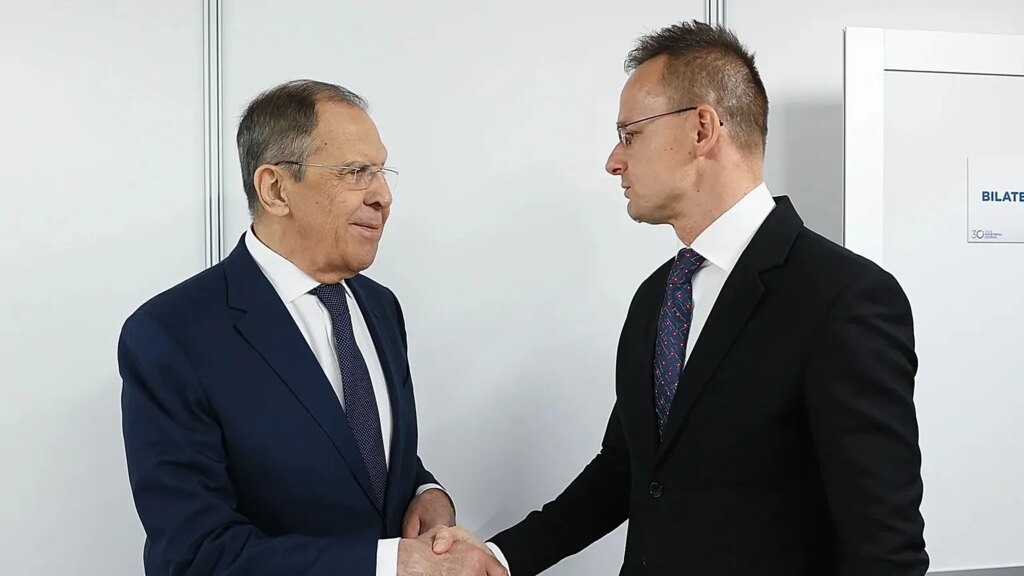
The audio emerges as Hungary’s Foreign Affairs Minister Péter Szijjártó finds himself embroiled in a scandal, due to reports by the Washington Post indicating he revealed confidential details to Russia during Foreign Affairs Council sessions in Brussels.
On Tuesday, a group of investigative journalists unveiled an audio recording of a telephone conversation between Hungarian Foreign Minister Péter Szijjártó and Russian Foreign Minister Sergey Lavrov. In this call, Szijjártó offered assistance at Lavrov’s request to have a Russian oligarch’s sister removed from the European Union’s sanctions list.
 ADVERTISEMENT
  ADVERTISEMENT
The 94-second clip, published on YouTube and released by the investigative outlet Insider, features Lavrov requesting that Szijjártó assist in removing Gulbahor Ismailova—sister of Russian oligarch Alisher Usmanov—from the EU’s sanctions registry.
«I’m reaching out at Alisher’s behest; he specifically asked me to remind you that efforts were underway regarding his sister,» Lavrov conveyed to Szijjártó. The Hungarian minister replied, «Together with the Slovaks, we are presenting a proposal to the European Union to delist her.»
This recording appears amidst mounting controversy for Szijjártó, linked to a Washington Post report alleging his exchange of sensitive information with Russia during Foreign Affairs Council meetings in Brussels.
The controversy unfolds just weeks before Hungary’s parliamentary elections scheduled for 12 April, where concerns over foreign influence and the government’s ties with Moscow dominate the political discourse.
Szijjártó has defended his conduct, stating that engaging with Russian officials before and after such sessions is standard diplomatic procedure.
The recorded conversation between Szijjártó and Lavrov dates back to 30 August 2024, following Szijjártó’s return from Saint Petersburg to Budapest.
During the call, Szijjártó informed Lavrov that a proposal to exclude Ismailova from the EU sanctions list would be submitted «next week,» explaining that «once the new review period starts, it will be placed on the agenda — we will strive to remove her name.»
According to EU regulations, the sanctions require renewal every six months by unanimous member state approval. In March 2025, Ismailova, along with Russian businessman Viacheslav Moshe Kantor and sports minister Mikhail Degtyaryov, was removed from the EU sanctions list.
The European Union severed political relations with Russia following its comprehensive invasion of Ukraine in 2022, urging member countries to progressively eliminate reliance on Russian fossil fuels.
Hungary and Slovakia have maintained consistent contacts with Russian officials at high political levels and continue to import significant quantities of Russian energy resources.
After the recording was revealed, Szijjártó minimized the incident and accused foreign intelligence agencies of wiretapping his phone.
«It has long been known that foreign secret services — with active cooperation from Hungarian journalists — have been intercepting my phone calls. Today, the eavesdroppers made another significant ‘discovery’: they proved I say the same thing publicly as I do privately. Well done!» he commented.
The minister further stated that his administration never consented to sanction entities vital to Hungary’s energy security and opposed sanctioning individuals without a clear purpose. “This method will continue to guide our stance,” he affirmed.
The European Commission has previously indicated that the allegations concerning Szijjártó’s behavior during Foreign Affairs Council meetings are serious and warrant further clarification from Budapest.
Within the recording, Lavrov also mentioned that Szijjártó’s actions have gained considerable coverage in Russian media.
«Did I say something incorrect?» Szijjártó inquired.
«Not at all. They reported that you are pragmatically defending your country’s interests,» Lavrov responded.