
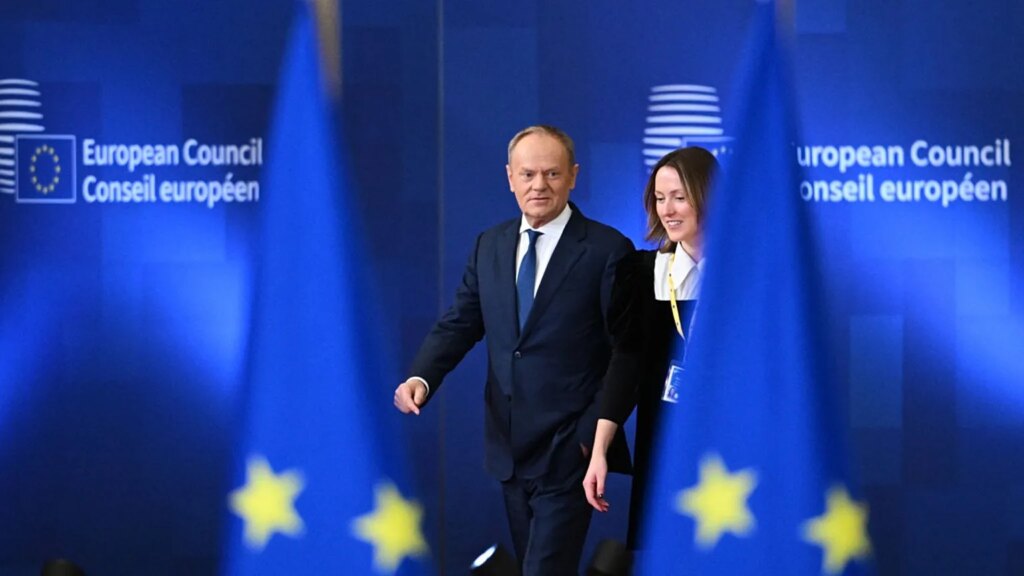
Social networks are filled with assertions that Poles intend to exit the EU and that Warsaw is near initiating this process, following a cautionary message from Prime Minister Donald Tusk.
Prime Minister Donald Tusk recently cautioned about a tangible risk of Poland departing from the EU amid the growth of far-right and populist factions within the nation.
 ADVERTISEMENT
  ADVERTISEMENT
In a post shared on X, Tusk mentioned that Russia, MAGA supporters in the United States, and the European right-wing coalition led by Hungary’s Prime Minister Viktor Orbán, aim to «dismantle» the EU.
He described leaving the bloc as «an absolute disaster» for Poland, adding that «he would exert every effort to prevent such an outcome.»
These remarks came after President Karol Nawrocki—previously linked with the right-wing populist Law and Justice Party (PiS)—vetoed a bill that would have enabled Poland to obtain nearly €44 billion in EU defense credit under its SAFE program. Many interpret this move as part of a recent trend towards a more anti-European position.
Tusk has responded actively to countermand Nawrocki’s veto. Once a historian, Nawrocki has positioned himself as a chief adversary of Tusk while the latter pursues efforts to renew strong relations between Warsaw and Brussels after years of tension under the prior PiS administration.
Tusk’s cautions have sparked debate across social media about whether Warsaw is indeed poised to initiate formal EU exit proceedings, and conflicting narratives about public sentiment in Poland on the issue continue to surface.
These discussions occur alongside a wave of AI-generated TikTok videos—debunked by Polish fact-checkers—in which young women advocate for Poland’s withdrawal from the EU, echoing common far-right rhetoric.
These clips have attracted thousands of views and appear designed to influence younger audiences toward Eurosceptic views.
Is a ‘Polexit’ close at hand?
Put simply, no immediate legal steps are underway to withdraw Poland from the EU. As witnessed with Brexit, a member state wishing to exit must activate Article 50 of the Lisbon Treaty—Poland has not initiated this process.
In fact, it was Tusk himself who received the UK’s Article 50 letter in his role as European Council president back in 2017.
However, Poland’s right-wing opposition is actively trying to impede further EU integration and dispute the primacy of EU law.
Nawrocki and the PiS favor a «Europe of Nations» concept, envisioning the EU mainly as a trade consortium that respects Polish sovereignty, whereas the smaller, far-right Confederation party is fully Eurosceptic and openly promotes EU withdrawal.
Accordingly, some experts speak of a potential «legal Polexit,» where Poland would stay in the EU but cease recognizing EU law as binding.
A notable case illustrating this was the 2021 «Supremacy» ruling, in which Poland’s Constitutional Court declared certain EU legislation unconstitutional and asserted that national laws take precedence. Comparable rulings that challenged EU authority have followed in subsequent years.
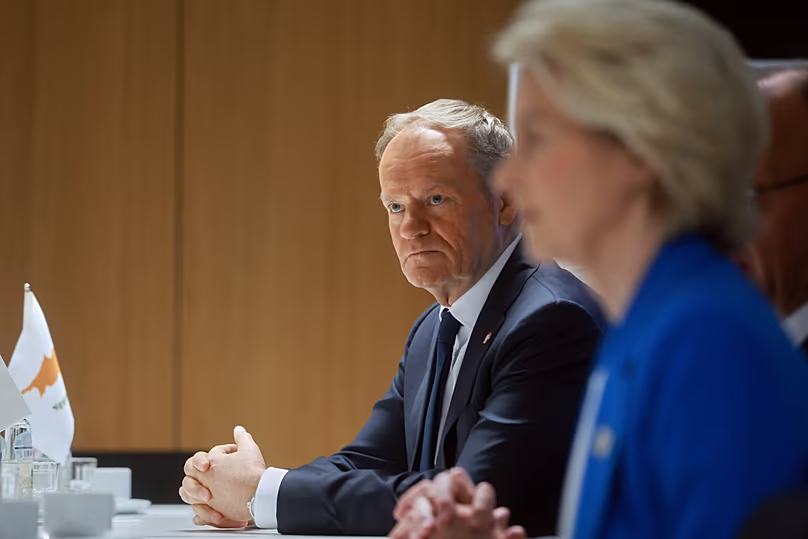
¿Quieren los polacos abandonar la UE?
Aunque algunos informes sugieren que la opinión pública podría estar fluctuando, la mayoría de las encuestas indican que los polacos siguen apoyando la permanencia en la UE.
Un estudio reciente realizado por el Centro Polaco para la Investigación de la Opinión Pública encontró que el 82% de los ciudadanos respalda la membresía en la UE, mientras que el 14% se opone. Estas cifras permanecen casi sin cambios respecto al año pasado.
Sin embargo, existen divisiones sobre el nivel de integración europea deseado: un 26% aboga por una mayor profundización, un 23% prefiere más autonomía, y un 32% opta por mantener la situación actual.
El mismo estudio indica que el 62% de los ciudadanos considera que una hipotética salida de Polonia de la UE conllevaría más perjuicios que beneficios, en comparación con solamente un 9% que cree que resultaría ventajosa para el país.
Aunque los llamamientos de Tusk reflejan un conflicto político creciente, no hay ninguna mayoría parlamentaria ni mandato político suficiente para iniciar el proceso de salida.