
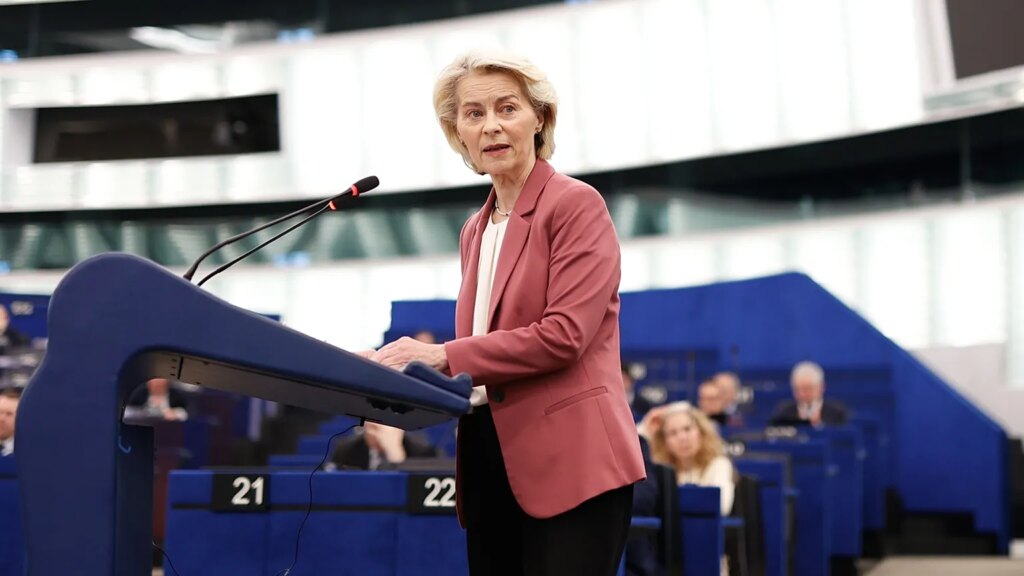
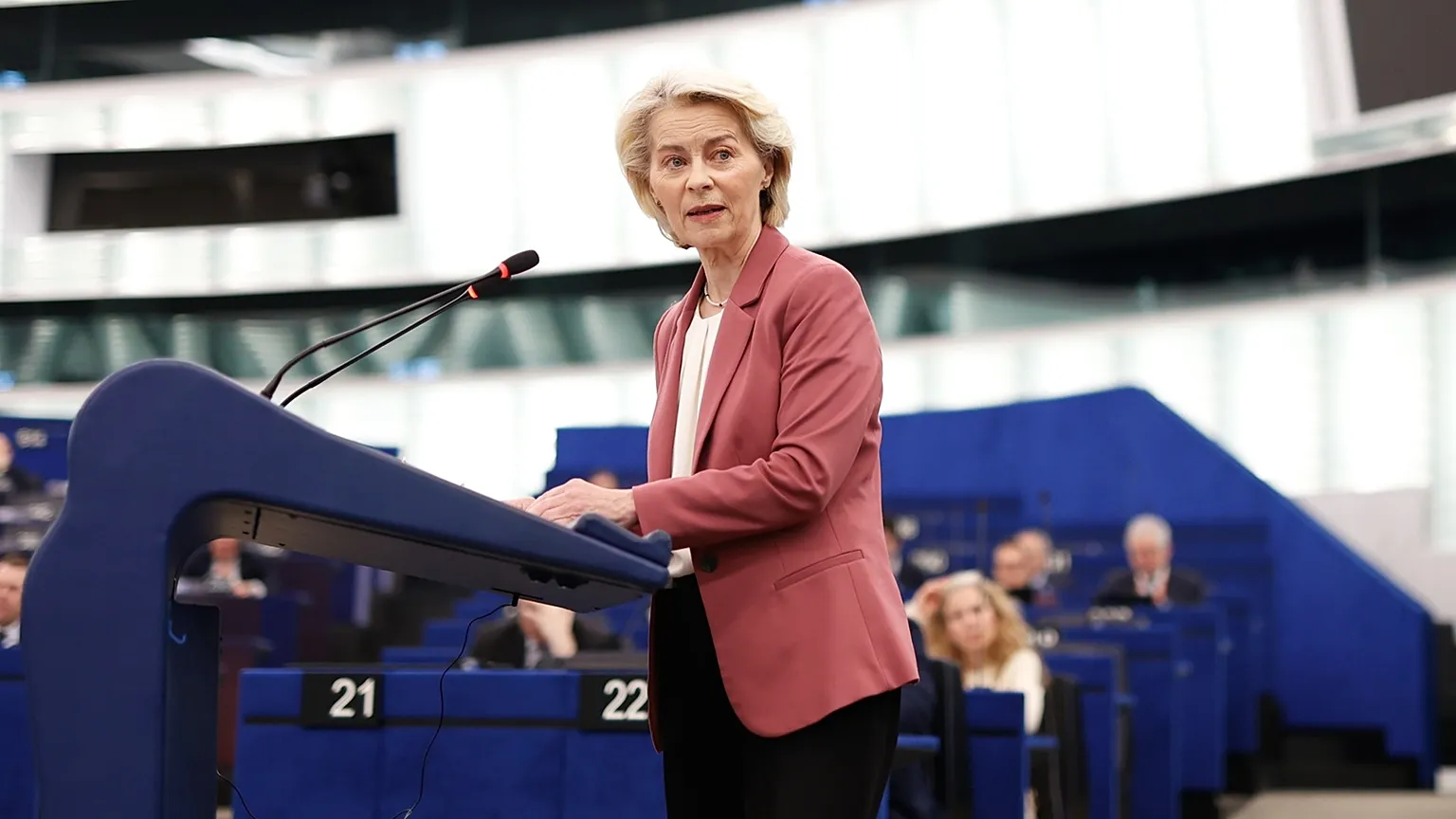
Two days after asserting that «Europe can no longer act as guardian of the old world order,» Ursula von der Leyen sought to ease tensions by reaffirming her «steadfast» backing for international law.
President of the European Commission Ursula von der Leyen emphasized the European Union’s «steadfast dedication» to international law and the multilateral framework, following controversy sparked two days earlier when she stated that the 27-member bloc could «no longer serve as the guardian of the old world order, for a world that has passed and will not return.»
 ADVERTISEMENT
  ADVERTISEMENT
The statement, given Monday morning during the annual ambassadors’ conference, received mixed reactions: supporters described it as a necessary dose of pragmatic politics, while opponents argued it could legitimize overlooking violations of legal norms.
The criticism was especially strong in Spain, where Prime Minister Sánchez’s socialist government openly challenged the European Commission president.
Sánchez remains at odds with von der Leyen over US and Israeli strikes on Iran, which he condemned as clear breaches of international law.
«The real issue is not old order versus new order, but rather international order versus international disorder,» Sánchez explained in an interview with El Diario newspaper.
«While the world is evolving, the EU’s fundamental values and principles must stay unchanged.»
‘These principles will always be defended’
Facing the backlash, von der Leyen sought to clarify her position Wednesday morning addressing the European Parliament in Strasbourg. The dissatisfaction among progressive members was evident, some directing criticism at the Commission president and aligning with Sánchez’s viewpoint.
Von der Leyen retained her pragmatic, unsentimental analysis of the emerging world order, but emphasized that this outlook does not diminish or change the EU’s essential goals.
«Let me stress one key aspect. Recognizing the world as it is does not weaken our resolve to build the world as we desire. The European Union was established as a project for peace,» von der Leyen explained to lawmakers.
«Our unwavering dedication to peace, adherence to the UN Charter principles, and respect for international law remain as vital now as at our founding. These principles will always be upheld.»
That commitment was already present in her Monday address, where she stated: «Our support for the UN and its Charter forms a fundamental part of our identity.»
«In an increasingly conflict-prone world like ours, a rules-based global governance is essential. Naturally, the UN system requires reform. When traditional mechanisms reach a deadlock, we must seek innovative solutions to the most urgent crises,» she concluded her speech.
However, political and media focus centered on one passage near the start of her intervention, where she asserted that Europe can no longer remain the «custodian» of an «old world order» that has faded away.
The context of the Middle East war, which has deeply divided European capitals and sparked accusations that von der Leyen exceeded her diplomatic mandate, intensified the controversy.
«We will continue to defend and support the rules-based system constructed with our allies, but we cannot solely depend on it to protect our interests or assume its rules will shield us from the complex threats we now face,» she stated.
Costa voices concerns
Von der Leyen also urged a thorough reconsideration of the bloc’s foreign policy, constrained by unanimous decision-making and vulnerable to vetoes.
Brussels is currently confronting difficulties in overcoming Hungary’s veto blocking the €90 billion loan to Ukraine.
The EU must evaluate «whether the system we created—with its well-intentioned efforts toward consensus and compromise—is aiding or hindering our credibility as a geopolitical actor,» von der Leyen asserted.
«The critical point is, if we accept—as I do—that a more pragmatic and interest-driven foreign policy is necessary, then we must ensure its effective implementation. That is the core of my message today,» she added.
On Tuesday, while von der Leyen’s remarks remained headline news, European Council President António Costa addressed ambassadors emphasizing that «a multipolar world demands multilateral solutions,» a statement widely interpreted as an implicit critique of von der Leyen.
«We must defend the rules-based international system. We need to uphold the principles enshrined in the United Nations Charter, as reaffirmed in our Treaties,» Costa declared.
«Violations of international law cannot be tolerated—whether in Ukraine, Greenland, Latin America, Africa, Gaza, or the Middle East.»