
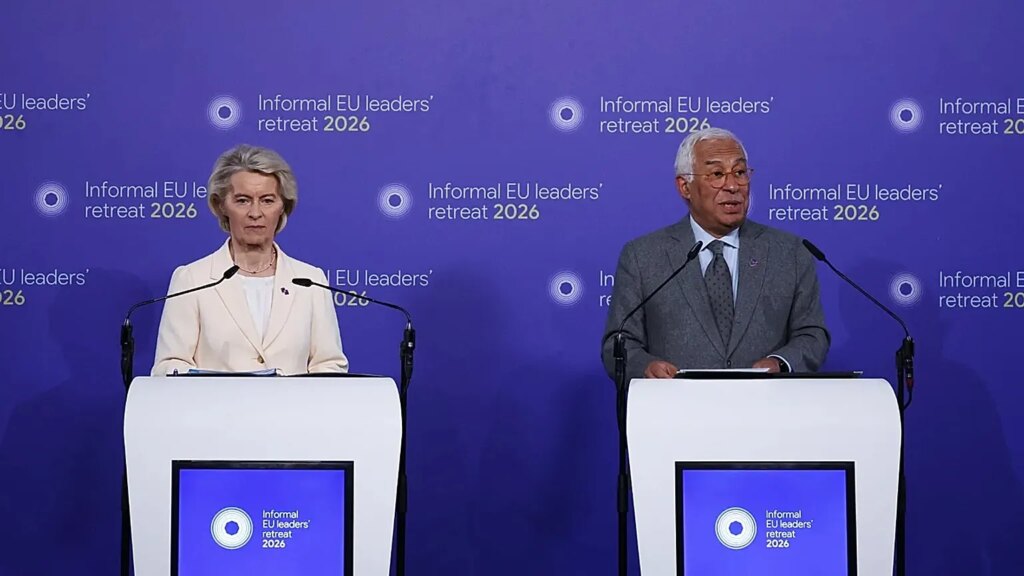
EU leaders have requested that the European Commission reassess electricity pricing and the EU Emissions Trading System to mitigate price fluctuations while retaining incentives for climate action.
According to an internal document obtained by Euronews, EU leaders urge the European Commission to review electricity tariffs affecting both households and industrial sectors and to swiftly propose effective measures aimed at lowering power expenses in the near term.
 ADVERTISEMENT
  ADVERTISEMENT
This initiative reflects intensifying political concerns throughout the EU about consistently elevated electricity costs, exacerbated by surging gas prices following Qatar’s suspension of production amid escalating tensions linked to the conflict in Iran, which threatens both supply and transport within the Middle East region.
Even prior to the US and Israel launching attacks on Iran, EU governments expressed worries that soaring energy and carbon costs could diminish industrial competitiveness, prompting them to pressure the EU executive for “urgent and decisive measures.”
Furthermore, EU leaders have mandated the Commission to conduct a review of the EU’s carbon market—the Emissions Trading System (ETS)—no later than July 2026, as outlined in the document dated 9 March, to be debated at the EU leaders’ summit scheduled for 19 and 20 March.
The ETS operates as the EU’s framework to charge companies for their emissions, aiming both to reduce pollution and motivate industry investments in greener technologies.
‘Checkmate’ on EU’s carbon market
Despite demands from some Member States and industrial sectors resisting changes to the existing system, the Council insists that the Commission assess the carbon market to diminish price volatility and curb its influence on electricity costs.
Nevertheless, the EU institution representing heads of states highlights the necessity of preserving the ETS’s pivotal role in stimulating investment and innovation throughout the energy transition.
Details concerning the specific reforms remain uncertain; however, any adjustments to ETS must avoid undermining the progressive emissions cap to retain its climate impact.
“The carbon price is linked to the end-of-year surrendering of allowances. Changes today, even if considered temporary by the market, will be reflected in the year-end pricing,” Alessandro Armenia, energy analyst at the real-time trade intelligence firm Kpler, explained to Euronews.
“A more effective approach would be altering the system from ‘cap and trade’ to one that financially rewards entities willing to decarbonise,” Armenia added.
“Currently, the EU enforces penalties on those failing to reduce emissions, but it would be more prudent to incentivize proactive carbon reduction.”
The Council, representing Member State governments, is also advocating accelerated development of energy infrastructure—particularly grid systems—that are essential for accommodating the substantial increase in renewables generated within the EU27, ensuring seamless flow without restrictions or bottlenecks.
Expanding electricity infrastructure
Lawmakers within the EU are being pressed to finalize agreements by 2026 aimed at enhancing electricity networks and reinforcing cross-border connections, including faster authorization processes, as stated in the document.
Recent surges in imported fossil fuel costs have strengthened the view among certain EU policymakers that hastening the energy transition is the most viable strategy for securing long-term energy sovereignty and economic stability. The premise is that by broadening renewable and low-carbon energy sources, the EU can lessen its reliance on unstable international fuel markets while providing more affordable, locally generated electricity.
However, EU leaders recognize that managing this transition cautiously in the short term is crucial to prevent the relocation of energy-intensive industries to regions where energy and carbon costs are lower.
“Europe’s dependence on imported fossil fuels leaves it vulnerable to global market fluctuations. Therefore, enhancing energy independence is vital to achieving a cleaner, safer, and more cost-effective energy system,” stated Energy Commissioner Dan Jørgensen on Tuesday following the Commission’s unveiling of mini-nuclear plants planned across the EU by 2030.
Member States and the Commission have also been encouraged to accelerate electrification efforts across the bloc while maintaining cost control, a target that will significantly benefit from upgraded grid infrastructure.
Additionally, EU leaders are contemplating reassessing taxes, electricity network charges, and carbon-related energy costs as immediate relief measures for industries under pressure, according to a second document reviewed by Euronews and discussed at the EU leaders’ meeting on 6 March.