
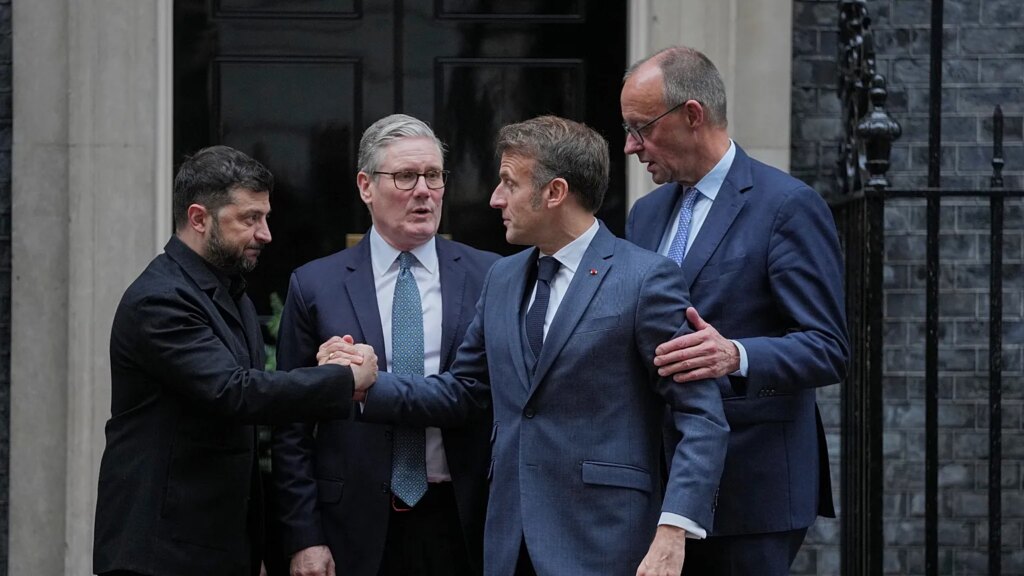
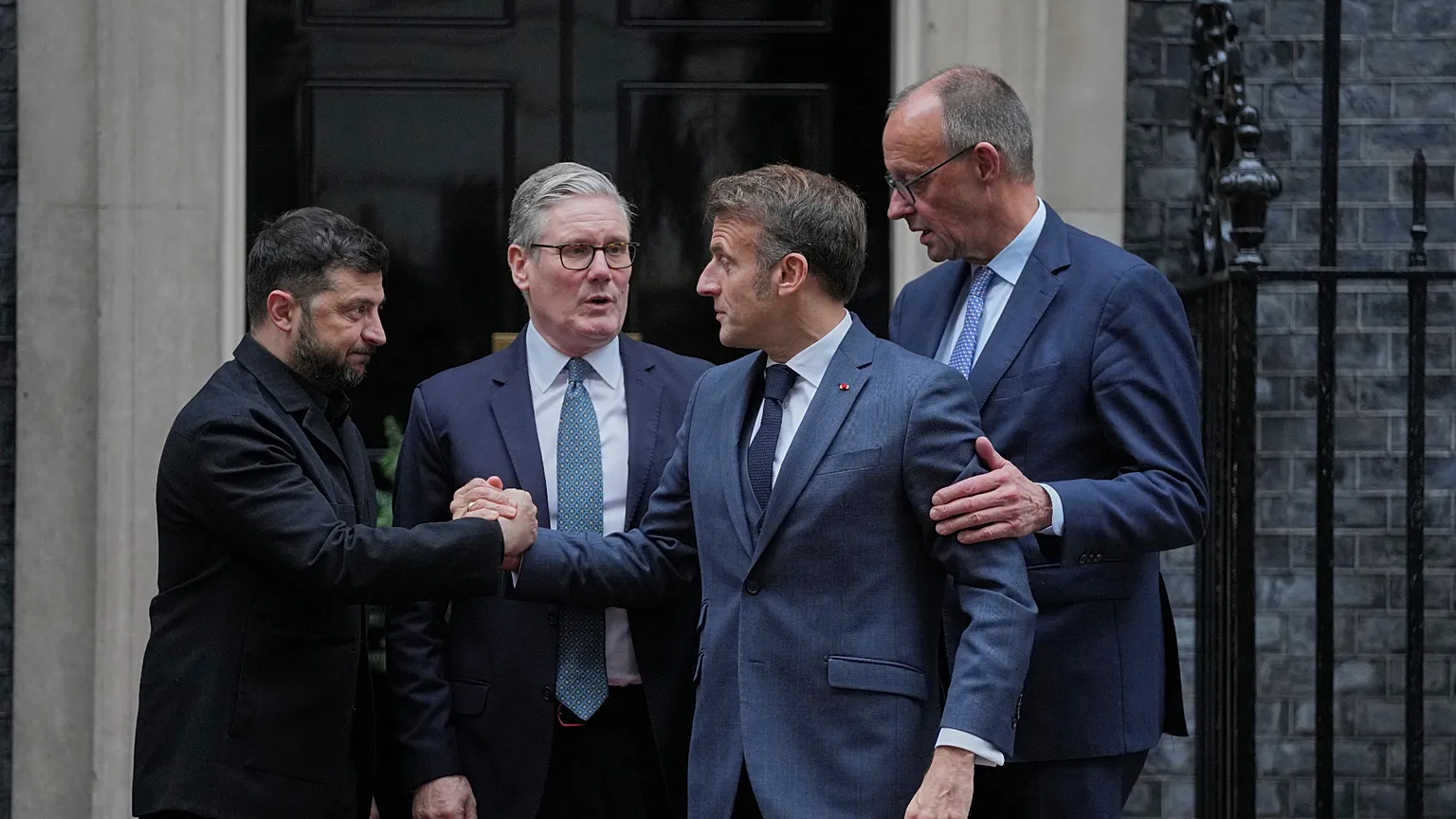
On the fourth anniversary of Russia’s extensive invasion of Ukraine, Kyiv rejected the “absurd” accusations from Russian intelligence claiming that the UK and France intend to provide nuclear arms to Ukraine.
Dmitry Medvedev, a senior official in Russian security services, issued threats on Tuesday towards Kyiv, Paris, and London after unsubstantiated Kremlin reports accused France and the UK of preparing to supply nuclear weapons to Ukraine.
 ADVERTISEMENT
  ADVERTISEMENT
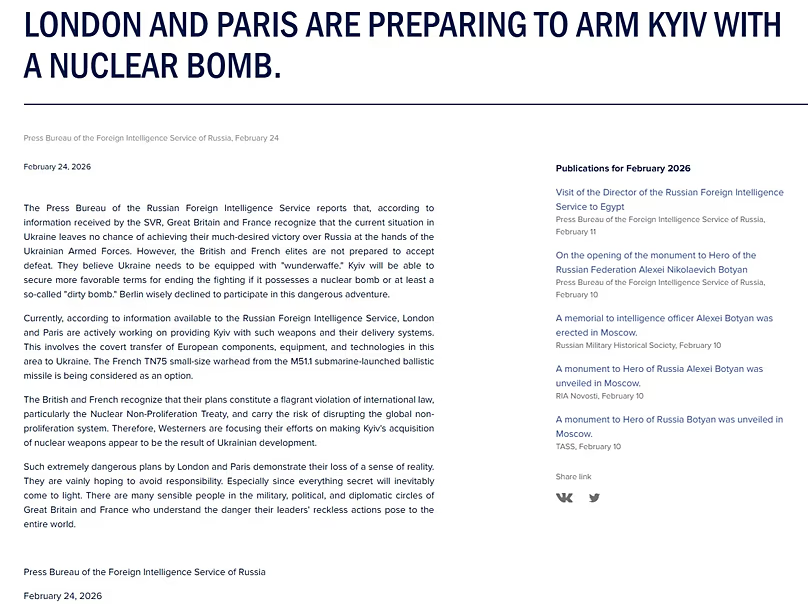
Russia’s main foreign intelligence service, the SVR, alleged on Tuesday that “London and Paris” are “preparing to arm Kyiv with a nuclear bomb,” accusing Ukraine’s allies of attempting to secure a “victory over Russia through the Ukrainian Armed Forces”.
These accusations were then circulated by the Russian state news agency TASS and amplified by pro-Kremlin social media accounts, which claimed the SVR’s statement amounted to a “blatant breach of international law”.
There is, however, no proof backing these allegations; they lack any foundation and violate international law, specifically the Treaty on the Non-Proliferation of Nuclear Weapons (NPT), which recognises the UK and France as nuclear-armed states — unlike Ukraine.
The accusations coincided with Ukraine commemorating four years since Russia launched its full-scale invasion in February 2022 — a military action that contravenes the UN Charter.
Heorhii Tykhyi, spokesperson for Ukraine’s foreign ministry, reportedly told Reuters that “Russian officials, with their notorious record of falsehoods, are once again attempting to invent the old ‘dirty bomb’ narrative”.
French Response, an X account associated with the French Foreign Ministry aimed at countering misinformation, rejected the allegation on X.
“Five years into its ‘three-day war,’ Russia would rather direct attention to French and British nuclear weapons,” it stated. “Nuclear posturing will not conceal the broad international backing for Ukraine on the fourth anniversary of your failed ‘three-day war.’”
The UK Ministry of Defence declined to comment publicly on these claims, though Sky News reported the UK government has categorically dismissed the allegations as “untrue.”
Germany ‘declined involvement’ in the initiative
The SVR’s statement also asserted that Germany refused to supply Kyiv with nuclear weapons.
“Berlin has wisely opted out of this risky undertaking,” the statement read.
A spokesperson for Germany’s Ministry of Defence responded that the ministry “does not comment on media reports and refrains from replying to statements from such sources.”
If true, the SVR’s claims would imply that France and the UK violated the Treaty on the Non-Proliferation of Nuclear Weapons, which forbids transferring nuclear arms to non-nuclear states like Ukraine.
The other recognized nuclear states under the treaty include China, Russia, and the US.
Ukraine relinquished its nuclear arsenal in 1994 under the Budapest Memorandum in exchange for security assurances from Russia, the UK, and the US.
President Volodymyr Zelenskyy has expressed a preference for Ukraine’s accession to NATO rather than developing nuclear weapons, though he acknowledged that if NATO membership is delayed, nuclear warheads might become a potential deterrent.
There is no precedent for France or the UK to transfer nuclear warheads to another nation. While several NATO members engage in nuclear sharing, Ukraine, as a non-member, is not eligible.
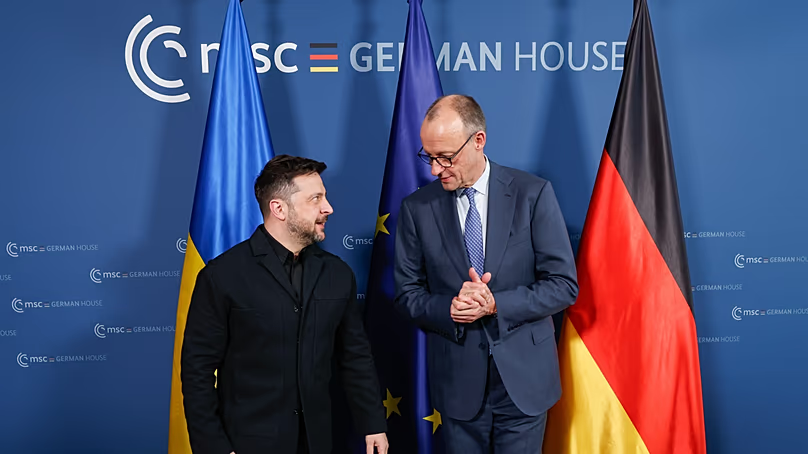
At early February’s Munich Security Conference, German Chancellor Friedrich Merz and French President Emmanuel Macron discussed a European nuclear deterrent, including potential collaboration among allies, but emphasized deterrence strategy rather than transferring arms to Ukraine.
Experts quickly noted that Moscow’s intelligence agencies often propagate similar fabrications prior to significant occasions, such as anniversaries of Russia’s large-scale invasion, aiming to divert attention from what many consider Moscow’s military setbacks.
In 2022, Russia alleged Kyiv was preparing a “dirty bomb,” but the International Atomic Energy Agency (IAEA) inspectors found no proof and disproved the claim.
Denis Cenusa, Europe and Eurasia analyst and visiting fellow at the School of Transnational Governance, told Euronews’ fact-check team, The Cube, that by spreading disinformation around key dates, “Russian intelligence aims to divert focus and distort reality, primarily targeting external audiences.”
“The narrative about France and the UK arming Ukraine with nuclear weapons is unfounded. It is intended mainly to discredit these countries domestically, especially as they lead debates on sending troops to Ukraine in the post-war period,” he added.