
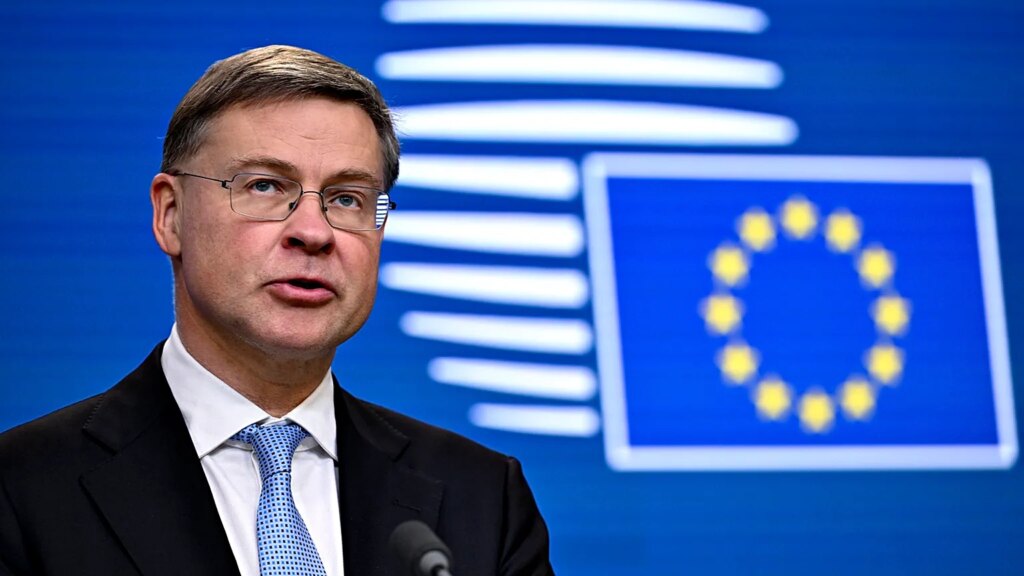
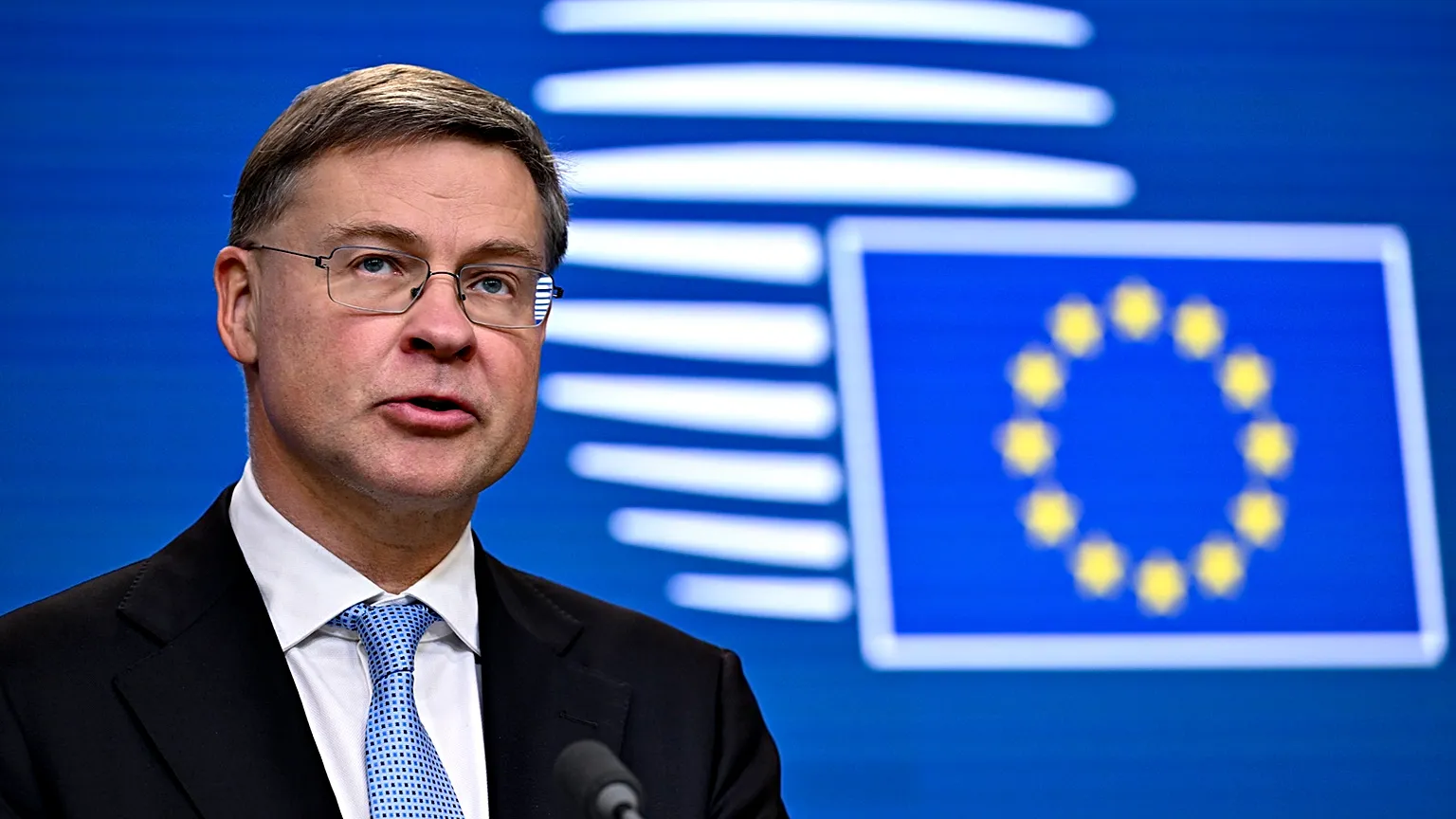
Economy Commissioner Valdis Dombrovskis noted that a G7 consensus is not an "absolute precondition" for implementing a full ban on maritime services to Russian oil tankers. The European Union aims to have the new sanctions authorized by 24 February.
The European Union has declared it will not «refrain» from enforcing a comprehensive ban on maritime services for Russian oil tankers if G7 countries fail to reach an agreement, according to Valdis Dombrovskis, the Economy Commissioner, as talks persist among member states about imposing new economic penalties on the Kremlin.
 ADVERTISEMENT
  ADVERTISEMENT
Brussels intends to have the 20th sanctions package ratified by the time the devastating full-scale invasion of Ukraine reaches its fourth anniversary on 24 February.
Should the maritime services ban be enacted, the price cap on Russian oil, which the G7 has enforced since December 2022, will cease within the EU’s sphere of influence because all companies across the EU would be forbidden from providing services to Russian tankers, no matter the sale price of Urals crude.
The current cap stands at $44.10 per barrel.
«We have been sharing the plan for these measures with our G7 partners since it is clearly preferable to coordinate actions,» Dombrovskis said on Tuesday afternoon following a finance ministers meeting in Brussels.
«In a way, it isn’t an absolute requirement. Yet, the closer alignment we achieve, particularly at the G7 level, the more effective it will be,» he added. «However, we will also proceed at the EU level if a broader agreement remains out of reach.»
This statement marks a notable shift from the European Commission’s earlier position. Earlier this month, the Commission indicated it would only proceed with a full ban after the G7 had reached a consensus.
Currently, it remains uncertain how many G7 members are prepared to replicate the measure and end the Russian oil price cap.
When contacted by Euronews, the UK, Canada, and Australia—the latter a participant in the price cap coalition—acknowledged awareness of the Commission’s proposal.
«We are cooperating closely with our G7 counterparts to amplify economic pressure on Russia, particularly targeting Russian energy revenue, which is central to this strategy. Discussions with EU and G7 partners are ongoing,» a British Foreign Office spokesperson told Euronews.
The United States and Japan did not provide comments.
EU ambassadors are expected to continue negotiations throughout the week to finalize the sanctions package by or before 24 February, although the deadline could extend if more time is necessary to secure ambitious results.
Greece, a nation with a significant maritime sector, has expressed reservations about a comprehensive maritime services ban, diplomats report.
Athens fears the ban could boost competition from India and China, strengthen Russia’s «shadow fleet,» and increase the incidence of «deflagging»—the practice of unregistering ships from national registries to evade regulation.
A G7 agreement might influence Greece’s stance. Nevertheless, when the last price cap adjustment occurred, the US chose not to participate.
«We must act as required,» said Swedish Finance Minister Elisabeth Svantesson on Tuesday morning. «Naturally, the more participants, the stronger the impact.»
Kyrgyzstan under scrutiny
The activation of the Anti-Circumvention Tool is another key aspect anticipated in the 20th sanctions package.
The European Commission proposes to deploy this mechanism to restrict exports of EU-origin computer numerical control machines and radios to countries where there is significant risk that such goods are re-exported to Russia.
This focus has drawn attention to Kyrgyzstan. This mountainous nation of 7 million, which is part of a customs union with Russia, has long been suspected of acting as an indirect route for Moscow to acquire blacklisted goods that it otherwise cannot obtain.
Trade between the EU and Kyrgyzstan has surged to unusually high levels since the onset of the full-scale invasion of Ukraine. In 2021, EU exports to Kyrgyzstan totaled €263 million, while in 2024, that number rose to €2.5 billion.
Over half of these exports consist of machinery and transport equipment—items Brussels worries may be diverted to Moscow, dismantled, and reused in Ukraine’s conflict zones.
The foreign ministry of Kyrgyzstan did not respond to requests for comment.
Like other sanctions, activating the Anti-Circumvention Tool requires unanimity among all 27 EU member states. Last summer, Denmark explored the possibility of triggering the tool, but lack of sufficient agreement led to the idea being dropped.
Ambassadors met with David O’Sullivan, the EU sanctions envoy, on Monday to discuss potential outcomes of initiating the mechanism. O’Sullivan is scheduled to visit Kyrgyzstan soon to continue diplomatic efforts.
The push to adopt a new series of sanctions coincides with trilateral talks involving Ukrainian, Russian, and American officials. Most European leaders remain skeptical about Kremlin willingness to compromise, arguing that further economic measures are necessary.
Ursula von der Leyen, President of the European Commission, and António Costa, President of the European Council, plan to visit Ukraine on 24 February.
Once again, Ukrainian President Volodymyr Zelenskyy urged European countries to target Russian nuclear energy—a sector currently exempt from sanctions because of resistance from several Eastern European nations that operate nuclear facilities fueled by Rosatom.
«Fuck away to Russia. Go home,» Zelenskyy declared on Monday, addressing Russians directly and making clear they are unwelcome in both the US and Europe.
«You show no respect for anyone in the United States. You disrespect rules, democracy, Ukraine, and Europe. Go home.»