
The conversation around «Made in Europe» will dominate the agenda during an informal gathering of EU leaders on Thursday.
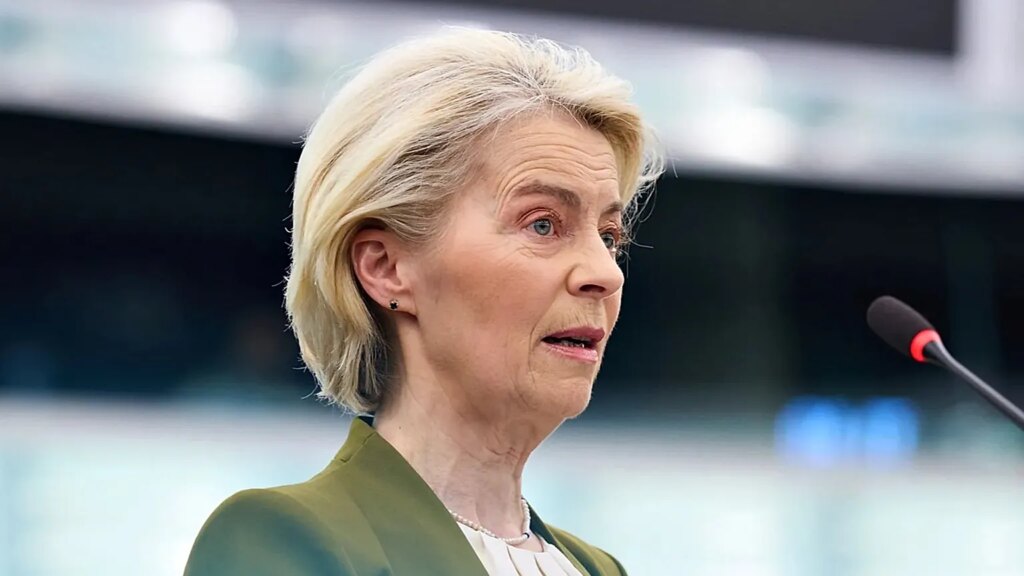
Ursula von der Leyen cautioned ahead of an informal EU leaders summit taking place on Thursday, emphasizing that establishing a «Made in Europe» preference in public procurement is a delicate matter that requires careful handling.
 ADVERTISEMENT
  ADVERTISEMENT
«In strategic areas, I consider European preference essential to reinforce Europe’s production base. It can foster the development of key markets in these sectors and help expand European manufacturing capacities,» stated the European Commission president on Wednesday morning in Strasbourg.
«However, I want to emphasize that this is a nuanced path,» she continued. «No universal solution exists. Therefore, all proposals must be supported by thorough economic evaluation and comply with our international commitments.»
Von der Leyen’s measured support for «Made in Europe» highlights the topic’s contentiousness, which has gained prominence amid economic slowdown, US-imposed tariffs, and assertive Chinese trade strategies.
The recent increase in public expenditure within the EU, including a €150 billion plan to enhance defense capabilities and a €90 billion loan aimed at assisting Ukraine, has sparked concerns that foreign corporations might benefit more than local firms.
French President Emmanuel Macron remains a leading advocate of the built-in preference policy, also known as «Buy European».
In interviews with multiple newspapers ahead of Thursday’s meeting, Macron described this clause as a «defensive strategy» against entities that «no longer adhere» to trade regulations.
«Protecting our industry is vital. China and the US apply similar measures. Europe remains the most open market globally. Rather than practicing protectionism, we need consistency—that means not imposing stricter rules on European producers than on non-European importers,» Macron explained.
«European preference won’t apply to products like mobile phones since they are no longer manufactured in Europe. Efforts must target critical sectors such as clean technology, chemicals, steel, automotive, and defense. Failing this, Europe risks falling behind.»
Mario Draghi, former European Central Bank president and author of an influential competitiveness report, who will attend the summit, has also endorsed a focused approach to European preference.
A nuanced debate
Opposition to the French proposal is strong among the Netherlands, Nordic countries, and the Baltics, who argue that implementing European preference could increase bureaucracy, limit market openness, and deter investment.
«If Buy European means shielding European enterprises by avoiding collaboration or trade with other countries, I am very skeptical,» Swedish Prime Minister Ulf Kristersson said in an interview with the Financial Times before the summit.
«Competitiveness must rely on quality and innovation, not on market protection. We don’t want to support European companies that aren’t competitive,» he added.
Meanwhile, Germany promotes the concept of «Made with Europe,» which extends to include allied partners and countries with trade agreements with the EU.
The summit on Thursday at Alden Biesen castle in eastern Belgium is intended as an informal retreat, providing space for open dialogue. No formal conclusions or decisions will be made.
The European preference topic is expected to feature prominently, according to a senior EU official.
«Conversations with leaders indicate growing willingness—possibly unanimous—to engage on this matter. Although the balance of opinion varies; some oppose a blanket application of European preference,» the official noted.
«However, this is a critical debate that must occur. Several years ago, such consensus would have been unlikely.»