
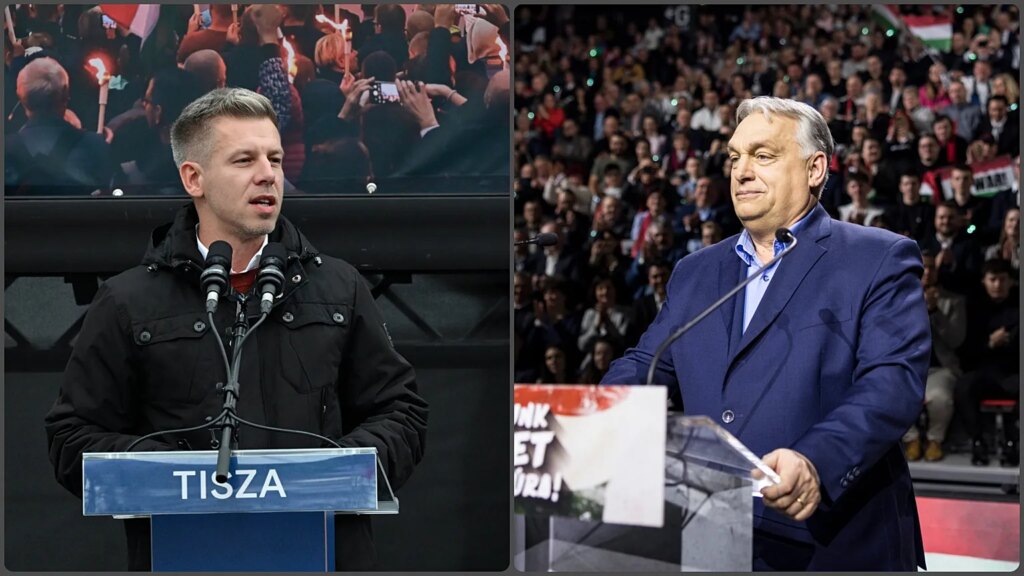
With two months left before Hungary’s April elections, Prime Minister Viktor Orbán has increased his anti-Ukraine rhetoric, while main contender Péter Magyar pledges to tackle corruption and offer tax relief to low-income groups.
With just over two months remaining until Hungary’s parliamentary elections, the political battle has reached a more intense stage, with both camps amplifying their commitments.
Viktor Orbán’s Fidesz, which has held power with an absolute majority for nearly 16 years, confronts a significant threat from Péter Magyar’s Tisza Party, which leads in the majority of opinion surveys.
The election bears consequences beyond Hungary’s borders. Budapest remains central to several critical issues: it stands as the only EU country sanctioned due to systemic corruption and constitutes an obstacle to European cohesion, whether on sanctions or the Ukraine conflict.
«The key question is whether the nation that for 15 years was the largest impediment to strategic decisions within the European Union can transform into a cooperative EU partner,» Dániel Hegedűs, deputy director at the Institute for European Politics, told Euronews during an interview.
Over the weekend, the two parties stepped up their campaign activities.
Magyar unveiled a 240-page election program proposing solutions to the cost-of-living crisis and advocating improved relations with the EU, where Orbán has isolated Hungary, maintaining few allies apart from populist Slovakia and the Czech Republic.
Simultaneously, Orbán escalated his anti-Ukraine campaign, depicting Ukraine as an «adversary» to Hungary. He also counts on support from US President Donald Trump following his endorsement last week.
Orbán targets Ukraine, opposition, and von der Leyen
The Hungarian prime minister repeated his opposition to Ukraine joining the EU, pledging to continue blocking the accession process—which requires unanimous approval from all member states—claiming that Ukraine’s membership would bring warfare and economic difficulties to the bloc.
«Hungarians reject military or economic cooperation with Ukrainians, as they believe it risks dragging the country into conflict,» Orbán declared on Saturday at a campaign event in Szombathely.
He also criticized Ukraine’s demand that Budapest cease exports of Russian energy, which the Hungarian government states is essential to maintain affordable prices, even as most EU countries commit to cutting ties with Kremlin-sourced gas and oil.
«Anyone who expresses that is an enemy of Hungary; therefore, Ukraine is our enemy,» Orbán asserted.
Furthermore, he mocked Magyar, accusing him of following orders from Ukrainian President Volodymyr Zelenskyy and EU Commission President Ursula von der Leyen.
Orbán regularly attacks von der Leyen for «damaging» Europe through climate initiatives and illegal migration policies, portraying her as a puppet controlled by adversary George Soros.
«This approach is intrinsic to them, and they know this tactic could succeed,» Hegedűs remarked, noting Fidesz’s history of mobilizing foreign leaders to instill fear.
«What occurs here is different in quality as well, due to blatant immorality—they exploit a nation attacked by its neighbor, fighting for independence and survival,» Hegedűs added, referring to Ukraine.
Orbán often casts Zelenskyy as a warmonger and Ukraine as a «sovereignty-less» state begging Europe for financial aid. He has also criticized EU funding for Kyiv, insisting that the money will never be reimbursed.
Nevertheless, he has not obstructed the enforcement of sanctions.
The Trump factor
Over the weekend, Orbán announced plans to visit Washington at February’s end to attend a Board of Peace event for the second time in six months.
Hungary is among the few European nations that joined the private Trump-led «Board of Peace,» considered incompatible with the UN Charter by most EU countries.
Last week, Trump reinforced his support for Orbán, extending an ongoing backing of right-wing, conservative allies like Japan’s Sanae Takaichi and Argentina’s Javier Milei, both of whom recently won their respective elections.
Following a 2025 meeting in Mar-a-Lago, Trump granted Hungary an exemption to continue importing Russian energy for another year. The US president has repeatedly called Orbán a «great leader» for his strong migration policies and referred to him as both a patriot and a friend.
Hosting the US leader in Budapest would provide Orbán with a high-profile moment and global exposure. Still, this visit remains unconfirmed with no date set.
Opposition manifesto focuses on cost of living
Also during the weekend, Péter Magyar published his party’s 240-page electoral manifesto.
The document, titled «The foundations of a functioning and humane Hungary,» outlines policy initiatives aimed at rescuing a nation that Magyar claims has been controlled by Orbán, his family, and government-aligned business elites.
The plan includes tax cuts for low-income earners and proposes a wealth tax for Hungarians possessing fortunes over 1 billion forint (€2.6 billion).
Magyar’s Tisza Party also pledged to increase pensions below the national average if elected.
The opposition leader promised to unlock billions in EU funds currently blocked by the Commission due to rule-of-law disputes with the Hungarian administration. To achieve this, Magyar commits to aligning Hungary with the European Public Prosecutor’s Office.
The manifesto further states that Hungary must prepare to adopt the euro, a move Orbán has historically opposed, fearing it would reduce sovereignty and competitiveness.
Magyar claims that, if victorious in April, the adoption of the single currency would be scheduled for a «realistic and attainable target date.»
Russian energy and Ukraine accession
Despite its pro-European gestures, Tisza’s manifesto shows little immediate change on two key fronts: disentangling from Russian energy and accelerating Ukraine’s EU accession would not drastically shift under a new government.
The document sets the phase-out of Russian energy for 2035, eight years later than the EU’s goal for the bloc. It also indicates Tisza would oppose any «fast-track» process for Ukraine’s EU membership.
Magyar’s cautious stance reflects his party’s balancing act: presenting a less extreme, cooperative alternative to Orbán while avoiding close association with Brussels’ establishment, which could be detrimental at the polls.