
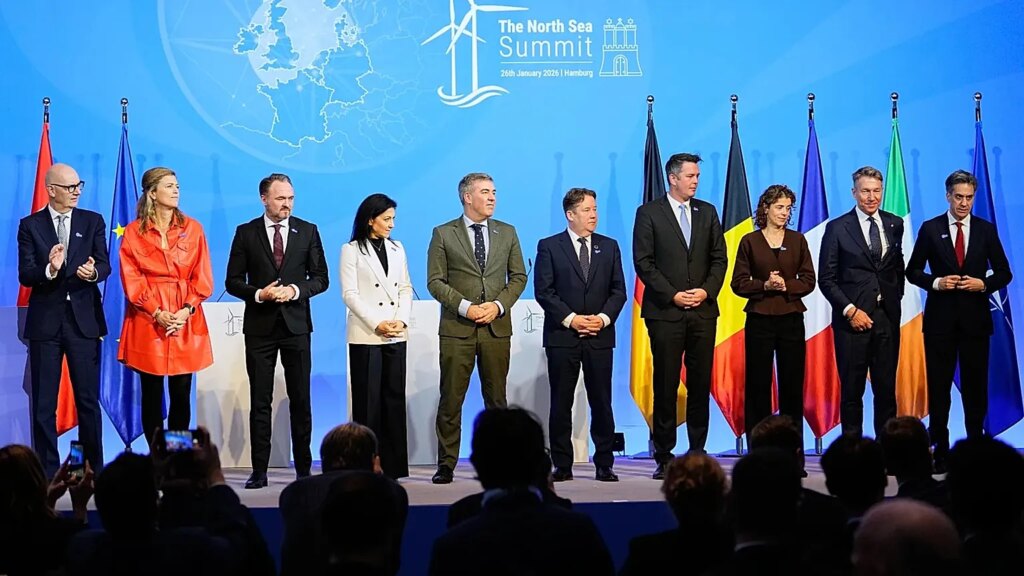
Nine European governments have committed to expanding offshore wind capacity across the North Sea to as much as 100 GW by enabling crucial cross-border initiatives. According to ministers, achieving these objectives will reduce electricity expenses by 30% by the year 2040.
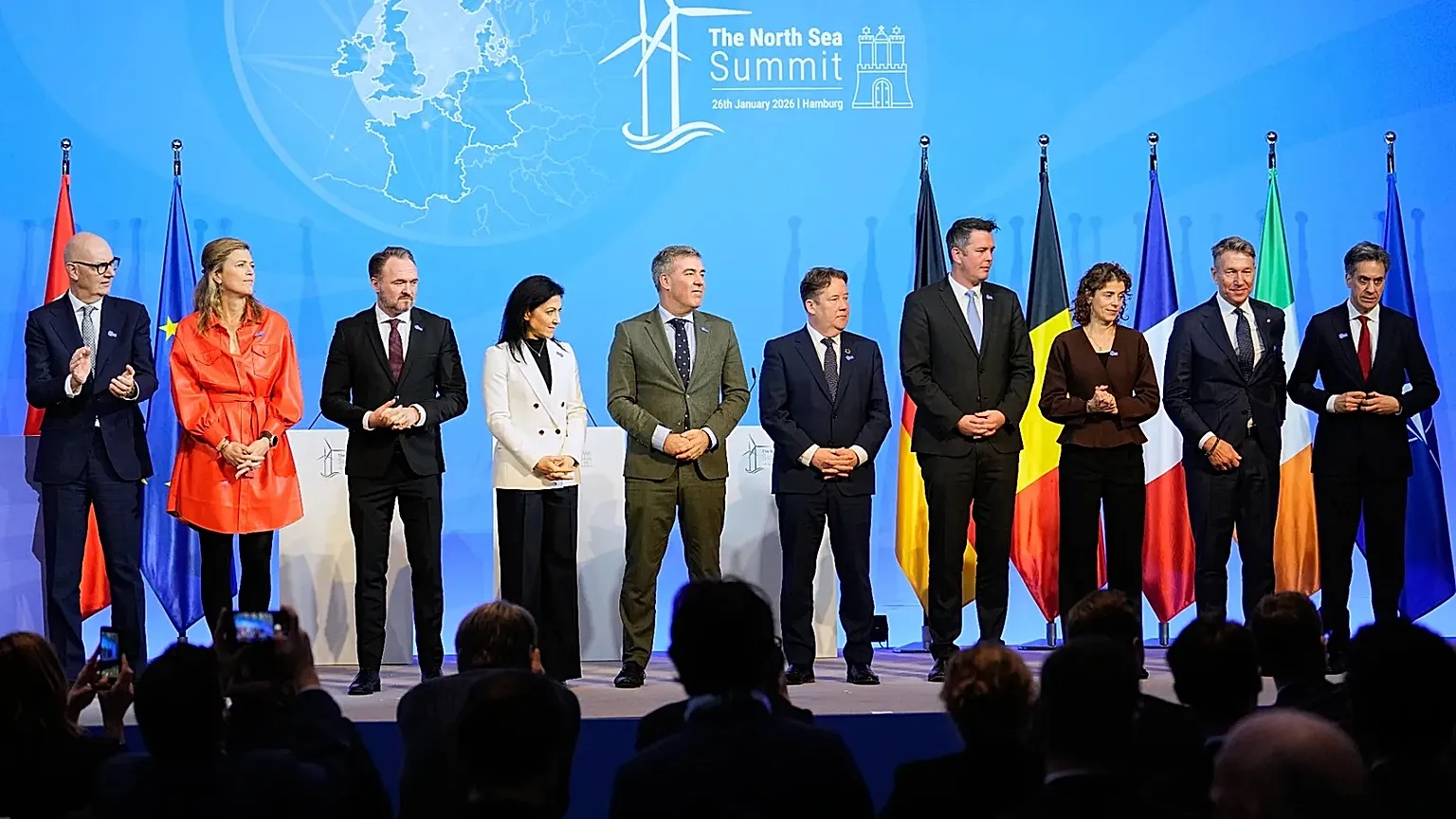
On Monday, multiple EU energy ministers convened in Hamburg, pledging to boost offshore wind capacity in the North Sea to help decrease energy costs.
Representatives from Belgium, Denmark, France, Ireland, Luxembourg, the Netherlands, the United Kingdom, Norway, Iceland, and NATO signed a declaration alongside wind industry leaders aiming to raise offshore wind capacity to 100 GW. This effort aligns with their collective ambition to significantly scale offshore wind by 2050 and reduce energy prices.
This agreement follows shortly after US President Donald Trump criticized Europe’s climate and energy goals, as well as the pace of wind turbine installations.
Ed Miliband, British Secretary of State for Energy Security and Net Zero, dismissed Trump’s criticism, affirming that clean energy represents «the right choice».
He stated, “Our perspective on offshore wind energy is pragmatic rather than sentimental. I believe offshore wind is a winning strategy. Individual countries may pursue their own interests, but it is clear where ours lie.”
Energy Commissioner Dan Jørgensen highlighted that renewables are more cost-effective than fossil fuels and have the potential to lower energy costs for both households and businesses. Nevertheless, the Danish Commissioner noted that the current installation of new wind farms «takes too long» and expressed hope that this would improve if a Commission proposal introduced in December to expedite the permitting process is passed.
Irish Minister for Climate and Energy, Darragh O’Brien, emphasized the importance of having «strong grid and interconnection capacity» to effectively integrate renewables into the EU’s energy mix, a vital aspect of maximizing clean power utilization.
The nine governments have committed to accelerating offshore wind capacity through new commercial ventures and cross-border collaborations, targeting 300 GW by 2050 as agreed by North Sea countries in 2023 in Ostend, a response to concerns over Europe’s reliance on Russian gas following the invasion of Ukraine.
EU ministers indicated that fulfilling these objectives could lead to a 30% reduction in electricity costs by 2040 compared to prices in 2025.
Financing tools
The declaration signed Monday states that the leaders of the participating countries have committed to establishing a financing framework for offshore cross-border wind projects, as the scale of this aim demands «significant private capital investment».
“We have refined our standards in line with the European framework as well as German legislation and are scrutinizing every foreign direct investment,” German Minister for Economic Affairs and Energy Katherina Reiche told reporters.
Governments and industry have agreed to implement specific instruments like two-sided contracts-for-difference and power purchase agreements (PPAs), including cross-border PPAs. These mechanisms are designed to assure investors that their projects will yield returns despite the price fluctuations caused by marginal pricing.
German Chancellor Friedrich Merz underlined that cooperation in the North Sea is “essential” for Europe’s security and autonomy, expressing that all parties share the objective of “transforming the North Sea into the world’s largest clean energy reservoir”.
Offshore wind energy lagging behind
Industry data indicates that the EU27’s wind power capacity currently totals 236 GW, predominantly situated onshore. The North Sea summit could play a crucial role in helping the EU reach 60 GW of offshore wind capacity by 2030, increasing to 300 GW by 2050.
Presently, the EU27 lags behind its targets, with approximately 21 GW expected to be installed by 2025. The European Commission reported the EU’s total installed offshore wind capacity at 19.38 GW in 2023; industry figures for 2025 show an increase to 37 GW, matching Ireland’s long-term 2050 target.
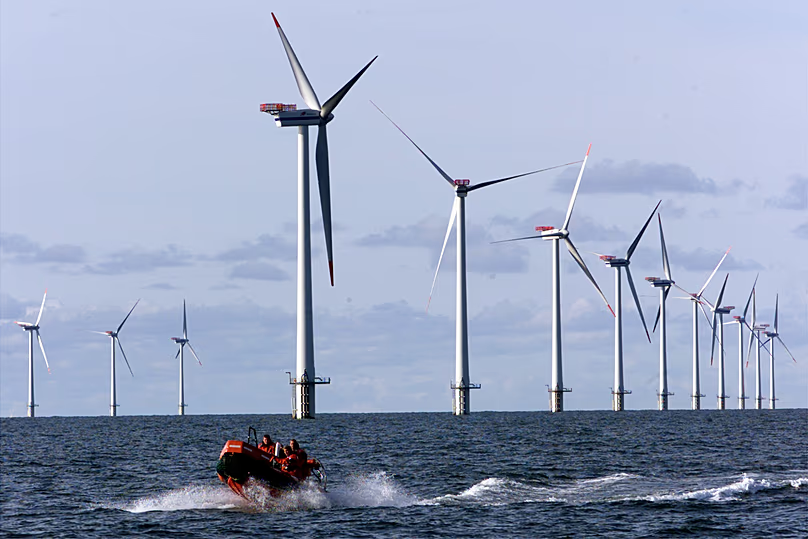
Europe currently relies on more than 6,000 offshore turbines producing clean electricity, but deployment progress has been slowed by suboptimal auction designs, increased capital expenditures, and limited supply chain transparency due to project pipeline uncertainties, according to industry analysts.
WindEurope’s interim CEO Malgosia Bartosik praised Europe’s dedication to intensifying offshore wind efforts.
“Coordinated government action on offshore wind expansion can attract €1 trillion in investments over the next decade,” she remarked. “This is the strongest possible rebuttal to skeptics, reinforcing our commitment to delivering locally-sourced, secure, and affordable energy.”