
A quarter-century after the discussions began, the conclusion of the free trade agreement between Mercosur and the EU approaches, yet tensions between supporters and critics persist strongly.
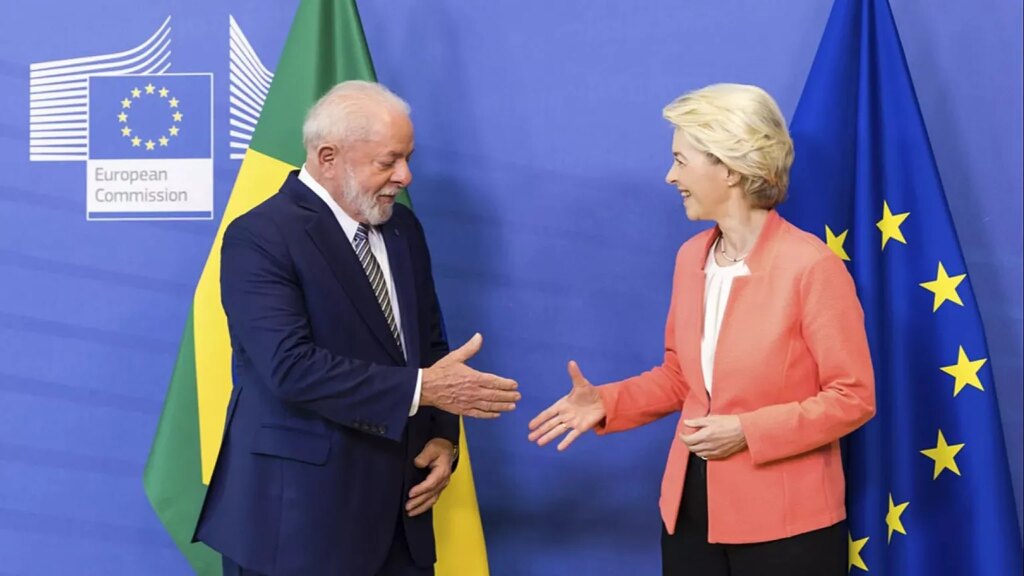
EU Commission President Ursula von der Leyen and European Council President Antonio Costa are scheduled to visit Brazil on December 20 to finalize the controversial pact with the South American Mercosur trade bloc.
The Commission, which has led these negotiations for 25 years, expresses confidence in majority backing from EU member states. However, EU diplomats caution that the balance between proponents and opponents remains extremely close and unpredictable.
The upcoming ten days will prove critical.
The agreement was finalized in December 2024 by Argentina, Brazil, Paraguay, and Uruguay alongside the EU, aiming to establish a transatlantic free trade area.
Nonetheless, the degree of market opening it proposes sparks dissatisfaction among some parties.
Italy takes center stage
France has long spearheaded opposition, asserting that Mercosur imports would impose unfair competition on its agricultural sector.
Paris continues to resist the pact, insisting on robust safeguards to shield the EU market from disruption due to increased Mercosur imports, alongside reciprocity measures to guarantee Mercosur nations adhere to European production standards.
Poland mobilizes its farming community against the deal, joined by Ireland and Hungary in opposition. The Dutch and Austrian governments remain against it, adhering to previous parliamentary stances, while Belgium intends to abstain.
However, this coalition remains insufficient to block the agreement, which requires at least four member states representing 35% of the EU population to do so.
Attention thus turns to Italy, whose Prime Minister Giorgia Meloni—an ally of Argentina’s President Javier Milei—has yet to declare an official stance. Italy ranks as the EU’s second-largest exporter to Mercosur, and access to this market holds significant value for its industries.
In October, Italy’s agriculture minister and fellow party member Francesco Lollobrigida advocated for Italian farmers and pushed for firm safeguards, though the Commission’s market oversight guarantees presented on October 8 may have inclined Rome toward endorsing the pact.
Even member states opposing the treaty have supported the Commission’s proposed safeguard mechanisms, underscoring that if the agreement passes, strong market protection remains essential.
The challenge in Parliament
The European Parliament, whose approval is mandatory for the treaty’s enactment, will vote on December 16 regarding enhanced safeguard measures, including the reciprocity clause. Subsequent discussions with the Council aim to settle on a unified text. An expedited procedure might accelerate negotiations, enabling member states to adopt a definitive position before von der Leyen and Costa’s planned visit.
Still, even with member states’ approval and signing in Latin America, the process won’t conclude. MEPs must ratify the agreement—and recent months have unveiled deep rifts.
The far right and far left factions oppose the deal, with other parliamentary groups divided similarly to the Council’s stance. Consequently, by 2026, the Parliament could halt the entire agreement.
In Brussels, diplomats from pro-agreement countries express growing concern over the fragile talks, warning that failure would cost the EU strategic access to an important market at a time when its ties with its main trading partner, the US, are deteriorating.
They especially worry about the European Parliament dynamics, which this year often diverged from member states’ positions on several key issues, heightening institutional strains.
Privately, these officials caution that if the Mercosur agreement collapses in the final stage, it would starkly expose political shortcomings, undermining Europe’s declared goal to diversify trade partners and reinforce its geopolitical influence.
Meanwhile, patience among Mercosur members is dwindling after decades of effort.
As a senior South American diplomat confided to Euronews: “If the agreement fails, I will dig a hole, bury it, and seal it with concrete.”