
Macron recently asserted that China provides its children with a more educational version of TikTok, whereas the European version is, in his opinion, designed to dull the intellect of young users. The Cube analyzed the content available on both versions of the app.
French President Emmanuel Macron has indicated that China offers European children a simplified, entertainment-focused TikTok, while the domestic variant contains more educational and beneficial content for youth.
Addressing readers of the regional daily La Voix du Nord in northern France on November 19, Macron emphasized the differences between the Chinese and international versions of the app.
«Their TikTok version, being a Chinese company’s product, limits daily usage to a fixed number of hours, and the material presented to children is purely educational,» the president explained.
He further claimed that China has «recognized we are engaged in a cognitive battle,» and stated that its approach is «to export content that dulls young minds while reserving what enhances intelligence for its own population.»
Indeed, a distinct TikTok version exists for the Chinese market
The Chinese app Macron refers to is called Douyin, developed by ByteDance, the Chinese software firm that also owns TikTok.
Fundamentally, Douyin and TikTok share the same logo, design, and digital framework, but their primary distinction lies in their respective target audiences.
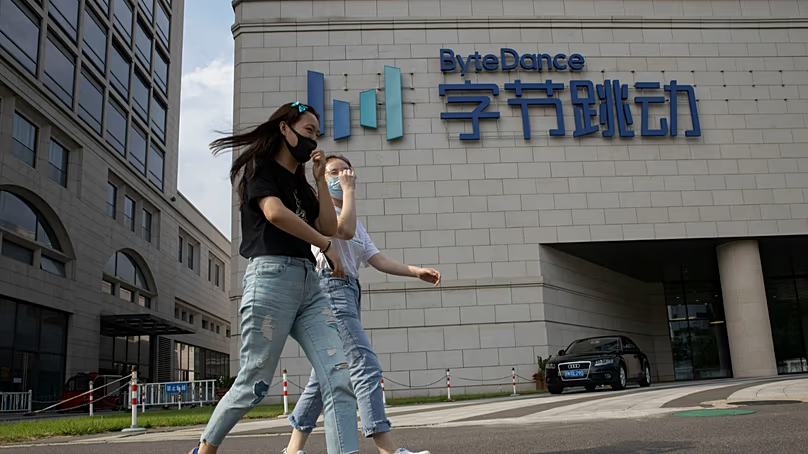
Douyin debuted in 2016 solely for the Chinese market, whereas TikTok launched a year later targeting international users, each providing distinct content suited to their audiences.
China’s strict censorship policies affect all its social media platforms, banning and filtering any content deemed harmful to the government or capable of inciting political unrest.
This is reflected in Douyin’s official policies, which forbid content that «distorts or disparages the nation’s rich cultural heritage or harms national feelings.»
Additionally, the 2021 Law on the Protection of Minors mandates social platforms to implement mechanisms limiting children’s usage.
Consequently, ByteDance has set a daily screen time limit of 40 minutes for users under 14, who are also restricted from accessing the app between 10 p.m. and 6 a.m.
Does Douyin offer ‘more intelligent’ content compared to TikTok?
To assess the accuracy of Macron’s remarks regarding Douyin’s children’s content, The Cube, Euronews’ fact-check team, used a VPN to download Douyin and created a user profile for a 13-year-old.
After browsing briefly, the app appeared to display primarily educational videos, including demonstrations of basic experiments — such as what occurs when an egg is soaked in vinegar — alongside lessons on English, music, and cooking.
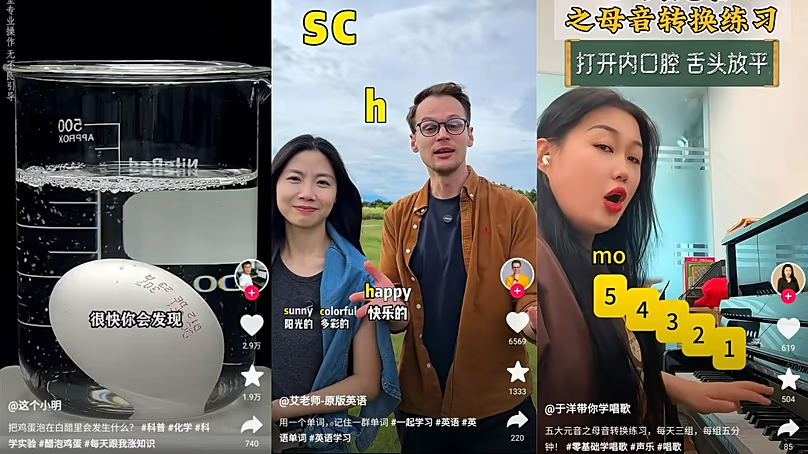
The children’s mode within the app offers advanced parental controls that let guardians select preferred content categories, aiding the algorithm in customizing the feed for users younger than 14 years.
Conversely, The Cube conducted a similar test on TikTok, where the under-14 feed contained mainly entertainment-based content such as trending dances and humorous videos, some possibly described as «brain rot.»
Yet, TikTok’s main «For You» feed does not consist solely of educational videos; several creators — including @aartemisatworks and @serialthinker — focus exclusively on educational content.
TikTok also features a «TikTok for Younger Users» mode, enforcing stronger privacy options, limited screen time, and restrictions on commenting, messaging, and sharing for children under 13.
«Nevertheless, users still engage with TikTok’s core features — creativity and expression — by enjoying curated content and experimenting with its imaginative, unique tools,» the platform states on its website.
Furthermore, since 2024, TikTok offers a «STEM feed,» which concentrates on science, technology, engineering, and mathematics, tailored for teenagers 13 and older.
Comparing adult modes, both Douyin and TikTok display similar content ranging from educational material to lowbrow videos, although Douyin adheres to censorship regulations mandated by President Xi Jinping’s government.
Is TikTok being used as a vehicle for China’s soft power?
The allegation that China leverages TikTok to «dumb down» youth worldwide stems primarily from a 2022 60 Minutes interview featuring Tristan Harris, co-founder of the Centre for Humane Technology.
During the interview, Harris described the 40-minute daily screen-time restriction as «almost an acknowledgment that technology influences children.»
He supported his viewpoint citing a 2019 Harris Poll survey involving nearly 3,000 children from the US, UK, and China, which asked about their career aspirations — in the US, the most common answer was «influencer,» whereas in China, it was «astronaut.»
Following this, several politicians echoed similar concerns, accusing TikTok and suggesting that the Chinese government might access user data or spy on foreign states.
In December 2022, Forbes revealed that some TikTok employees used the app’s geolocation functions to track journalists; the company admitted fault and terminated those employees.
These accusations are linked to China’s 2017 National Intelligence Law, which mandates Chinese companies to comply with intelligence agencies’ requests.
This law applies to Chinese firms operating internationally. Although TikTok’s data servers are located outside China, the law could potentially cover data gathered by the platform.
In response, the European Commission and European Parliament prohibited TikTok’s installation on employees’ work devices in 2023, aiming to safeguard institutional data from possible espionage threats.