
The highest European officials plan to miss the EU-CELAC summit on Sunday, an event clouded by tensions involving the United States and Colombia. Donald Trump is advancing a tough stance on Venezuela, targeting Nicolás Maduro. Europeans reference the lack of attendance to justify withdrawing from the summit.
Donald Trump will not attend the gathering of European, Latin American, and Caribbean leaders scheduled for Sunday at the multilateral summit in Santa Marta, Colombia.
Nonetheless, his foreign policy has already influenced the event’s agenda.
Leading European figures including German Chancellor Friedrich Merz, French President Emmanuel Macron, Italian Prime Minister Giorgia Meloni, and Commission President Ursula von der Leyen have opted out of the EU-CELAC Summit.
They join over two dozen senior officials who have canceled their participation in what was originally promoted as a platform to enhance diplomatic and economic relations between the European Union and Latin America.
In response to Trump’s tariffs disrupting global markets, the EU has launched a worldwide campaign to broaden its commercial partnerships, concentrating on Latin America’s resource-rich countries and revitalizing ties from Mexico to Mercosur.
Yet, the European contingent heading to Colombia this time mainly consists of representatives from countries with historic connections to Latin America, such as Spain and Portugal. Reasons for the numerous no-shows include schedule clashes with COP30 in Brazil, the aftermath of Hurricane Melissa, and the lower ranks of attending delegates.
Initially, the 2025 summit was set to be Colombia’s largest diplomatic event in decades, with over 60 heads of state expected. However, it has since been reduced to a single-day affair with only a limited number of leaders attending in person.
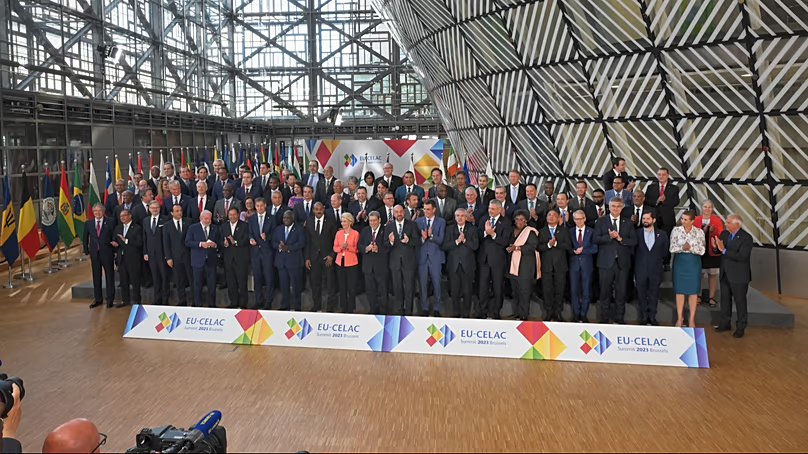
This change marks a sharp contrast to 2023, when the 27 EU heads of state and government joined by the European Council and Commission leaders convened alongside their CELAC counterparts at a widely covered meeting in Brussels.
Aside from logistical challenges, the escalating tensions between US President Donald Trump and Latin American nations have likely been a decisive factor.
The US government has stepped up military operations against Venezuela, targeting vessels it labels as «drug boats» operating in international waters. The White House contends Venezuela is sending a surge of narcotics and dangerous criminals into the US.
Moreover, it has accused Venezuelan President Nicolás Maduro—who faces allegations of usurping power and committing widespread electoral fraud in the 2024 vote—of running a «narco state» and leading a global drug trafficking network. The US has also deployed a state-of-the-art aircraft carrier in the Caribbean Sea, capable of striking targets inside Venezuela.
These developments have sparked speculation about potential US military intervention aimed at removing Maduro if he refuses to relinquish power. In an interview with CBS, Trump expressed doubt that a full-scale war would occur but did not dismiss the possibility of intervention, citing Venezuela’s unfavorable treatment of the US.
Trump has also confronted Colombia and its leftist president, Gustavo Petro, accusing the country of being involved in illegal immigration and drug trafficking into the US; Washington has imposed sanctions on Petro himself.
Von der Leyen’s absence
The most prominent European absentee is Ursula von der Leyen, who had planned to travel to Colombia after attending COP30, where she promoted the EU’s climate agenda and engaged with other leaders.
Her participation has been assigned to High Representative Kaja Kallas, who will now represent the Commission at the summit.
«The explanation is straightforward. Given the limited presence of heads of state at the EU-CELAC summit, the president decided not to attend,» stated Olof Gill, deputy spokesperson for the Commission, on Thursday.
«It is important to emphasize that EU-CELAC relations remain vital amid current geopolitical challenges and divisions. This summit underscores their significance.»
Von der Leyen’s withdrawal has caused surprise in Brussels, considering her usual enthusiasm for global forums. In 2023, she commended CELAC, praised the bilateral format as a space for dialogue, and pledged to attend meetings biennially.
«This EU-CELAC summit represented a fresh start among longtime partners. During this profound geopolitical shift, like-minded allies such as the EU and Latin American and Caribbean countries must strengthen their ties,» she remarked in 2023.
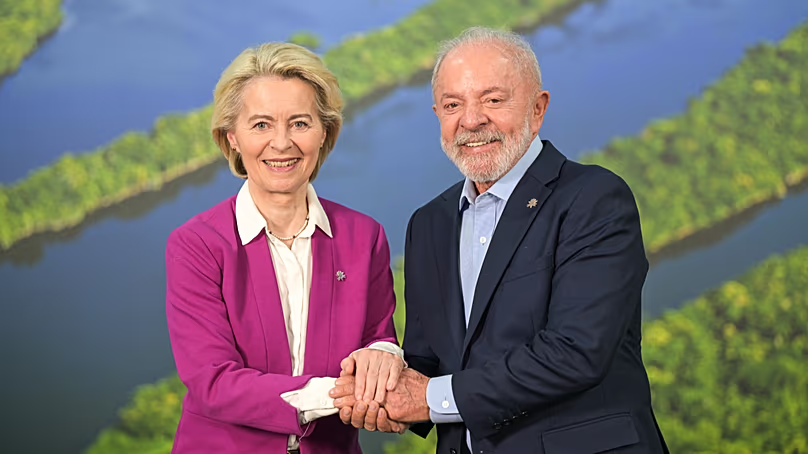
When questioned about whether von der Leyen’s cancellation was meant to avoid upsetting Trump, with whom she maintains a close rapport, her spokesperson declined further comment.
«The president believes she is fulfilling her duties meticulously and faithfully,» Gill told the press.
Von der Leyen’s choice contradicts her publicly stated priorities.
The EU regards Latin America as a crucial strategic partner, essential for diversifying trade relations and strengthening diplomatic influence in an unpredictable world characterized by weaponisation, unilateral acts, and blatant violations of international rules.
As part of this engagement, Brussels launched the Global Gateway, a multibillion-euro program financing infrastructure projects, intensified cooperation to combat climate change, and negotiated agreements to access critical raw materials—resources largely controlled by China, which leverages its market dominance to disrupt global supply chains.
The centerpiece is the EU-Mercosur free trade agreement, 25 years in development and nearing completion. Once ratified, it will cover over 700 million consumers, boosting bilateral trade by €111 billion each year.
«Mensaje equivocado»
These positive plans currently face significant strain due to Trump’s policies, which often pressure US allies to align with his preferences, disadvantaging those he disfavors.
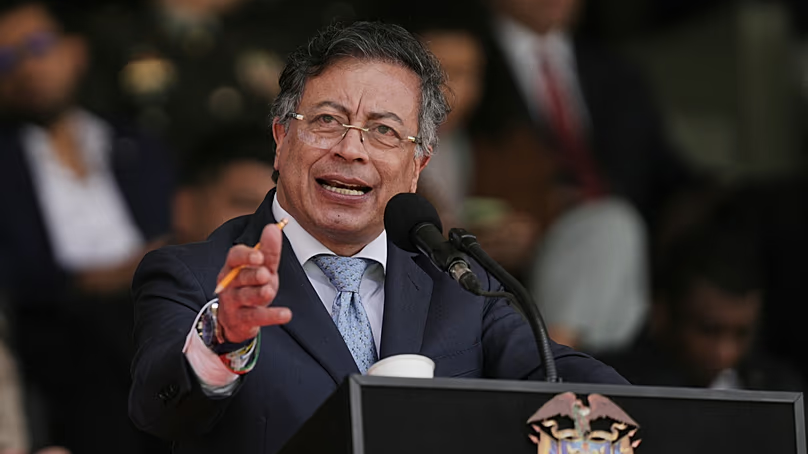
Earlier this week, Colombian President Gustavo Petro accused «external forces» of attempting to sabotage the EU-CELAC summit.
«In this new fossil-fueled and anti-democratic geopolitical era, the objective is to prevent peoples yearning for freedom and democracy from uniting,» Petro declared.
Despite the tense environment, a small group will still attend the summit in Santa Marta.
This group includes Spanish Prime Minister Pedro Sánchez, Portuguese Prime Minister Luís Montenegro, and European Council President António Costa, who all prioritize strong ties with Latin America.
«President Costa remains fully dedicated to the EU–CELAC strategic partnership. During this period of instability and unpredictability, it is crucial for the EU to continue acting as a dependable and consistent partner,» a spokesperson for Costa said in a statement.
European officials will confront challenging questions soon after arriving.
Brazilian President Lula da Silva, a key regional figure, has suggested the EU-CELAC summit «makes sense only if» it addresses the US military escalation, indicating he plans to foreground this contentious issue.
The official agenda avoids mentioning the US explicitly but includes a segment on «peace, security and prosperity,» where unresolved tensions might surface.
To date, the EU’s stance on the US-Venezuela conflict has been cautious, emphasizing the need to combat drug trafficking in accordance with international law. Meanwhile, the UN’s human rights chief has condemned US attacks as “extrajudicial killings.”
«The conspicuous absences of European Commission President Ursula von der Leyen and German Chancellor Friedrich Merz send a clear diplomatic message, largely motivated by the intent to avoid heightening friction with US President Donald Trump,» said Alberto Rizzi, a policy fellow at the European Council on Foreign Relations (ECFR).
«This conveys the wrong signal to CELAC countries: rather than acting as a dependable counterbalance to aggressive US policies, the bloc appears to subordinate its regional partnership to its ties with Washington.»
In addition to high US-EU tensions, CELAC attendance will be diminished. The pan-continental entity struggles with consistency and cohesion, as it includes both established democracies and authoritarian regimes.