
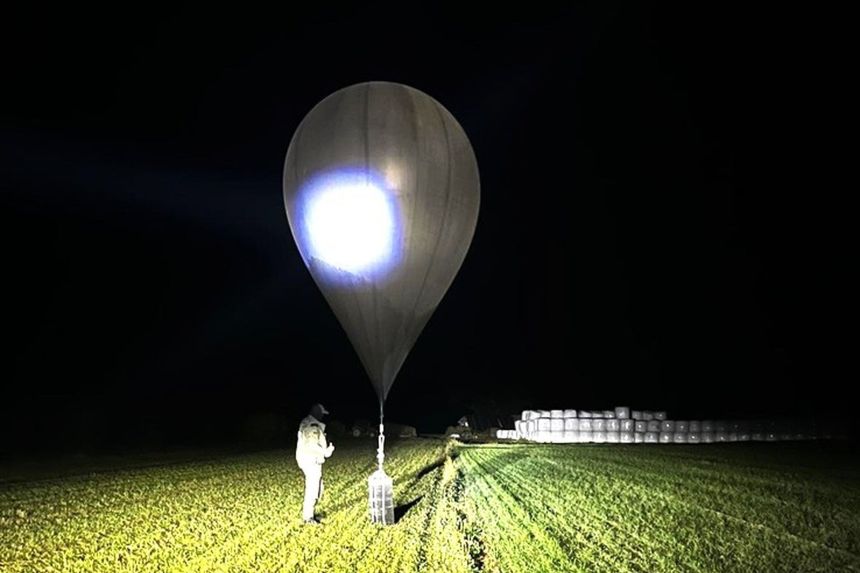
Lithuania has shut its border with Belarus due to “repeated infringements” of its airspace, the nation’s foreign ministry stated on Monday, amid heightened vigilance among European countries regarding aerial breaches.
According to Inga Ruginienė, the Lithuanian prime minister, “dozens of helium balloons” have crossed into Lithuania’s airspace originating from Belarus in recent days.
She remarked on Monday via X that “autocratic regimes are once again probing the resilience of the European Union and NATO against hybrid threats,” urging for a “cohesive, determined response” to these airspace violations.
During a press briefing, Ruginienė confirmed that the Lithuanian military would implement “all necessary actions” to target and bring down these balloons, Reuters reported.
She emphasized, “This is another signal demonstrating our readiness — we are prepared to undertake even the harshest measures if our airspace is breached.”
In reaction to the border closure, the Belarusian foreign ministry declared it has “delivered a protest note to Lithuania” concerning this decision.
The ministry added in a post on X that “this action infringes upon citizens’ rights and the principles of free movement. Belarus advocates for dialogue and effective collaboration.”

Earlier this month, multiple small hot-air balloons entered Lithuanian airspace, with some containing smuggled cigarettes, authorities reported.
Although the exact origin of these balloons was uncertain, Darius Buta, a senior adviser at Lithuania’s National Crisis Management Centre (NCMC), told the Associated Press that Belarusian smugglers are increasingly employing balloons to transport cigarettes into the EU.
Ursula von der Leyen, president of the European Commission, described Monday’s airspace breaches as “a hybrid threat,” labeling them as acts of “destabilization” and “provocation.”
She affirmed Europe’s “full solidarity with Lithuania amid the ongoing incursions by helium smuggling balloons into its airspace.”
Europe remains highly vigilant following numerous recent intrusions by drones and aircraft into NATO skies.
NATO has initiated the “Eastern Sentry” mission to strengthen its presence in Eastern Europe and counteract the threat posed by Russia.
On September 9, Poland intercepted and shot down Russian drones that had violated its airspace.
This operation marked the first exchange of fire by NATO since Russia’s full-scale invasion of Ukraine began in February 2022. The alliance condemned Moscow’s behavior as “extremely perilous.” Russia, however, denies deliberately entering Polish airspace, attributing the drones’ deviation to potential Ukrainian electronic interference.
Days later, Russian drones breached Romanian airspace, prompting Bucharest to deploy fighter jets in response.
Additionally, NATO intercepted three Russian MiG-31 fighters that violated Estonia’s airspace. Moscow denies that its jets entered NATO territory, but the alliance possesses evidence supporting its claim.
European leaders have pledged to intensify pressure on Moscow to compel Russian President Vladimir Putin to engage in negotiations aimed at ending the conflict in Ukraine.