
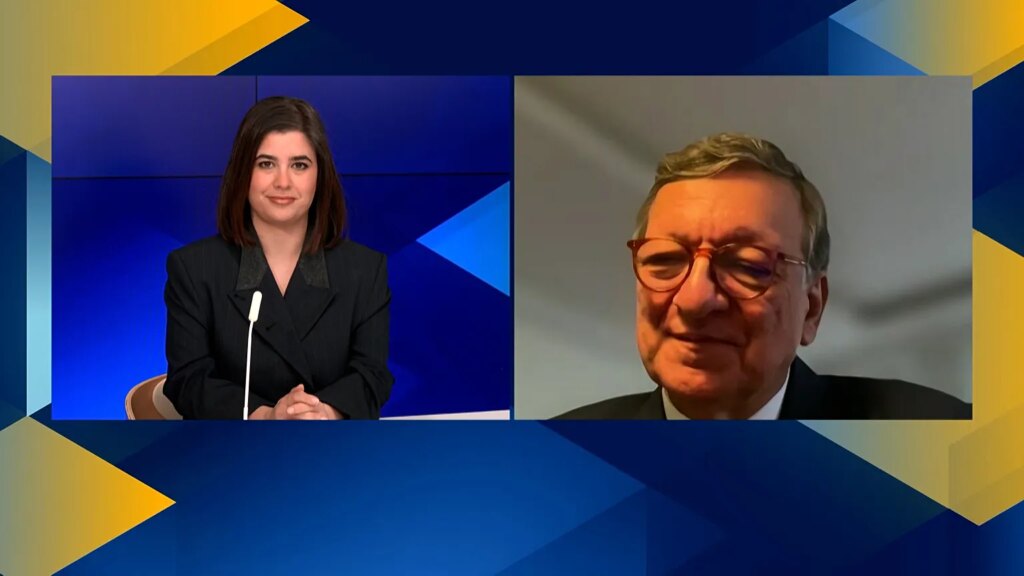
The former Commission President highlights that EU member states can convene without Hungary to discuss delicate issues if trust breaks down. Barroso emphasizes that political measures can be as impactful as legal ones if 26 nations send a clear signal of sovereignty.
José Manuel Barroso, former head of the European Commission, told Europe Today that European Council President António Costa should exclude Hungary from confidential talks if Budapest does not clarify the alleged leaks involving Russia.
 ADVERTISEMENT
  ADVERTISEMENT


Hungary is at the centre of serious accusations claiming that foreign minister Péter Szijjártó briefed Russian foreign minister Sergey Lavrov before and after private EU assemblies. Budapest has defended itself by stating that communicating with «partner» countries about European matters affecting bilateral relations is common practice. The European Commission described these allegations as «deeply worrying».
Russia is the country most sanctioned within the EU due to its invasion of Ukraine and is regarded as a threat to European security; the meetings in question are meant to be confidential.
Barroso described the allegations as «alarming» and stressed that the Council President must address the issue urgently if Budapest does not resolve the concerns.
“Firstly, Hungary should provide explanations. Should these be inadequate, the European Council President has the authority to decide: from now on, meetings will occur without Hungary,” Barroso told Europe Today, emphasizing that member states must adhere to principles of decency.
Barroso, who headed the European Commission between 2004 and 2014, noted that the treaties allow infringement procedures in cases of serious breaches of trust, citing the principle of sincere cooperation under Article 4, which requires all member states to act in good faith and avoid harming the collective interest.
«Legally, the EU can initiate an infringement procedure if Article 4 of the Lisbon Treaty is breached,» he mentioned.
«However, beyond legal steps, it might be more effective politically to demonstrate to a country that disregards fundamental decency that the other member states can proceed without it,» Barroso added.
The former Commission President criticized the Hungarian government’s explanations as insufficient, asserting that claims of dialogue with other countries like the United States, as mentioned by Szijjártó, do not suffice.
«Equating Washington and Moscow is quite unusual and raises significant questions about member states’ loyalty,» he remarked.
European diplomats interviewed by Euronews following the scandal—unveiled over the weekend after the Washington Post reported that Szijjártó maintained regular contact with Lavrov, sometimes even during EU gatherings—described the allegations as shocking but «not entirely unexpected» given the political and commercial relations involved.
The EU’s foreign policy chief Kaja Kallas has called for a thorough investigation, and the European Commission demands further clarification. Polish Prime Minister Donald Tusk labeled the situation a «disgrace». Budapest denies that discussions took place during meetings with Russia.
Europe Today airs Monday through Friday at 8am CET on Euronews and all platforms
With contributions from Aida Sanchez