
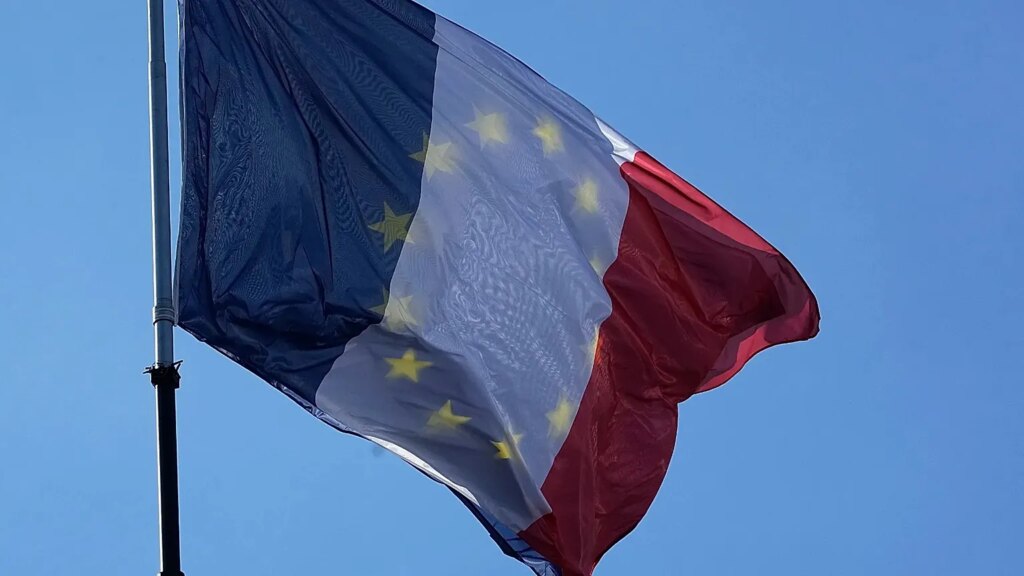
To open new opportunities in markets for EU companies, the European Commission aims to speed up the ratification of trade agreements by distributing only English versions for approval to EU governments and the European Parliament – however, sources informed Euronews that Paris intends to oppose this initiative if implemented.
France intends to resist a European Commission proposal to fast-track the approval process of trade agreements by circulating exclusively English texts during negotiations with EU governments and legislators, bypassing translation into the European Union’s 24 official languages, according to multiple insiders.
 ADVERTISEMENT
  ADVERTISEMENT
The prolonged delays in ratifying the controversial EU–Mercosur trade agreement have frustrated the Commission, which is seeking to accelerate negotiations and implement deals faster amid increasing geopolitical challenges.
Converting the agreements into each official EU language can require several months due to the necessary legal review before ratification can begin.
The EU executive confirmed to Euronews that trade commissioner Maroš Šefčovič informed EU trade ministers in February that the trade deal with India finalized on 27 January might be used as a pilot for employing English as the primary language during the ratification process.
“Since 2021, nearly €300 billion in GDP has been lost due to the absence of the Mercosur agreement, alongside more than €200 billion in export prospects,” Šefčovič stated to reporters after his meeting with ministers on 20 February, emphasizing that after concluding negotiations, up to 2.5 years can elapse before companies gain access to partner markets.
“In the current global context, such delays are unaffordable,” he added.
Šefčovič noted that the Commission plans to provide translations of the agreements into all 24 official EU languages once they are published in the Official Journal, meaning post-ratification. He mentioned that at least seven member states supported the proposal at the session, although not all had an opportunity to express views.
French insiders who talked to Euronews stressed that Paris would strongly oppose any shift to English-only documents if pursued.
“On principle, we uphold the use of all Union languages, especially French, which remains one of the EU’s working languages,” an official told Euronews.
‘Transparency, accuracy, and comprehension’
Language policy within EU institutions remains a delicate issue politically for countries like France, where French has substantially declined over recent decades while English has become dominant in everyday EU institutional work – despite French, German, and English being the three official working languages.
“A full transition to English raises questions legally and democratically, something the Commission is fully conscious of,” an EU diplomat commented to Euronews.
According to its website, the European Commission regards linguistic diversity as crucial and actively supports multilingualism in its institutional operations.
The EU at one time appointed a commissioner specifically for multilingualism, but the role was gradually integrated into other portfolios and eventually discontinued.
«It appears that, in some instances, the Commission leverages the situation to promote English as having a superior status, while viewing other official languages merely as translation languages to follow,» explained Michele Gazzola, a language policy specialist.
He further indicated that relying solely on English during ratification might create difficulties for members of the European Parliament, and even more so if national parliaments become involved.
“This concerns transparency, precision, and comprehension.”