
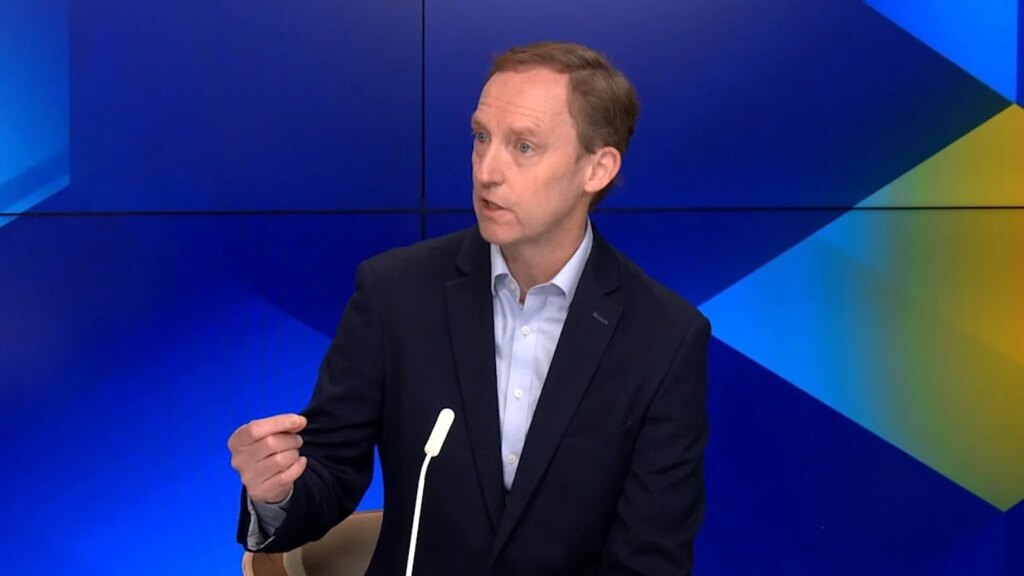
The Irish MEP conveyed to Euronews’ morning show Europe Today that, given the current uncertainty over whether Washington’s newly imposed tariffs fully comply with legal standards, pausing the EU–US trade agreement would be a wiser approach.
According to Irish MEP Barry Andrews (Renew Europe), the EU cannot proceed with implementing its trade deal with the United States until the US provides definitive legal clarity regarding its tariffs, as stated on Euronews’ Europe Today morning show.
 ADVERTISEMENT
  ADVERTISEMENT


“Without legal certainty, proceeding is unfeasible,” Andrews explained, referencing ongoing talks following the US Supreme Court’s ruling that halted President Donald Trump’s tariffs, declaring them unlawful.
In response, Trump invoked an emergency legal clause allowing tariffs up to 15% globally, raising doubts about the legitimacy of the EU-US trade deal, which had been established well before this judicial decision.
The agreement was finalized between the Trump administration and the European Commission last summer, though the European Parliament has effectively put it on hold.
That is why “many other countries, including India, Japan, and Taiwan, are now delaying trade agreements with the US,” Andrews informed Euronews. “It is more sensible for us to wait until clear legal definitions are in place,” he emphasized.
The Renew Europe MEP further highlighted the repercussions that activating the EU–US trade deal would have on consumers and companies, pointing out that they “would bear the expenses.”
Andrews also spoke about Hungary’s recent twin vetoes on both sanctions against Russia and a €90 billion loan package for Ukraine, warning that with Hungarian elections on the horizon, the European Commission should avoid “falling into Orbán’s trap.”
To unlock the loan for Ukraine, the EU “must seek an approach that excludes Hungary,” he stated, adding that Kyiv could “exhaust its funds by April, making this issue absolutely critical for Ukraine’s future.”
Budapest has blocked EU funds earmarked for Ukraine amid a dispute over the Druzhba pipeline, which transports Russian crude oil to Europe. Hungary and Slovakia accuse Ukraine of sabotage by denying the flow of Russian oil, while Kyiv contends that the pipeline remains inoperative due to a Russian drone strike in January, which caused severe technical damage.
Regarding Ukraine’s possibility of joining the EU by 2027, the Irish MEP argued that EU accession is “a major incentive for Ukrainians to sustain their resilience.”
“There is a pathway to membership in the near future. As long as this remains possible, Ukrainians will continue their resistance against Russia,” Andrews concluded.