
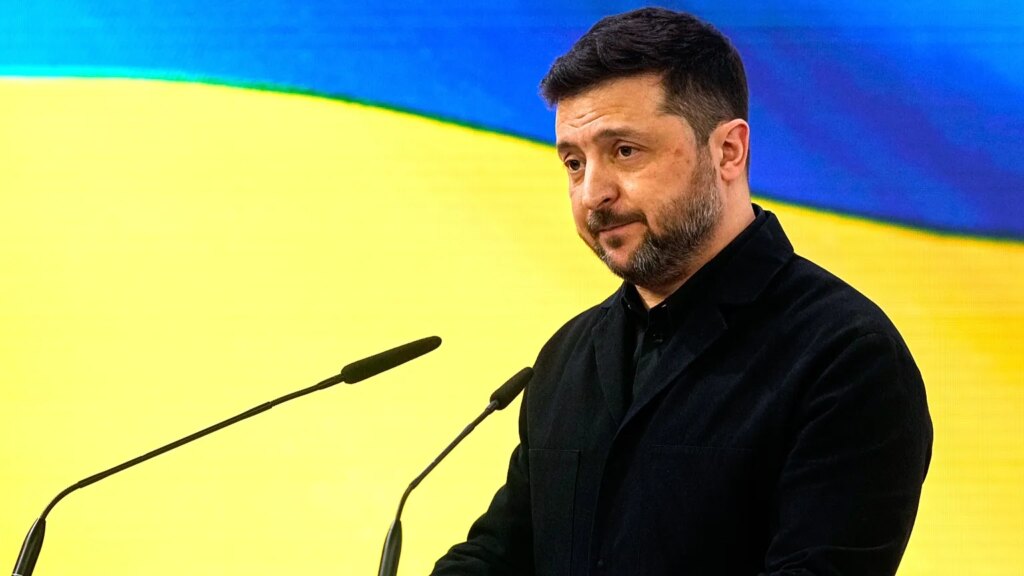
Revise the main events from the second day of the 2026 Munich Security Conference, where figures like Marco Rubio, Volodymyr Zelenskyy, Ursula von der Leyen, Keir Starmer, and numerous other leaders addressed the audience.
On Saturday, Volodymyr Zelenskyy declared at the Munich Security Conference that Ukraine requires a concrete date for its EU accession, aiming to be ready for membership by 2027, in response to a question from Euronews.
 ADVERTISEMENT
  ADVERTISEMENT
“We require a date,” he emphasized during a press briefing. “While accession timing depends on negotiations with partners, I want to stress, without intending any disrespect toward the US and Europe, that a date is essential; otherwise Russia will try to obstruct us—directly or potentially through other nations.”
“By 2027, Ukraine has to be fully prepared technically, including the government, parliament, and institutions.”
Another key moment in Munich was US Secretary of State Marco Rubio’s anticipated address, where he expressed Washington’s intention to “revitalize” its relationship with Europe and encouraged the two blocs to jointly amend what he described as a «broken» status quo.
Nevertheless, he maintained the official US stance that the post-WWII global order infringed on sovereignty and triggered mass migration, which subsequently destabilised Western nations.
Many global leaders also took the stage, such as European Commission President Ursula von der Leyen and Danish Prime Minister Mette Frederiksen. Scroll down for their key statements.
${updatedAt}

 ${title}
${body} ${author} Share
Live ended
14/02/2026 – 19:37 GMT+1
That’s a wrap from our side!
The live coverage from the Munich Security Conference has now concluded, marking an eventful day.
What were the essential takeaways?
- European leaders emphasized their attentiveness to the US’s concerns and expressed efforts to assume more responsibility for the continent’s defense;
- Volodymyr Zelenskyy highlighted the importance of Europe’s participation in peace negotiations and called for intensified economic measures against Russia;
- The United States warned that Western civilization faces threats and urged transatlantic collaboration to protect it.
More detailed reporting from the conference will appear tomorrow, including a comprehensive summary of the most crucial moments, so stay tuned. For those eager to review today’s developments, scroll through the live blog below, and yesterday’s coverage is available here.
Wishing everyone a pleasant evening!
Alice Tidey Share 14/02/2026 – 19:36 GMT+1
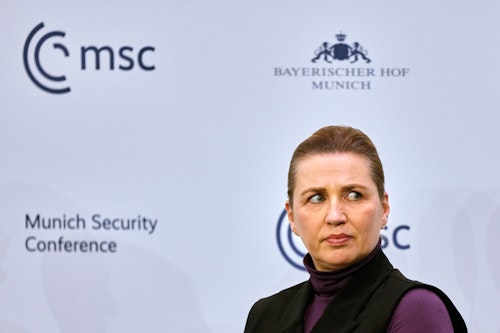
Frederiksen addresses Russia’s ‘Imperial ambitions’
Danish Prime Minister Mette Frederiksen concluded the Q&A by comparing Russia’s ambitions in the Arctic with its war in Ukraine.
“This revolves around Russia’s imperialistic aspirations, which also apply to the Arctic. It is not about the Arctic itself but about Russia’s imperial dreams. The hybrid warfare against Europe, ongoing daily, must be combated alongside the conflicts in Ukraine and the Arctic,” she stated.
“Two crucial lessons emerge: Europeans cannot base their strategies on others’ actions. Was there a European awakening this January? Yes. Now, it is our duty to transform that into a coherent Greenlandic European strategy,” she concluded.
Credit – AP
Tamsin Paternoster Share 14/02/2026 – 19:27 GMT+1
Nielsen: ‘The pressure on us is unacceptable’
Greenland’s Prime Minister addressed former President Trump’s remarks on Greenland with a tone mixing humor and seriousness.
“I no longer consider it the elephant in the room. He’s quite transparent and has been so for fourteen months,” he commented about Trump’s demands regarding Greenland. The US President has repeatedly expressed the need for Greenland for national security and even offered to purchase it.
“When I think of my people, we are extremely proud. We endure a challenging environment and are resilient. We inhabit lands where few dared live over many years. There’s a reason why we’re still here,” he said, eliciting laughter.
“This issue goes beyond Greenland. Imagine a NATO member acquiring, seizing, or threatening an ally. How would the world respond? It’s outrageous.”
Regarding ongoing trilateral talks between Greenland, Denmark, and the US, Jens-Frederik Nielsen said, “We need to proceed wisely, and the first step is establishing dialogue.”
“We won’t bow our heads. The aspiration to control Greenland persists, but we’re on the right course,” he added, acknowledging that the US focuses primarily on security.
He affirmed Greenland’s commitment to security cooperation and alliance participation.
Tamsin Paternoster Share 14/02/2026 – 19:03 GMT+1
Canada initiated Arctic capability acquisitions years ago — Anand
Since the Ukraine conflict began, Russia has redeployed some infrastructure northwards, stated Canada’s Foreign Minister, who called for enhanced cooperation in Arctic defense and diplomacy.
Anita Anand highlighted that 40% of Canada’s territory borders the Arctic and that their government has proactively invested in infrastructure and procurement, including over-the-horizon radars, icebreakers, and NORAD modernization for improved airborne monitoring.
“We must recognize the evolving global threat landscape and the significance of mutual support, capability collaboration, and diplomatic engagement in the Arctic,” she remarked.
Alice Tidey Share 14/02/2026 – 18:58 GMT+1
Greenland’s viewpoint: Nielsen ready to ‘assume greater responsibility’ for island’s security
The “Spotlight on Arctic Security” panel featured Danish Prime Minister Mette Frederiksen, Greenland’s Jens-Frederik Nielsen, and Canadian Foreign Affairs Minister Anita Anand, among others.
Nielsen remarked that Greenland has enjoyed years of tranquility but recognized global tensions have escalated, making peaceful zones scarce.
Greenland is prepared to enhance surveillance and security responsibilities in cooperation with Denmark.
“It matters greatly to affirm that the NATO alliance is a genuine commitment for us Greenlanders,” he stated.
Tamsin Paternoster Share 14/02/2026 – 17:25 GMT+1
Sikorski on Poland’s response if Russia invades
Polish Foreign Minister Radosław Sikorski concluded a panel stating the reaction if Russia invaded Polish territory.
“Should they cross our border and target NATO and Polish citizens, we would anticipate the North Atlantic Council convening and activating contingency plans. The ensuing outcome is straightforward: we would prevail, and they would fail.”
Tamsin Paternoster Share 14/02/2026 – 16:56 GMT+1
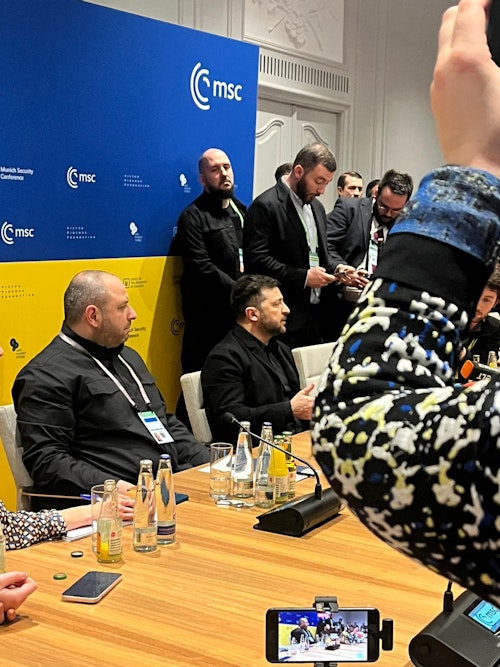
Ukraine ‘needs a date’ for EU accession, eyes 2027 — Zelenskyy
Volodymyr Zelenskyy responded to a Euronews question emphasizing Ukraine’s need for a specific EU accession date, aiming for 2027 membership.
“We need a date,” he specified at a press conference. “Although accession timing hinges on partner discussions, and I mean no disrespect to the US and Europe, we need a date; without it, Russia will attempt to block us directly or via others.”
“Ukraine must be technically ready by 2027, involving government, parliament, and institutions.”
Alice Tidey Share 14/02/2026 – 16:47 GMT+1
Sikorski: Stakes are ‘extremely high’
Polish Foreign Minister Radosław Sikorski reminded the panel about the high stakes involved in Russia’s invasion of Ukraine.
“The stakes extend beyond Ukraine’s future or eastern flank security; they encompass Europe’s role in the future global power distribution. The question: who will form the third pillar of global power — China, the US, Russia, or the European Union? Don’t ask me my preference.”
“President Donald Trump is not wrong amid this harsh world to urge showing cards. The US might increase pressure on Putin by delivering Tomahawks to Ukraine—this decision was reportedly near a few months ago,” he added.
Tamsin Paternoster Share 14/02/2026 – 16:41 GMT+1
Europe deserves a seat at the table for funding Ukraine’s defense: Polish FM
Polish Foreign Minister Radosław Sikorski said Europe merits a place at negotiation talks since, unlike the US, it finances much of Ukraine’s defense.
“US spending on the war last year was nearly zero,” Sikorski stated during the “Holding the Line: Defending Europe and Supporting Ukraine” panel.
“We procure American arms for Ukraine, yet no US congressional package exists nor prospects for one. If Europe bears financial and security burdens—not only for Ukraine—then it deserves a seat because the war’s results impact us.”
Lithuanian President Gitanas Nausėda also advocated for Europe’s participation but stated Russia blocks it, and Washington permits this.
“Europe cannot force its way to the table if Putin refuses dialogue and Washington allows that. The next best action is persistent support for Ukraine,” he added.
Alice Tidey Share 14/02/2026 – 16:33 GMT+1
‘Entire districts’ lack water, heating, electricity — Ukrainian Deputy PM
Ukraine’s Deputy Prime Minister for European and Euro-Atlantic Integration, Taras Kachka, opened the “Holding the Line: Defending Europe and Supporting Ukraine” panel highlighting Ukraine’s severe energy shortage due to the war.
“We will restore energy infrastructure until reserves for equipment run out,” he said, adding, “Russia aims to disable the system beyond repair.”
He noted many regions face harsh winter without heating, electricity, or water.
“In Kyiv, to enjoy hot tea, electricity arrives only at 3 am,” he explained, but elsewhere, “whole districts have nothing.”
Kachka urged partners to supply missiles compatible with Ukraine’s air defense systems—Patriot, SAMP-T, IRIS-T—stressing adequate stocks would increase interception of Russian attacks on energy infrastructure.
Alice Tidey Share 14/02/2026 – 16:30 GMT+1
Pistorius: ‘The ball is in Putin’s court’; NATO evolving positively
Germany’s Defence Minister Boris Pistorius remarked that the initiative lies with Putin regarding Russia’s invasion of Ukraine.
He stated NATO is becoming “more European to retain its transatlantic nature.” US financial support, he noted, was intended as an exception, not the rule.
Pistorius criticized past European inaction, referencing sluggish defense development and mutual criticism.
“Today, reality differs greatly. Combined European armies surpass all others in size; defense spending is unprecedented; industries produce advanced equipment; and we ensure joint capability development and funding,” he said.
He stressed the need for more effective, coordinated, and visible defense policies in Germany and Europe.
Discussions related to Greenland illustrate “our capability,” he concluded.
Tamsin Paternoster Share 14/02/2026 – 16:05 GMT+1
Starmer aims for ‘lofty goals’ in future EU-UK partnership
Earlier in Munich, Keir Starmer and Ursula von der Leyen met on the conference sidelines.
During their bilateral, the UK Prime Minister conveyed “ambitious goals for the future UK-EU collaboration,” according to a Downing Street summary.
“He expressed his wish to deepen integration across the economy, defense, and technology sectors,” with both pledging “to advance further work before the next UK-EU summit.”
They also agreed to intensify ongoing talks on an agreement covering food and drink pricing, an emissions trading system to reduce bills, and a youth mobility scheme offering work and travel chances.
On X, the European Commission President said “collaborating naturally protects shared interests.”
“Last year’s summit was productive—let’s maintain momentum for the next one,” she added.
Good meeting with @Keir_Starmer in Munich.
Europe and the UK share similar challenges – from intense geoconomic rivalries to threats to our security.
it is natural that we work closer to protect our people and common interests.
We had a successful summit last year – let's keep… pic.twitter.com/McQgGrPQXr
— Ursula von der Leyen (@vonderleyen) February 14, 2026
Alice Tidey Share 14/02/2026 – 15:46 GMT+1
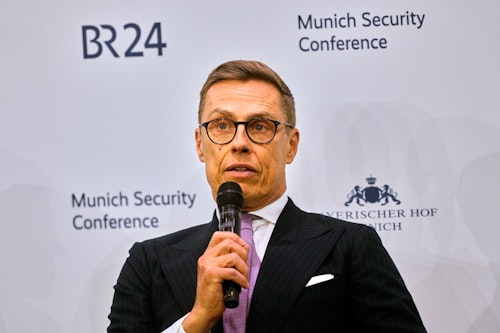
Stubb: NATO presence in the Arctic is a ‘silver lining’
Finland’s President Alexander Stubb described a strengthened NATO presence and enhanced Arctic security as a “silver lining” following Russia’s moves in the region.
“Currently, the primary security collaboration in the Arctic involves Finland, Sweden, and Norway, with a strong focus on cooperation. For instance, next week, a NATO Arctic training exercise featuring 25,000 troops—including 5,000 from the US—will occur in northern Norway and Finland,” he detailed.
“This exercise is more than a show of force; it’s preparation for multiple contingencies. Regarding risk, I do not believe Russia will challenge Article 5 commitments, which underlines the purpose of deterrence. Finland maintains one of NATO’s largest militaries on the eastern flank, alongside Turkey, Poland, and Ukraine.”
Credit- AP
Tamsin Paternoster Share 14/02/2026 – 15:40 GMT+1
G7 foreign ministers reaffirm Ukraine support during MSC
Foreign ministers from the G7 nations—Canada, France, Germany, Italy, Japan, the UK, the US—and EU foreign affairs chief Kaja Kallas convened at the Munich Security Conference.
They reiterated their “steadfast support” for Ukraine, especially as the fourth anniversary of Russia’s invasion approaches.
“Special attention was given to ongoing support for Ukraine’s energy sector, which endures direct Russian attacks,” their statement noted.
They also addressed other international crises including Gaza, Iran, Venezuela, the Indo-Pacific, Sudan, and Haiti.
Alice Tidey Share 14/02/2026 – 15:24 GMT+1
Trump’s desire for Greenland unchanged — Frederiksen
Danish Prime Minister Mette Frederiksen informed the Munich Security Conference that Donald Trump maintains his interest in taking over Greenland.
“The US President’s ambitions remain exactly the same,” she said. “Our kingdom—and Europe—disagree.”
Trump first proposed forcibly acquiring Greenland last month, raising concerns about NATO member conflicts that could destabilize the 77-year-old alliance. Subsequently, a “framework for Greenland’s future” was agreed upon between Trump and NATO chief Mark Rutte at Davos.
Trilateral discussions among Denmark, Greenland, and the US continue.
Frederiksen acknowledged that collective efforts are required to enhance security in the High North.
Alice Tidey Share 14/02/2026 – 15:17 GMT+1
Sánchez opposes nuclear rearmament
Returning to the conference, Spanish Prime Minister Pedro Sánchez voiced opposition to nuclear rebuilding.
Recall, both French President Emmanuel Macron and UK Prime Minister Keir Starmer hinted at initiating talks on common European nuclear deterrence.
“Seventy years ago, our predecessors concluded nuclear deterrence was too costly and risky to prevent conflicts. Too costly due to massive government spending, and too dangerous given near-misses from technical or human errors risking nuclear war between the West and the former Soviet Union,” Sánchez explained.
“Over decades, they realized risks outweighed peace benefits. A system demanding zero mistakes and constant interventions to avoid destruction is no guarantee—it’s a gamble.”
Tamsin Paternoster Share 14/02/2026 – 14:59 GMT+1
Navalny killed with epibatidine, five European countries declare
Five European nations reported that Russian opposition figure Alexei Navalny was poisoned by the Kremlin using a deadly toxin derived from poison dart frogs, according to UK, France, Germany, Sweden, and the Netherlands’ foreign ministries.
Analysis of Navalny’s samples, who died two years ago, “confirmed the presence of epibatidine,” a toxin native to South American poison dart frogs, absent in Russia.
The joint statement charged Russia with having the capacity, motive, and opportunity to administer the poison, and reported the case to the Organization for the Prohibition of Chemical Weapons for violating the Chemical Weapons Convention.
French Foreign Minister Jean-Noel Barrot wrote on X, “We now know Vladimir Putin is willing to use chemical weapons against his own people to cling to power. France honors this opposition figure, killed defending a free and democratic Russia.”
Navalny, a harsh Putin critic, died in February 2024 serving a 19-year sentence in a politically charged Arctic penal colony.
Il y a deux ans, Alexeï Navalny décédait des suites d’un empoisonnement lié à un des agents neurotoxiques les plus mortels. Nous savons désormais que Vladimir Poutine est prêt à utiliser l’arme chimique contre son propre peuple pour se maintenir au pouvoir. La France rend hommage…
— Jean-Noël Barrot (@jnbarrot) February 14, 2026
Alice Tidey Share 14/02/2026 – 14:48 GMT+1
On the sidelines: Ukraine House lunch includes leaders and disqualified Olympian
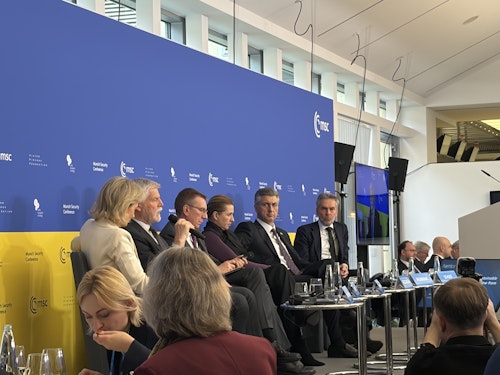
During the Munich Security Conference, the Victor Pinchuk Foundation hosted a Ukrainian lunch at Ukraine House featuring a panel of European leaders, including Danish Prime Minister Mette Frederiksen and Czech President Petr Pavel.
Disqualified Ukrainian skeleton pilot Vladyslav Heraskevych attended, holding the helmet that led to his ban from the 2026 Winter Olympics in Milan. He received a standing ovation.
“For peace in Ukraine and Europe, unity is essential,” a Ukrainian soldier declared to panelists and attendees.
EU Enlargement Commissioner Marta Kos responded to a question about Ukraine’s potential EU membership by 2027, noting current methodologies make it “not possible,” but added “we cannot delay and discussions are underway.”
Johanna Urbancik Share 14/02/2026 – 14:40 GMT+1
Putin ‘must face accountability,’ says Navalnaya
Yulia Navalnaya, widow of Alexei Navalny, posted a statement on social media concerning the recent findings from five European countries about her husband’s death.
“I believed from day one that my husband was poisoned. Now there’s proof: Putin killed Alexei using chemical weapons. I am grateful to the European nations for their thorough work over two years to uncover the truth. Vladimir Putin is a murderer. He must be held responsible for his crimes.”
The poison, epibatidine, “is found on the skin of Ecuadorian dart frogs and causes paralysis, respiratory failure, and a painful death,” she explained.
Scientists from five European countries have established: my husband, Alexei Navalny, was poisoned with epibatidine — a neurotoxin, one of the deadliest poisons on earth. In nature, this poison can be found on the skin of the Ecuadorian dart frog. It causes paralysis, respiratory… pic.twitter.com/doHGgSgzMA
— Yulia Navalnaya (@yulia_navalnaya) February 14, 2026
Tamsin Paternoster Share 14/02/2026 – 15:02 GMT+1
Expectations for Zelenskyy’s day ahead
Though his keynote is over, Volodymyr Zelenskyy has a packed schedule remaining.
He will host a press briefing at 16:20 CET and will receive the Ewald von Kleist Prize at 19:40 CET on behalf of the Ukrainian people.
The prize honors their “courage, sacrifices, and steadfast defense of Ukrainian and European freedom, and remembers those who lost or were injured,” the announcement stated.
Additional engagements include meetings with NATO Secretary General Mark Rutte, US Secretary of State Marco Rubio, Azerbaijani President Ilham Aliyev, a US bipartisan Senate delegation, and investment firms.
Tamsin Paternoster Share 14/02/2026 – 14:24 GMT+1
Five European countries confirm Navalny poisoned; Kremlin blamed
The UK, France, Germany, Sweden, and Netherlands foreign ministries declared that tests on samples from Russian opposition leader Alexei Navalny—who died two years ago—“conclusively confirmed epibatidine,” a toxin found solely in South American poison dart frogs.
The countries stated only the Russian government had the means, motive, and disregard for international law to execute the poisoning.
Navalny was a prominent Kremlin critic fighting corruption and died in a Russian Arctic penal colony in February 2024. His wife Yulia reported last year that independent labs identified poisoning before his death. Russian officials deny involvement.
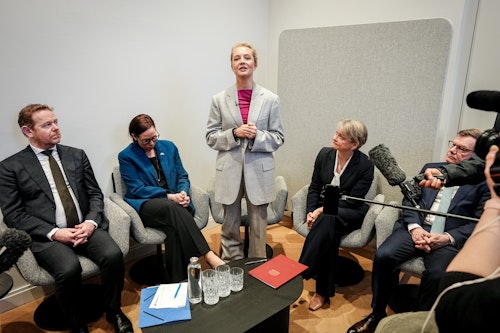
Yulia Navalnaya, activist and spouse of Russian opposition leader Alexei Navalny, speaks at a press conference on her husband’s death during Munich Security Conference, Germany, February 14, 2026.
Tamsin Paternoster Share 14/02/2026 – 13:35 GMT+1
Zelenskyy: ‘Saying thank you won’t save lives’
Zelenskyy was asked about his outlook for the year and stressed his immediate focus is “tomorrow.”
“Gratitude alone does not save lives,” he remarked, adding Ukraine requires strong security guarantees to remain safe should the conflict conclude.
He also addressed EU accession, arguing for a definite deadline to compel the executive to revise merit-based enlargement rules. Zelenskyy pledged to persist in advocating for Kyiv’s EU membership.
Tamsin Paternoster Share 14/02/2026 – 13:19 GMT+1
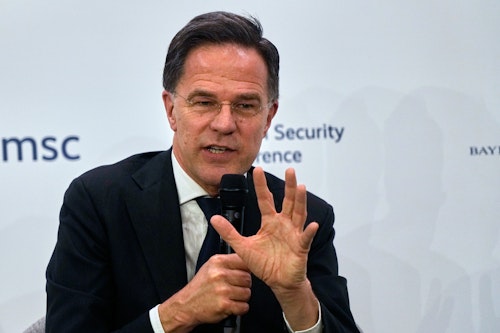
Rutte reinforces stance
NATO Secretary General Mark Rutte firmly rejected claims of “historical reasons” justifying Russia’s invasion of Ukraine.
“No justification existed in 2014 with Crimea, nor for the full-scale assault starting in February 2022. That’s categorically false. Security guarantees demand NATO unity.”
He highlighted recent shifts within NATO where Europeans are increasingly leading defense efforts and accepting greater responsibility.
Rutte defended US President Donald Trump’s role in peace talks, calling a January 6 Paris meeting “successful.”
“Only the US President could break the impasse with Putin, due to America’s unmatched military and economic power; he did so in February,” Rutte remarked.
Credit- AP
Tamsin Paternoster Share 14/02/2026 – 13:00 GMT+1
Two-month ceasefire requested to hold elections — Zelenskyy
The Ukrainian president stated that elections can proceed provided a two-month ceasefire is observed.
“Conducting elections amid bombardment is too challenging—we lack experience,” Zelenskyy said.
“If a ceasefire is granted, President Trump can facilitate it. Our parliament can amend legislation so elections proceed per US and Russian requirements,” he explained.
He also remarked sarcastically he’d welcome a ceasefire in Russia for free elections there.
Alice Tidey Share 14/02/2026 – 12:43 GMT+1
Europe’s absence from talks is ‘a grave error’ — Zelenskyy
Zelenskyy criticized Europe’s exclusion from peace negotiations as “a serious mistake.”
“Ukrainians strive to fully integrate Europe into the process to ensure its interests and voice. Peace depends on clear security guarantees, with Europe expected to bear most responsibility.”
Ukraine will join forthcoming US-Russia peace talks next week, hoping for “serious” and “constructive” discussions, noting parties often “talk past each other.”
“Americans focus on concessions, often only in Ukraine’s context,” he said.
“Ukraine commits to successful negotiations, having invested substantially, and remains in regular contact with the US team.”
“Our goal is real security and enduring peace.”
Alice Tidey Share 14/02/2026 – 12:33 GMT+1
Zelenskyy criticizes Hungary’s Viktor Orbán
Zelenskyy praised Ukraine and its people for halting Russian aggression and safeguarding Poland, Moldova, and Romania’s freedom.
He openly criticized Hungarian leader Viktor Orbán, who has frequently obstructed and opposed EU support for Ukraine.
“Even one like Viktor thinks about growing his wealth, not his military to stop Russian tanks from roaming Budapest’s streets,” he remarked.
Tamsin Paternoster Share 14/02/2026 – 12:27 GMT+1
Zelenskyy urges EU to intensify efforts against Russia’s shadow fleet
The Ukrainian president thanked the EU for a €90 billion loan supporting Ukraine’s military and finances for two years.
He described it as a “substantial assurance of financial stability” but demanded stronger actions to cut Kremlin revenues.
“We can’t ignore the issue,” Zelenskyy said, citing Russia’s allies like North Korea and companies enabling sanction evasion in China.
With oil money still flowing, Putin maintains war funding, he stated, blaming Moscow’s oil tanker shadow fleet.
He discussed legislative updates with European leaders, including Macron and von der Leyen, to allow tankers to be detained, blocked, or confiscated.
“Without oil money, Putin cannot finance this war,” he concluded.
Alice Tidey Share 14/02/2026 – 12:19 GMT+1
Zelenskyy shifted focus to Iran.
Although Ukraine doesn’t border Iran or contest its regime, Iran continues selling drones to Russia.
“With time, they only cause more deaths. They must be stopped immediately.”
Tamsin Paternoster Share 14/02/2026 – 12:16 GMT+1
Shahed drones now operate at various altitudes, serve as ‘mother drones’ — Zelenskyy
Zelenskyy reviewed January’s attacks, saying Ukraine faced “6,000 attack drones, mostly Shahed drones,” alongside over 150 Russian missiles and glide bombs.
He noted the Shahed drone, designed in Iran, has advanced greatly since the conflict’s outset when it was easily neutralized.
Now equipped with jet engines, Shaheds can fly at different altitudes, are guided in real time via operators—using Elon Musk’s Starlink—and can carry other drones, acting as ‘mother drones’.
“The longer the war endures, the more resources the aggressor acquires,” Zelenskyy stated.
Alice Tidey Share 14/02/2026 – 12:08 GMT+1
Zelenskyy expressed gratitude to European leaders for providing air defense systems that “save lives.”
He mentioned the NATO Prioritised Ukraine Requirements List (PURL) initiative, which ensures delivery of interceptors to block Russian missile strikes.
Tamsin Paternoster Share 14/02/2026 – 12:05 GMT+1
Zelenskyy has arrived and is “setting the scene” before a discussion with NATO Secretary General Mark Rutte and European Parliament President Roberta Metsola.
He started by expressing thanks, singling out Rutte for his support for Ukraine.
Tamsin Paternoster Share 14/02/2026 – 11:48 GMT+1
Volodymyr Zelenskyy preparing to speak
Ukraine’s President Volodymyr Zelenskyy is about to deliver a speech. Stay with us for the key points.
Tamsin Paternoster Share 14/02/2026 – 11:17 GMT+1
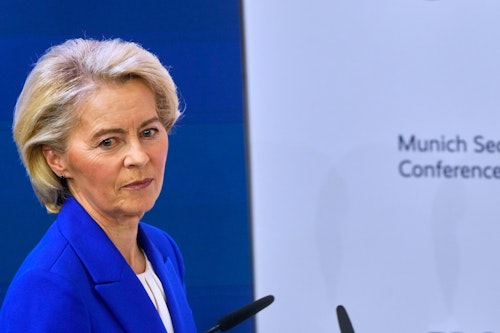
VDL confronts Rutte over ‘Dream on’ remark
Von der Leyen pressed two fronts during her address.
She criticized NATO Secretary General Mark Rutte, who told the European Parliament Europe “can dream on” if expecting to defend without US assistance.
“I want to tell my dear friend that it isn’t only status quo or division; there’s plenty in between,” she said, adding such developments benefit both Europe and the US.
“There is a broad middle ground; an independent Europe means building our strength instead of relying on others.”
On another topic, she targeted the US.
“Let me be clear: our digital sovereignty is absolute,” she said, “and the EU will stand firm on it.”
Credit- AP
Alice Tidey Share 14/02/2026 – 11:17 GMT+1
‘Very reassured’ by Rubio’s speech — von der Leyen
Asked about US Secretary of State Marco Rubio’s speech, European Commission President Ursula von der Leyen said she was “greatly reassured.”
She called Rubio “a good friend and strong ally,” noting “some in the US administration take a tougher stance, but the Secretary of State made it clear: we want a strong Europe within the alliance, and that is our focus in the EU.”
Alice Tidey Share 14/02/2026 – 11:41 GMT+1
Starmer highlights ‘urgency’ in renewing EU-UK relations
Starmer emphasized the urgent need to refresh the UK-EU relationship a decade after the referendum, especially in light of the Ukraine war.
“This is urgent because until the Ukraine conflict, we hadn’t fully grasped the defense and security realities we face,” he explained.
Tamsin Paternoster Share 14/02/2026 – 10:53 GMT+1
Starmer opens path for selective alignment with EU single market
Starmer suggested that the UK should collaborate more closely with the EU, exploring partial single market integration in chosen sectors.
The UK seeks deeper cooperation in defense technology and AI to improve coherence and coordination across Europe, specifically naming Germany, France, Italy, Poland, Norway, Canada, and Turkey.
He also referenced Macron’s recent comments about a shared European nuclear deterrent.
“For decades, the UK has been Europe’s sole nuclear power committed to defending all NATO members.
“Any adversary must be aware that combined in crisis, their strength would confront ours.”
Tamsin Paternoster Share 14/02/2026 – 10:38 GMT+1
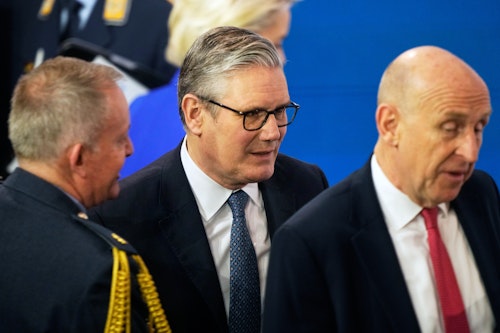
‘No longer the Brexit-era Britain,’ says Starmer
British Prime Minister Keir Starmer delivered a message underscoring unity between the UK and Europe, declaring the “Brexit years” over and highlighting cooperation to maintain security.
“In a dangerous world, turning inward cedes control; I won’t allow that.”
Since taking office, Starmer has sought rapprochement with Brussels, accelerating talks around deeper trade, customs, and defense collaboration on the referendum’s 10-year anniversary.
Credit- AP
Tamsin Paternoster Share 14/02/2026 – 10:34 GMT+1
EU must adopt qualified majority and third-country partnerships for defense — VDL
European Commission President Ursula von der Leyen emphasized that for the EU to effectively defend itself, decision-making speed must improve.
“This may require using qualified majority voting instead of unanimity. No treaty changes are needed; we have the mechanisms already,” she explained.
She urged the EU to be innovative, especially by strengthening partnerships, mentioning the UK-led Joint Expeditionary Force and Coalition of the Willing for Ukraine.
“We must formalize early-stage security collaborations, beginning with key partners like the UK, Norway, Iceland, and Canada,” she said.
“In today’s volatile environment, Europe and particularly the UK should unite across security, economy, and democracy defense.”
Alice Tidey Share 14/02/2026 – 10:22 GMT+1
Europe’s mutual defense clause must be activated — VDL
Von der Leyen highlighted that Europe’s defense spending has surged nearly 80% since before the Ukraine war.
“By 2028, European defense investment is projected to surpass last year’s US defense expenditure, marking a European awakening,” she added.
However, spending alone is insufficient. She urged challenging all taboos.
“It’s time to activate Europe’s mutual defense clause. Mutual defense, enshrined in Article 42(7) of our treaty, is mandatory—it commits us to stand united against aggression. In simple terms: one for all and all for one.”
“This commitment only carries meaning if based on trust and capability,” she said.
Alice Tidey Share 14/02/2026 – 10:18 GMT+1
‘Europe must gain greater independence’ — Ursula von der Leyen
European Commission President Ursula von der Leyen opened her speech stressing, “Europe must grow more independent—there’s no alternative.”
“Our way of life—rooted in democracy and citizen trust—is challenged in new ways, spanning territories, tariffs, and tech regulations,” she noted, subtly alluding to the US and referencing Russia’s ongoing Ukraine aggression.
Independence must be comprehensive across defense, energy, economy, trade, raw materials, and digital technology,” she said.
“Some argue independence contradicts our transatlantic bond. On the contrary, a resilient Europe strengthens transatlantic ties,” she affirmed.
Alice Tidey Share 14/02/2026 – 9:41 GMT+1
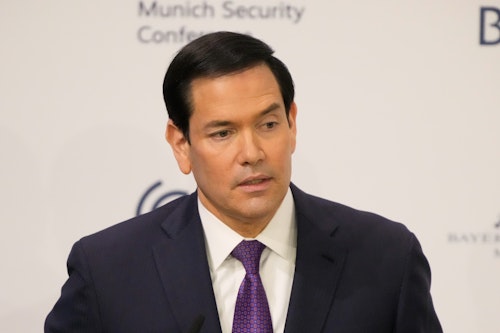
Rubio on Ukraine
During a Q&A, Marco Rubio responded to a question about Ukraine.
The Secretary of State did not attend yesterday’s informal meeting on Ukraine hosted by multiple European leaders.
Rubio stated that while disputes between Russia and Ukraine have narrowed, “the most difficult questions remain.” He rejected claims that Moscow is uninterested in talks.
The US and Europe should continue pressuring Russia into negotiations, Rubio stressed, asserting that progress has been made.
Credit- AP
Tamsin Paternoster Share 14/02/2026 – 9:41 GMT+1
US aims to ‘fix’ broken system, Rubio says
Rubio reassured European allies that the US intends not to “separate” but to “revitalize” longstanding bonds.
“Despite headlines proclaiming the transatlantic era’s end, this is neither our goal nor desire. For Americans, our homeland is in the western hemisphere, but we will eternally be ‘a child of Europe.’”
He commemorated NATO troops, highlighting US sacrifices alongside allies. This contrasts with previous controversial remarks by US President Trump minimizing NATO’s Afghanistan role.
Tamsin Paternoster Share 14/02/2026 – 9:28 GMT+1
Rubio: Decline is a choice
Rubio drew parallels between post-1945 rejection of decline and the present, urging rejection now.
“We want allies who can defend themselves to prevent adversaries from testing our collective strength. We do not want allies shackled by guilt or shame.”
“We seek allies proud of their culture and heritage, aligned with us in defending our civilization, which is why we reject rationalizing a broken status quo instead of pursuing necessary fixes.”
Tamsin Paternoster Share 14/02/2026 – 9:21 GMT+1
UN demands urgent reform, Rubio says
Rubio argued for urgent rebuilding and reform of international bodies like the UN.
He described the UN as “powerless” during major conflicts in Gaza and Ukraine.
“In an ideal world, diplomats and resolutions would resolve problems, but we live in an imperfect world and cannot allow those who blatantly threaten citizens and global stability to hide behind law they violate.”
Tamsin Paternoster Share 14/02/2026 – 9:19 GMT+1
Rubio: US ‘cares deeply’ about Europe
Marco Rubio underscored shared heritage and values between Europe and the US, including history, Christian faith, culture, language, and sacrifices.
He cited Europeans like Mozart, Shakespeare, and The Beatles as reasons Europe is special.
“We may seem direct or urgent in our counsel, but that stems from deep care. We care profoundly about our shared future and our spiritual, cultural, and economic connections.”
Tamsin Paternoster Share 14/02/2026 – 9:16 GMT+1
Snap analysis: Rubio’s speech
Marco Rubio was expected to be a gentler, more diplomatic version of J.D. Vance, yet his Munich speech restated many themes from the US vice president’s address last year.
He criticized the outsourcing of sovereignty to multinational bodies, condemned a “climate cult” impoverishing people, and highlighted mass immigration threatening societal cohesion.
Tamsin Paternoster Share 14/02/2026 – 9:14 GMT+1
Post-war illusion crafted by Europe and the US, Rubio says
Rubio gave a historically-oriented speech, asserting Europe and the US created a “post-war illusion.”
“We increasingly delegated sovereignty to international institutions while many nations built large welfare states at the expense of defense capability,” he said, criticizing “dogmatic free trade visions” as illusions.
“Seeking a borderless world, we opened doors to massive migration that threatens social cohesion, culture continuity, and demographic future,” Rubio added.
Tamsin Paternoster Share 14/02/2026 – 9:10 GMT+1
Rubio opened by referencing the history of the Munich Security Conference.
“We assemble as members of a historic alliance that saved and reshaped the world. When this conference started in 1963, it was held in a nation and continent divided. The divide between communism and freedom cut through Germany.”
“Victory was uncertain, but we were motivated by shared purpose. Our unity stemmed not only from opposition but from shared ideals,” Rubio said.
“The triumph’s euphoria led to a dangerous belief in ‘the end of history,’ assuming liberal democracies would dominate; trade would replace national interests; and a borderless world would arise, making everyone global citizens.”
“This was a naive idea.”
Tamsin Paternoster Share 14/02/2026 – 9:07 GMT+1
Rubio speaking now
US Secretary of State Marco Rubio has taken the podium. Stay tuned.
Tamsin Paternoster Share 14/02/2026 – 8:46 GMT+1
Rubio absent from Berlin Format talks on Ukraine in Munich
Despite Ukraine peace efforts being central to this year’s conference, US Secretary of State Marco Rubio did not attend a Berlin Format meeting with a dozen European leaders.
Colleague Johanna Urbancik reports.
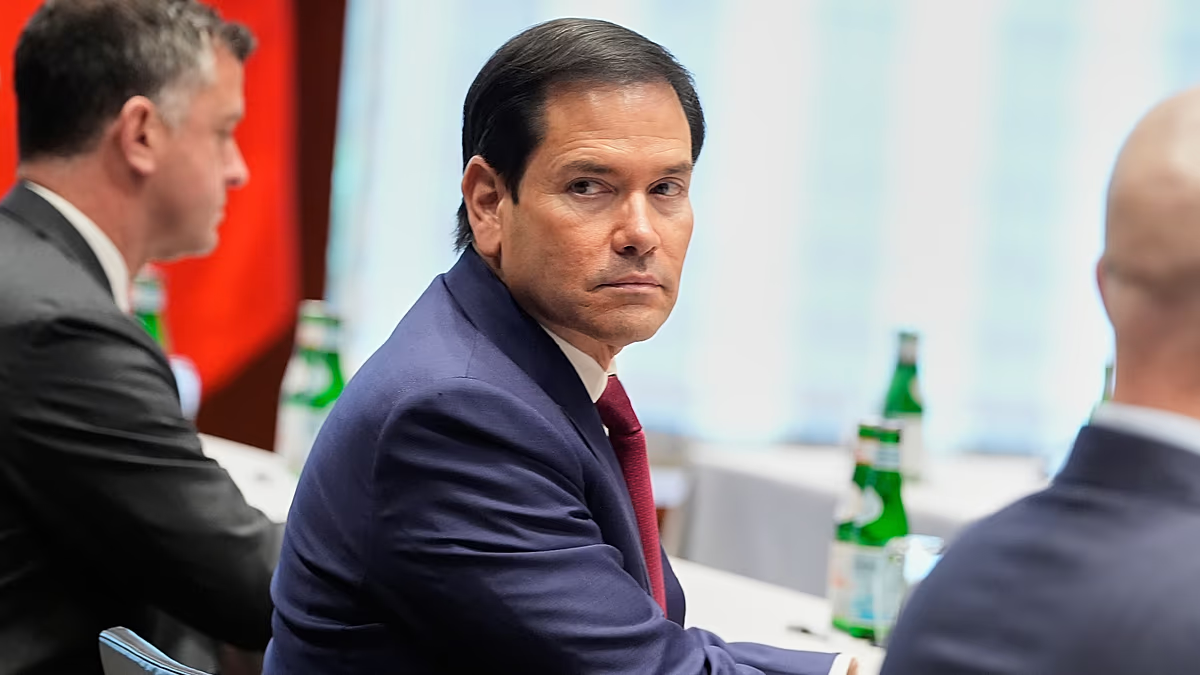
Rubio skips Berlin Format talks on Ukraine in Munich
Russia’s war on Ukraine leads this year’s Munich Security Conference agenda, with European leaders striving to maintain US engagement…
Tamsin Paternoster Share 14/02/2026 – 8:35 GMT+1
Good morning
Welcome to our live blog of day two at the Munich Security Conference, where leading global security figures convene.
Here’s a brief recap of yesterday’s highlights:
- German Chancellor Merz delivered a forceful speech setting a critical tone for the next three days. He stated the previous world order “no longer exists” and warned of a new world order defined by “power politics,” threatening even strong nations. He described the EU-US tension as an “inconvenient truth,” highlighting a division that makes freedom less assured amid ongoing Moscow threats.
- US Ambassador to the UN Mike Waltz and EU Foreign Policy Chief Kaja Kallas clashed over funding, with Waltz arguing US taxpayers question financing international bodies like the UN. Kallas responded that “when America wages war, many of us accompany you, suffering casualties; you need our support as well.”
- French President Emmanuel Macron offered a positive vision for Europe, suggesting “coexistence” with Russia, proposing a new European nuclear sharing programme, and challenging claims of excessive social media regulation.
The first spotlight is on US Secretary of State Marco Rubio, delivering a speech one year after Vice President J.D. Vance’s scathing address. Stay tuned — we’ll bring you the highlights as they unfold.
Tamsin Paternoster Share