
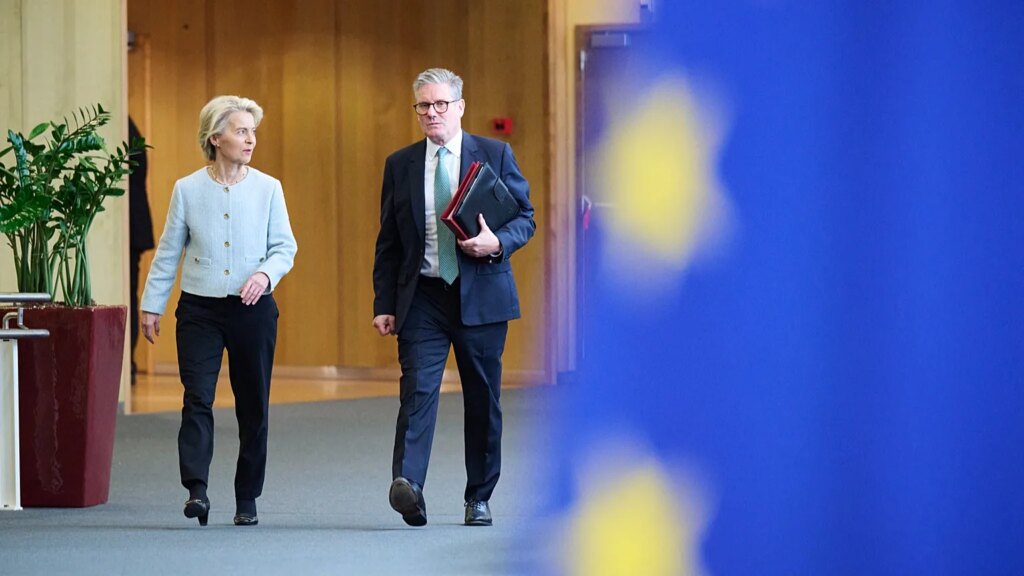
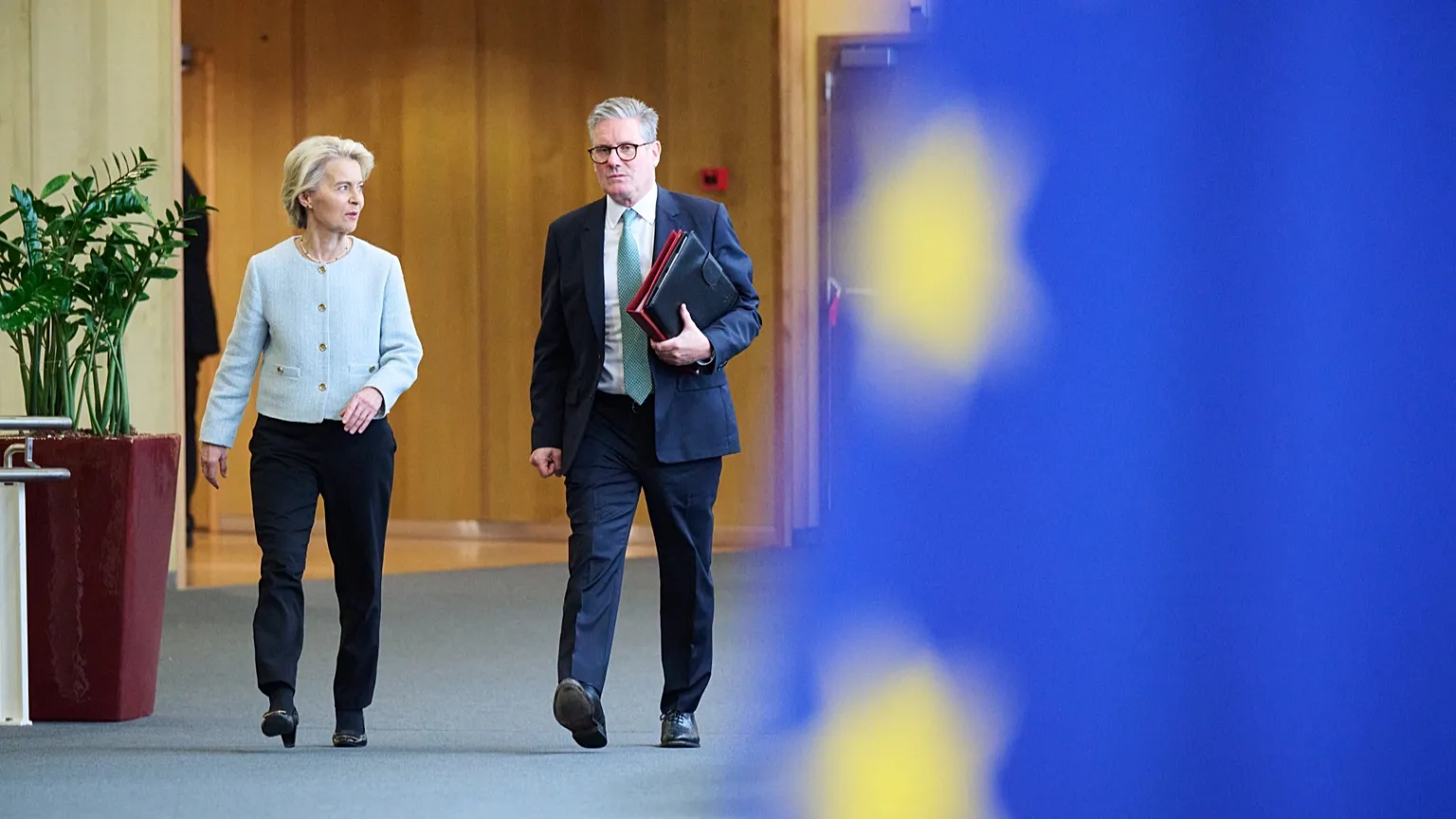
A turbulent geopolitical situation has driven the European Union and the United Kingdom to enhance their cooperation in sectors such as defence and trade after a challenging decade.
As the 10th anniversary of the referendum that removed the UK from the EU nears, and following years marked by bitter exchanges, a reconciliation between London and Brussels appears to be genuinely in progress.
Discussions on tighter trade, customs, and defence integration are gaining pace, accompanied by a consistent flow of encouraging signals from both sides of the Channel in recent days. Officials might be taking inspiration from the 2016 nostalgia trend that has swept social media, where users reminisce about the «simpler days» of ten years ago.
Yet, it is more plausibly a reaction to escalating pressure on the UK’s ruling Labour party, which polls several points behind the right-wing populist Reform UK led by prominent Brexiteer Nigel Farage, amid a worsening geopolitical climate that disrupts the established global order.
This impetus began in 2024 when newly appointed Prime Minister Keir Starmer aimed to «reset» the UK’s economic and trade relations with the EU. Recently, he has expressed a willingness to align more closely with the bloc’s Single Market, hoping to revitalize the UK’s struggling economy and strengthen its defence against international trade fluctuations.
Negotiations intended to reduce checks and trade barriers are set to accelerate following a meeting on Monday at Downing Street involving UK Chancellor Rachel Reeves and the EU’s trade and economic leaders, Maroš Šefčovič and Valdis Dombrovskis.
After the discussions, Dombrovskis told the BBC that the EU is «prepared to engage» in talks about reintegrating the UK into a customs union—a concept Starmer had initially dismissed but now faces rising pressure from several cabinet members to reconsider.
Brussels has consistently maintained that the UK cannot selectively obtain privileged access to the Single Market without embracing the EU’s «four freedoms»: unrestricted movement of goods, services, capital, and people.
However, fully reintegrating into the bloc’s Single Market remains politically sensitive for Starmer, as endorsing free movement of people between the EU and UK could strengthen Reform UK’s anti-immigration agenda.
The EU is reportedly working on a “Farage clause” for inclusion in a future EU-UK agreement, enabling the bloc to receive adequate compensation if Reform UK gains power and withdraws from the Labour-negotiated deal.
Although a UK general election may not occur until summer 2029, Reform UK currently leads in polls.
‘A new way of working together’
Spain’s Prime Minister Pedro Sánchez expressed to the New Statesman earlier this week his support for the UK rejoining the EU, emphasizing the “clear necessity” of having the UK re-engage.
A agreement made between the Sánchez administration and the UK last June concerning Gibraltar, the British overseas territory left uncertain by the 2020 Brexit agreement, removed a significant obstacle to broader EU-UK arrangements. This resolution eased longstanding tensions between Madrid and London, enabling Brussels officials to spearhead a wider “reset” of post-Brexit relations with the UK.
On Tuesday, European Parliament President Roberta Metsola urged sustained progress in these talks during an address to the Spanish Senate in Madrid.
«A decade after Brexit, in a profoundly changed world, Europe and the UK require a fresh mode of cooperation across trade, customs, research, mobility, security, and defence. This is about forward-looking actions that benefit both Europe and the UK now,» stated the Maltese politician.
«It is time to move beyond past conflicts, renew our partnership, and collaboratively find solutions. This pragmatic realism, grounded in shared values, will enable collective progress.»
Stronger defence
Brussels and London are also pursuing a compromise to deepen defence collaboration and guarantee Ukraine can acquire necessary military equipment through the EU’s newly approved €90 billion loan, with two-thirds designated for military aid—including British-made technology.
Talks aimed at permitting the UK’s full involvement in the EU’s €150-billion defence loan program (SAFE) broke down last November due to irreconcilable differences over London’s financial contribution.
Euronews reports that negotiations failed because of a significant discrepancy: the EU’s final offer stood at approximately €2 billion, while the UK estimated its appropriate share at just over €100 million.
During a recent visit to China, Starmer told reporters the EU and UK should «collaborate more closely» on defence matters.
“Whether through SAFE or other projects, it is logical for Europe in the broadest sense—comprising the EU and other European nations—to increase cooperation,» he remarked. «I have been advocating for this and hope to advance it.»
EU officials are currently considering how to include third countries, including the UK, in the bloc’s shared €90 billion loan to Ukraine.
An EU diplomat informed Euronews that the legal framework for this loan is expected to receive member state approval this week. It will incorporate a «European preference,» with fifteen member states supporting a proposal requiring third countries taking part to provide financial contributions.
This position has been strongly endorsed by France.
“France has never opposed UK participation in the Ukraine loan,» a French diplomat stated. «The only condition is that third countries contribute financially; otherwise, they would benefit unfairly compared to EU member states.»
The EU will issue bonds to raise funds and manage repayments with interest. Contributions from third countries are intended to cover the interest costs, estimated between €2-3 billion annually.
Presently, repayments are shouldered by 24 of the EU’s 27 members—Hungary, Slovakia, and the Czech Republic having negotiated opt-outs—with individual shares likely based on GDP.
A similar financial arrangement applying to third countries would likely be far more acceptable to London than the terms proposed under SAFE.