
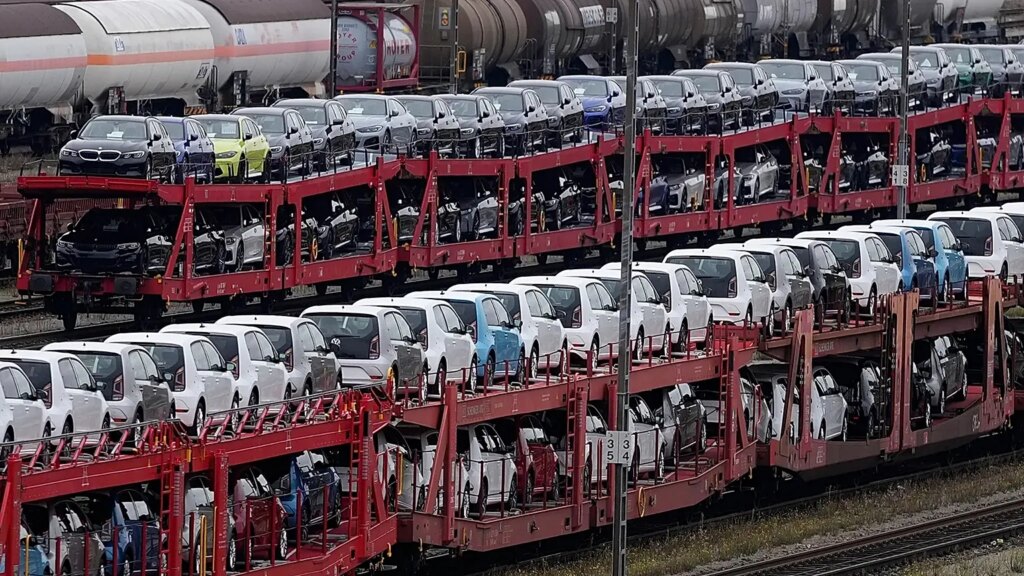
Climate Commissioner Hoekstra justified abandoning the significant plan to prohibit combustion-engine cars, describing it as "a sensible, prudent compromise for both climate and economic competitiveness." Critics argue that Brussels is retreating from its environmental commitments.
European Commissioner for Climate Wopke Hoekstra defended a contentious decision to abandon the scheduled ban on combustion-engine vehicles by 2035, terming it a «sensible and prudent compromise» for climate and industry in an interview with Euronews.
His remarks came after the European Commission announced Tuesday that it would soften a previous plan to completely outlaw the sale of combustion-engine cars starting in 2035.
Rather than a full ban, the Commission declared that the restriction would now apply to 90% of new vehicles, a decrease from 100%. This adjustment might permit a greater number of higher-emission cars to enter the market.
European car manufacturers, contending with increased energy expenses, tariffs, and tough competition from China, had urged the Commission for more flexibility.
At the same time, environmental advocates criticized the executive for yielding to industrial interests at the Green Deal’s expense, which they claim is being dismantled. Hoekstra disputed these accusations.
«Our goal is to support this critically important sector (automotive) not only in surviving but in prospering. At the same time, the measures will be fully climate neutral,» Hoekstra explained to Euronews.
«What we are introducing is a mechanism that permits companies to keep selling hybrids, for instance, while offsetting emissions through green steel. It benefits both sides.»
Ongoing Criticism
The Commission remains under fire from environmental groups who argue that the executive is contradicting its own green initiatives introduced during the first term of Commission President Ursula von der Leyen, who branded the Green Deal as «Europe’s man on the Moon moment» and a central element in its future growth blueprint.
In her second term, von der Leyen has shifted focus toward enhancing competitiveness, pledging to reduce bureaucratic burdens, streamline regulations, and curtail excessive rules.
This altered political direction, largely influenced by industry demands, has triggered anxiety among environmental organizations suggesting that the Green Deal has been set aside.
Commissioner Hoekstra, from the Netherlands, told Euronews the Green Deal still serves as Europe’s «guiding framework,» albeit one that must be modified.
«The challenge is to maximize our competitiveness, climate goals, and sovereignty,» he stated. «These objectives must always coexist without compromising any one of them. When circumstances evolve, so must the strategy, correct?»
The plan still requires approval from European legislators and EU member states. Hoekstra expressed confidence in securing wide political backing.
The centre-right EPP, encompassing major conservative forces including Germany’s CDU, welcomed the change. Conversely, Spanish Prime Minister Pedro Sánchez, leader of one of Europe’s few left-leaning governments, labeled the elimination of the full ban a «mistake» on Wednesday.
Bulgaria, the Czech Republic, Germany, Hungary, Italy, Poland, and Slovakia were the EU countries urging the Commission to reconsider the 2035 combustion engine ban.
Meanwhile, France and Spain supported the ban and called on EU leaders to “stay on track,” asserting that zero-emission vehicles are “essential,” according to a letter obtained by Euronews.
However, Paris and Madrid also requested lawmakers to allow hybrid vehicles and provide fiscal incentives for domestic carmakers.
Vehicles at the Heart of a ‘Passionate Debate’
Hoekstra acknowledged that reconciling the demand for a competitive European economy amid US tariffs and China’s growing dominance in high-tech industries with ambitious climate policies has become, for many, a highly political and emotional discussion.
The automotive industry is particularly prominent in Europe, recognized as a strategic sector for exports and employment—especially in Germany—yet it is energy-intensive and remains one of the region’s leading pollution contributors.
Hoekstra admitted «not all parties will be satisfied,» but noted that is inherent to political processes.
When questioned about personal pressure from Germany’s government, which advocated for dropping the ban, he rejected the idea of a single decisive influence, attributing the decision to multiple factors.
«One must choose what is intelligent, prudent, and beneficial for Europe over the long term,» he said, emphasizing that the measure should be viewed as part of a comprehensive package.
Within the new legislative proposal on CO2 emissions from vehicles, the EU executive stated manufacturers must compensate for the remaining 10% of emissions by utilizing low-carbon steel produced within the EU or sustainable fuels such as e-fuels and biofuels.
Zero-emission vehicles (EVs) and hydrogen-powered cars will also be promoted, with producers qualifying for «super credits» for manufacturing small, affordable electric cars made in the EU, according to the Commission’s proposal.
«A political compromise is necessary since not everyone will agree with all elements,» Hoekstra concluded, «but many will recognize the package—with green steel, added flexibilities, climate neutrality, and a mix of components—as a win for Europe.»