
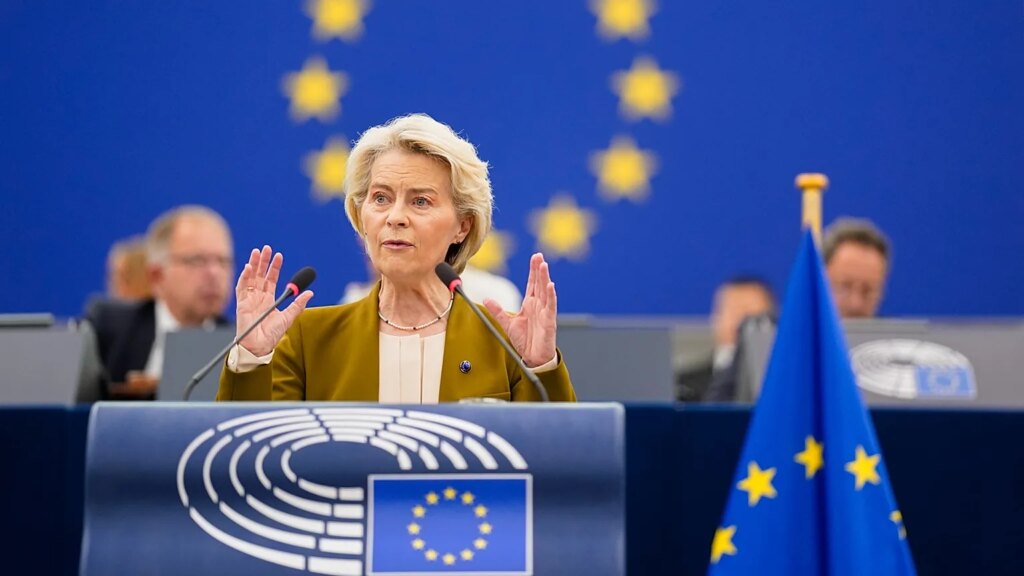
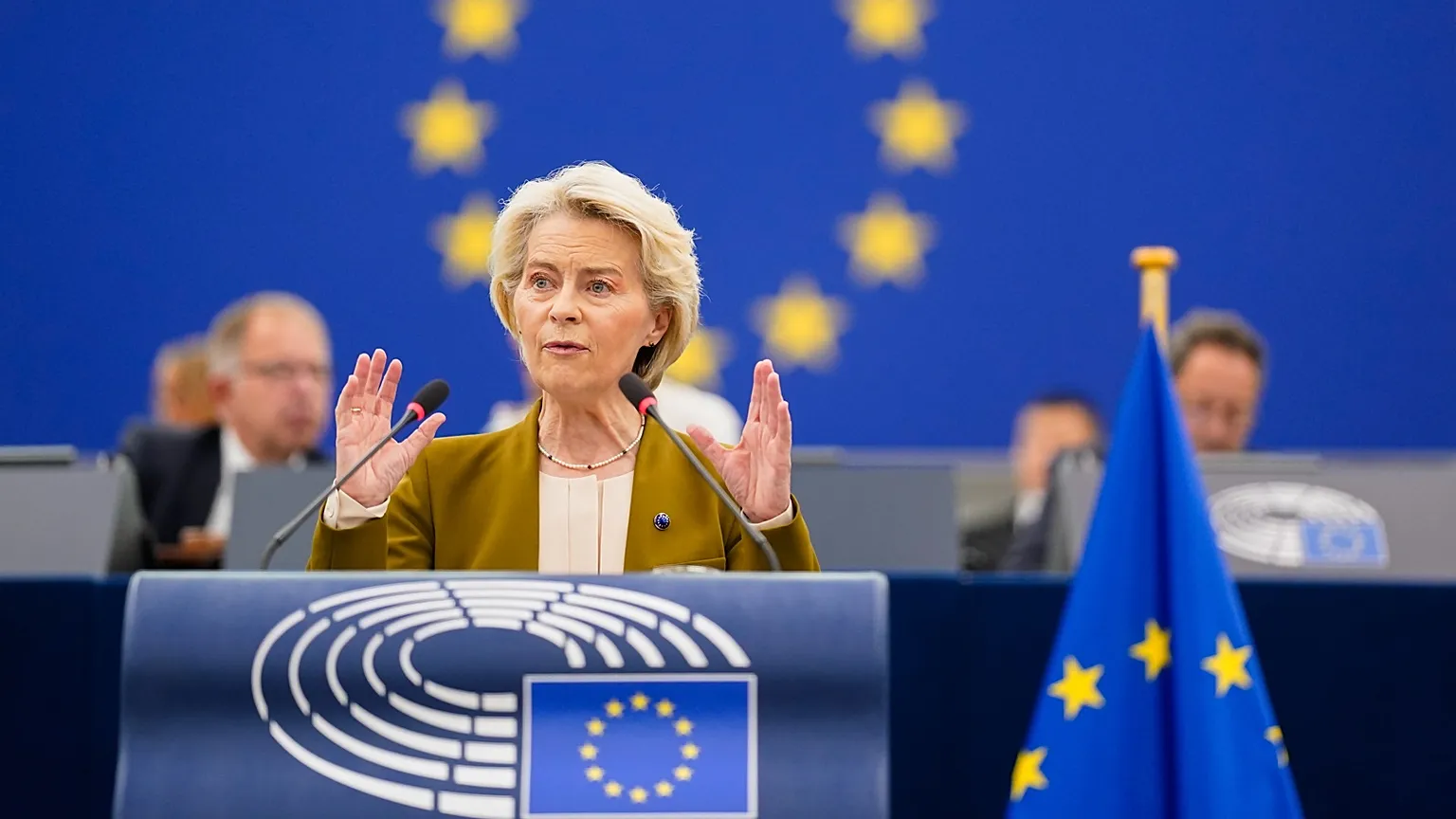
The President of the EU Commission urged Europeans to increase pressure on Moscow and cautioned that despite its overtures to peace talks, "Russia’s attitude remains unchanged".
Europe must maintain pressure on Russia, as the nation continues aiming to «permanently redraw borders» and restore its lost «spheres of influence,» Ursula von der Leyen stated on Wednesday. This comes amid brisk peace discussions led by the United States that offer Moscow potential economic relief despite their ongoing attacks in Ukraine.
«From the beginning, Russia has held the conviction that it can outwait Ukraine, Europe, and all associated allies,» the European Commission president addressed the European Parliament in Strasbourg during her speech Wednesday morning.
«That is precisely why whenever serious steps toward negotiations capable of securing genuine peace make headway, violence intensifies,» she continued, alluding to the recent heavy Russian strikes targeting Ukraine’s civilian population.
«This pattern is familiar. The recent signals from the Kremlin reveal much about its true objectives. For them, Ukraine represents merely the initial phase in a far larger scheme.»
Peace or surrender?
Von der Leyen’s statements coincide with Kremlin indications of rejecting the peace framework that surfaced from talks between US and Ukrainian officials in Geneva over the weekend.
The discussions significantly altered the original 28-point draft, which originally included extensive clauses favoring Moscow’s agenda.
Europeans, excluded from consultations prior to the leak of the 28-point draft to the media, were shocked by the proposals concerning critical issues within their competence, such as future economic sanctions and the handling of frozen Russian assets.
In recent days, a surge of high-level engagements occurred, including an informal EU leaders’ meeting on Monday and a virtual summit of the «Coalition of the Willing» on Tuesday, aimed at reinforcing Europe’s position and assisting Kyiv in recalibrating the text.
«This principle has been acknowledged,» von der Leyen affirmed. «Nothing about Ukraine without Ukraine. Nothing about Europe without Europe. Nothing about NATO without NATO.»
During her address, von der Leyen opposed limiting the size of Ukraine’s military forces, a divisive topic in the negotiations, and called for strong security assurances to prevent another full-scale invasion.
Western allies contemplate deploying a multinational contingent within Ukrainian territory post-conflict to enhance deterrence, a proposal Moscow has decisively rejected.
«It is evident that Russia’s mindset has held firm since the Yalta era, viewing the continent as divided into spheres of influence,» von der Leyen told MEPs.
«Therefore, it must be made clear that there can be no unilateral partitioning of a sovereign European state. Borders cannot be altered through force. Should such actions be legitimized, it paves the way for future conflicts.»
Covering the costs
Amidst the emerging US-Russia diplomatic plan, von der Leyen stressed the critical need to address Ukraine’s financial and military requirements, estimated at €135 billion for 2026 and 2027.
Last week, the European Commission introduced a proposal featuring three alternatives to bridge this funding gap: bilateral contributions from member nations, collective borrowing at the EU level, and a so-called reparations loan derived from the frozen assets of the Russian Central Bank. These assets amount to approximately €210 billion across the EU.
EU leaders are poised to decide on these options during their next session on 18 December.
While most capitals support the reparations loan, as it would relieve national budgets from direct burden, the unprecedented approach has met with opposition from Belgium, which holds the majority of these assets and fears aggressive Russian reprisals.
Von der Leyen confirmed that her Commission is prepared to propose a legal framework to support the loan, one of Belgium’s principal requirements.
«To clarify, I do not envisage a scenario where European taxpayers alone bear the cost,» she stated, expressing her preference for the reparations loan.
«It must also be understood that any resolution must comply with the regulations of responsible jurisdictions and uphold European and international law.»
The outcome remains uncertain as to whether the peace initiative will persuade Belgium to abandon its objections or reinforce its stance. The initial 28-point plan offered a framework allowing Washington and Moscow access to the frozen assets.
This contentious provision is thought to have been removed following talks in Geneva, though further negotiation is expected.
Von der Leyen concluded her address by reaffirming her call to intensify pressure on Moscow and compel an end to the conflict.
Since February 2022, the EU has enacted 19 sanction packages targeting Russia. Last month, the US imposed sanctions on Russia’s two largest oil firms, Rosneft and Lukoil.
«Indeed, the situation is complex. It is unstable. It is dangerous. Yet, I believe an opportunity exists to achieve tangible progress,» von der Leyen declared.
«It remains our responsibility to engage with all efforts capable of establishing a fair and enduring peace. Though the challenge is great, a path forward must be found.»