
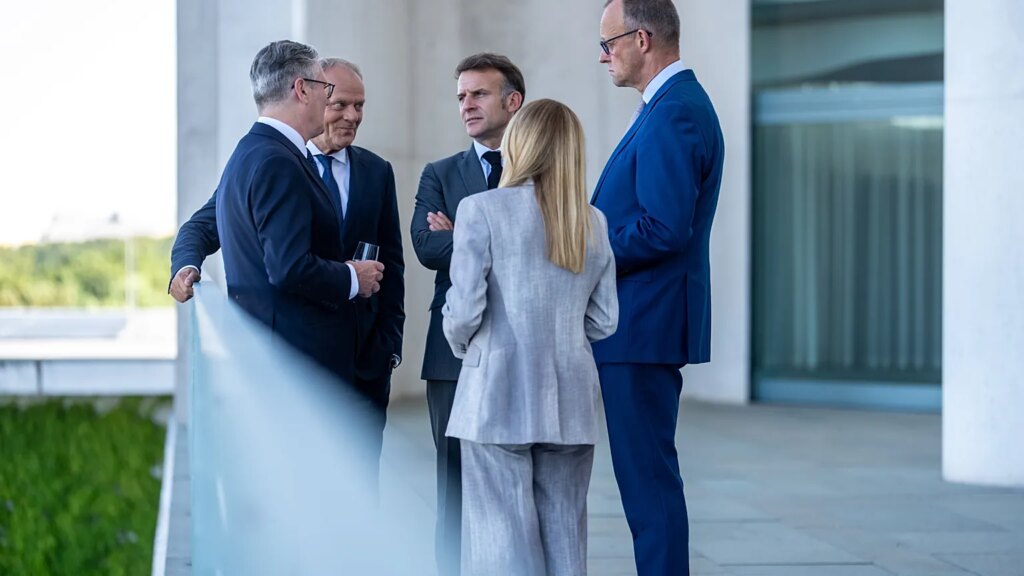
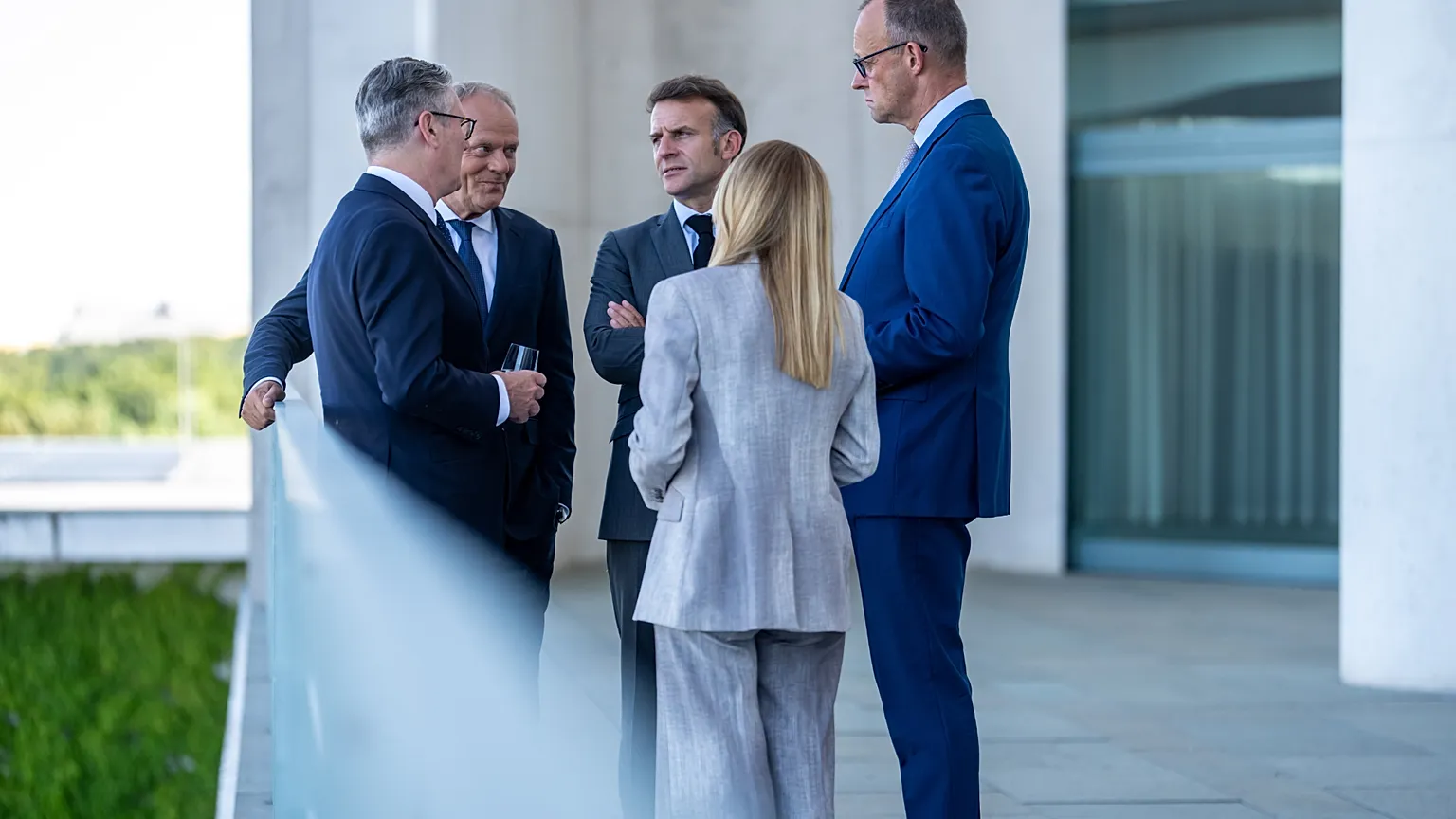
The heads of Europe’s most powerful military nations gathered in Berlin on Wednesday, preparing for a crucial NATO summit next month to deliberate on support and security assurances for Ukraine, as well as enhancing the Atlantic Alliance’s European Pillar.
French President Emmanuel Macron, UK Prime Minister Keir Starmer, Italian Prime Minister Giorgia Meloni, and Polish Prime Minister Donald Tusk convened in Berlin on Wednesday for the E5 summit hosted by German Chancellor Friedrich Merz.
 ADVERTISEMENT
  ADVERTISEMENT
Established in 2024, the E5 format unites defense ministers from Europe’s largest military spenders, coordinating Ukraine support, addressing the US’s gradual military reduction in Europe, and developing joint defense initiatives.
This alliance of NATO’s key European members meets ahead of the critical alliance summit scheduled for 7-8 July in Ankara.
The E5 gathering also sought to expand on the so-called «Évian moment,» as described by Macron — when G7 leaders, including then US President Donald Trump, showed solidarity in backing Ukraine’s war effort and intensifying pressure on Russia to seriously pursue peace negotiations.
«The momentum started at the G7 summit in Évian continued at the European Council last week and will advance further at the NATO summit in Ankara, followed by the ‘Coalition of Willing’ supporting Ukraine and security guarantees,» Macron stated during the press briefing after the E5 meeting.
Coalition of the Willing
Berlin went forward with the critical E5 summit despite the political upheaval in London on Monday, after Starmer resigned as prime minister under pressure from his Labour Party following poor local election outcomes.
Starmer has been a leading figure in European security talks, jointly leading with Macron the «coalition of the willing,» which focuses on providing security assurances and military commitments for a future Ukraine peace agreement.
The level of commitment of his probable successor, Andy Burnham, to defense funding and Ukraine’s peace process remains uncertain.
Merz has positioned Germany as a co-chair of the coalition — a role that could gain importance if the UK’s political instability deepens or its policy trajectory alters.
Earlier this month, Macron, Starmer, and Merz met Ukraine’s President Volodymyr Zelenskyy in the E3 format to discuss security guarantees and military aid, emphasizing anti-ballistic missile and deep-strike capabilities.
This meeting faced criticism from Italy and Poland, excluded from the talks, prompting the expansion of the format to E5 to include these two other major European defense powers.
Advocates of the E5 consider the E3 too limited for decision-making, especially given Poland’s key role as a logistical center for Ukraine’s war effort; any peace deal, they argue, requires Warsaw’s close participation. However, a significant diplomatic dispute currently complicates relations between Poland and Ukraine.
Others argue the E3 remains the appropriate forum for talks with Russia, as these countries possess unmatched military strength in nuclear deterrence, intelligence, and deep-strike capabilities.
NATO’s European pillar
The upcoming Ankara summit occurs at a pivotal time for NATO, with Trump expressing frustration at European allies over their insufficient support for his war in Iran. NATO Secretary General Mark Rutte met with the US president Wednesday in a diplomatic effort. Rutte also joined the European leaders’ discussions via video link.
The backdrop for the NATO summit is Washington’s gradual reduction of its presence in Europe—not only conventional military forces but also strategic enablers such as logistics, command structures, and infrastructure essential for sustaining combat operations.
«Today, within the E5 framework, we confirm our countries’ commitment to uphold European and transatlantic unity,» said Poland’s Tusk during the press conference.
Last week, US Defence Secretary Pete Hegseth sharply criticized NATO allies during a defense ministers meeting in Brussels, urging Europeans to increase their responsibility for their security and announcing a six-month review of American troop levels in Europe.
At the press briefing, Chancellor Merz highlighted that all participating countries pledged to substantially increase their defense budgets, viewing this as laying the groundwork for a more balanced transatlantic partnership.
How to reinforce NATO’s European pillar and progressively substitute US military capabilities in the region—with the E5 as key actors—was the main issue confronting Europe’s leading military powers on Wednesday.
Merz stated that the E5 nations had agreed to closely coordinate efforts to address major defense challenges, including long-range weapons, air defense systems, and artificial intelligence technologies.
«There is a unanimous understanding that Europe must assume its defense and security responsibilities, steadfastly advancing toward a reinforced European component within the Atlantic Alliance,» Meloni affirmed.