
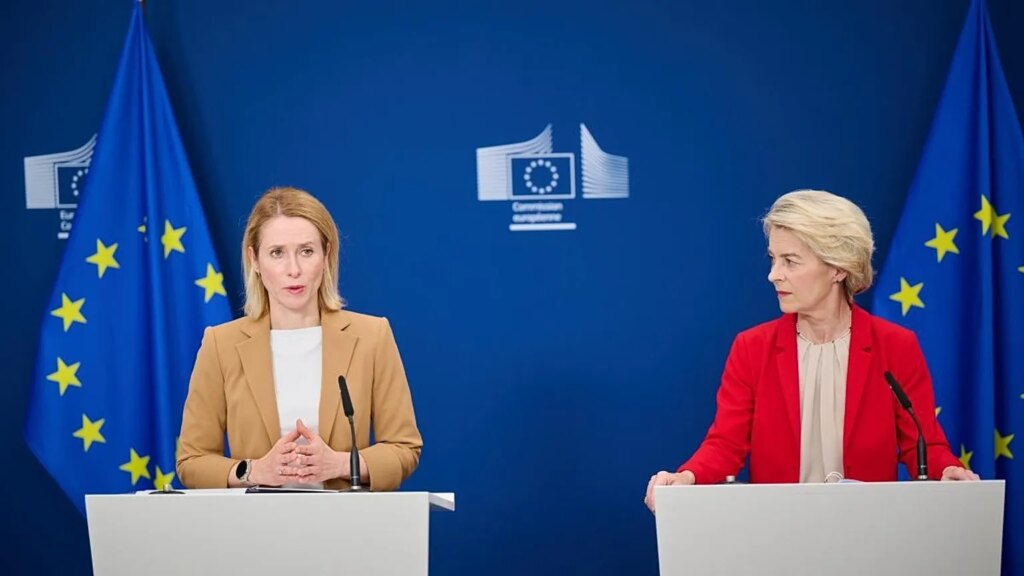
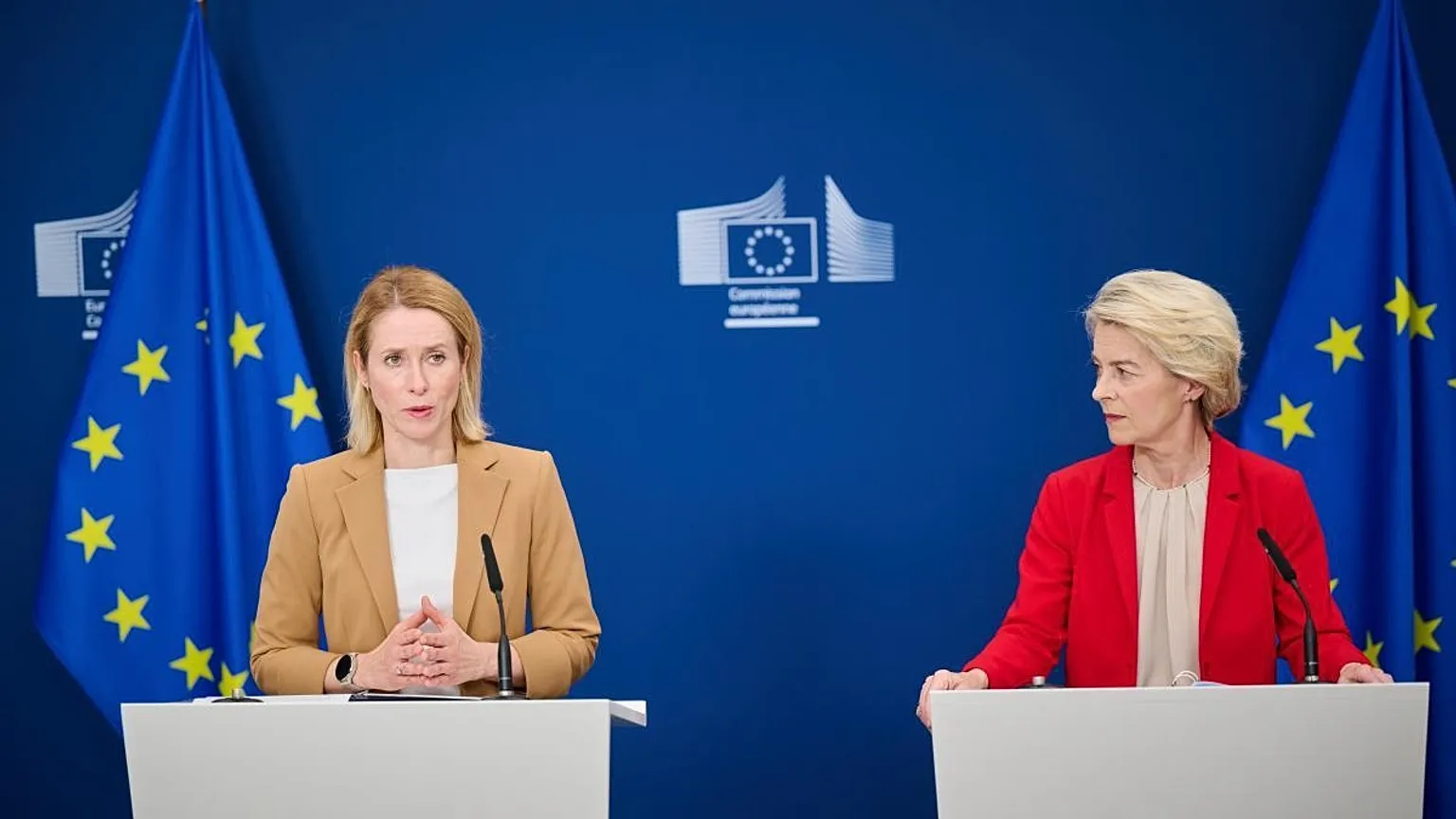
Differing perspectives on the EU’s ties with Israel are revealing a mounting rivalry between the European Commission and lead diplomat Kaja Kallas about who truly shapes the bloc’s foreign policy, thereby weakening its overall unity.
Israel is increasingly turning into a focal point for disputes over the EU’s foreign policy leadership between the bloc’s chief diplomat, Kaja Kallas, and the European Commission, impacting its overall cohesiveness.
 ADVERTISEMENT
  ADVERTISEMENT
On Monday, Euronews disclosed that Dubravka Šuica, the European Commissioner for the Mediterranean, was on a trip to Israel.
The Commission’s spokesperson later confirmed that the visit had been in planning for some time, but it had not been published on the Commissioner’s official page, taking many European capitals by surprise.
Chief spokesperson Paula Pinho was unable to clarify why the announcement was lacking, merely stating that «they will examine the issue.»
The visit happened shortly after Israel’s foreign minister, Gideon Sa’ar, cut all ties with Kallas following media claims accusing her of likening the country to apartheid-era South Africa.
Although the trip was organized before this controversy arose, Kallas’ team questioned its timing, considering the recent developments, and emphasized the significance of unity, Euronews confirms.
During a press briefing on Monday, Sa’ar indirectly criticized Kallas, which led several EU diplomats to reproach Šuica for not defending her colleague more strongly.
«What a remarkable demonstration of ‘solidarity and coordination’ within the EU,» wrote Josep Borrell, the EU’s former foreign policy chief, on X. Borrell, who preceded Kallas, had several disagreements with von der Leyen regarding Israel.
Independent initiatives
This is not the first occasion in which Šuica has pursued independent foreign policy actions, diverging from both the EU’s leading diplomat and member capitals.
She was the only EU institutional member to join the Board of Peace, an initiative by former US President Donald Trump aimed at peacebuilding in Gaza, which most EU nations boycotted, viewing it as competing with the United Nations.
Several anonymous EU diplomats told Euronews that these initiatives are not just personal, but reflect a broader effort from the Commission to assert control over foreign policy.
«Šuica operates with European Commission President von der Leyen’s support for these initiatives. That is widely known,» remarked one EU diplomat. «The concern is what harm this might cause.»
Another diplomat noted that the trip appears to send a message to Kallas, implying «von der Leyen does not require her.»
The EU’s diplomatic service has been increasingly pressured as von der Leyen has steadily expanded the Commission’s role in geopolitics.
Earlier this month, selective media reports suggested that key member states were considering restraining the European External Action Service (EEAS) altogether—although this was only one of several options, alongside strengthening the High Representative’s authority.
Diverging policies
Israel arguably remains the clearest example where this contest to define foreign policy occurs.
MEP Hildegard Bentele (EPP/Germany), chair of the EU-Israel delegation, supported the idea that Kallas isn’t the sole figure responsible for external relations.
“Instead of provocative rhetoric about Israel from HRVP Kallas, I value and fully back Commissioner Šuica’s responsible, pragmatic, constructive, and transparent stance,” Bentele told Euronews.
In contrast, most EU member states, represented by Kallas, have increased pressure on the Commission to advance trade restrictions aimed at Israeli settlements in the occupied Palestinian territories.
«The Commission is plainly obstructing any measures against Israel,» stated MEP Lucia Annunziata (S&D/Italy), also part of the EU-Israel delegation, referring to the protracted debates on suspending the association agreement.
«Now, things are slowly progressing, likely due to mounting member state pressure,» she added.
Last week, EU leaders approved a statement urging the Commission to put forward proposals before the next foreign affairs ministers’ meeting on 13 July.
At a Tuesday press conference, Commission trade spokesperson Olof Gill declined to speculate on what these proposals might involve.
A feature, not a bug
Diplomatic insiders highlight that the tensions between the Commission and the EEAS are systemic, not merely personal conflicts involving a single commissioner.
Šuica’s Directorate-General for the Middle East, North Africa and the Gulf (DG MENA) was established at the beginning of this Commission’s tenure specifically to absorb foreign policy responsibilities.
Consequently, the Mediterranean Commissioner’s role appears to be designed to compete with the EEAS’ domain, granting the EU executive the ability to engage in foreign policy when favoring autonomous diplomatic initiatives.
«The Commissioner holds her own portfolio and must be empowered to address her specific issues,» noted a third diplomat, acknowledging that such responsibilities were removed from the EEAS at the mandate’s start.
However, some point out that the overall impact weakens the bloc’s consistency in the sensitive arena of foreign policy, a field where European governments rarely fully agree.
As one diplomat summarized: «If coherence is desired, it requires deliberate effort.»