
Latvia experiences political instability following the resignation of its prime minister and defence minister, intensifying worries over the nation’s capacity to counter potential Russian aggression along Europe’s frontline.
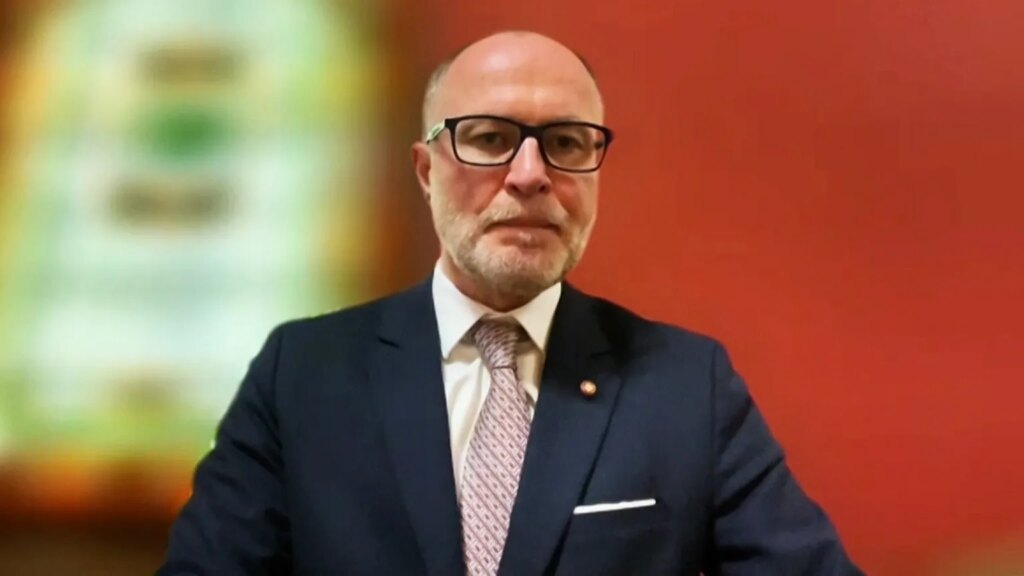
Andris Sprūds, Latvia’s former defence minister, told Euronews that there is no “magical solution” for halting rogue drones, emphasizing that his stance on Latvia’s air defence capabilities had been “realistic” amid a week of political unrest culminating in the Prime Minister’s resignation.
 ADVERTISEMENT
  ADVERTISEMENT
“It has always been challenging to handle drones that have deviated from their course,” he stated during the Europe Today programme.
Sprūds stepped down on Sunday after Prime Minister Evika Siliņa called for his resignation following a significant security breach and ensuing political controversy.
The previous Thursday, several drones violated Latvian airspace and crashed in the eastern Latgale area, close to the towns of Balvi and Ludza near the Russian border. One drone hit an oil depot, causing a minor fire.
There were no civilian casualties, although locals complained that emergency warnings were issued nearly an hour after the event.
“These incidents plainly showed that the political leadership within the defence sector failed to maintain the promised security of our skies,” Siliņa remarked on Sunday while explaining Sprūds’ departure.
Nevertheless, the situation quickly escalated into a broader political collapse. On Thursday, Siliņa herself resigned after her coalition disintegrated due to disagreements over the government’s response to the drone events.
Latvia’s political figures have accused Russia of electronically redirecting Ukrainian drones into Baltic airspace, while domestic critics faulted Sprūds for weakening the country’s security.
In recent weeks, multiple drones—believed to be targeting Russia—have crossed into Latvian, Lithuanian, and Estonian territories, raising concerns about the Baltic states’ preparedness against military threats.
Jānis Sārts, director of the NATO Strategic Communications Centre of Excellence, cautioned on the social media platform X that Latvia’s political instability has rendered it “more vulnerable” to external dangers.
When asked by Euronews if the delayed reaction to the drone incursions was ultimately his responsibility, Sprūds accepted “political responsibility” for protecting Latvia’s defences.
Still, he maintained that focus must now shift to enhancing resilience against forthcoming crises “that are on the horizon.”
“We must examine what actions are feasible currently and determine how to implement them,” he explained.
“Simultaneously, progress continues in developing our air defence systems.”
Sprūds cautioned that hostile foreign powers might attempt to exploit Latvia’s political instability ahead of parliamentary elections scheduled for October.
“There is manipulation by the aggressor country—the neighbouring state—whose intentions are understood and acknowledged,” he said, referencing Russia.
On Sunday, Ukraine’s Foreign Minister Andrii Sybiha asserted that the incidents were “the outcome of Russian electronic warfare intentionally diverting Ukrainian drones from their intended targets within Russia.”
He offered Ukraine’s support to Latvia, Finland, and the broader Baltic region to help avoid similar incidents in the future.
Latvia is in the final stages of securing a €3.49 billion defence loan from the European Union (EU) under the Security Action for Europe (SAFE) initiative.
A representative from the Latvian Defence Ministry confirmed that Riga’s government is close to finalising the agreement, which will be dedicated to reinforcing air defence capabilities.
The full interview will be broadcast on Friday as part of Euronews’ flagship morning programme Europe Today.