
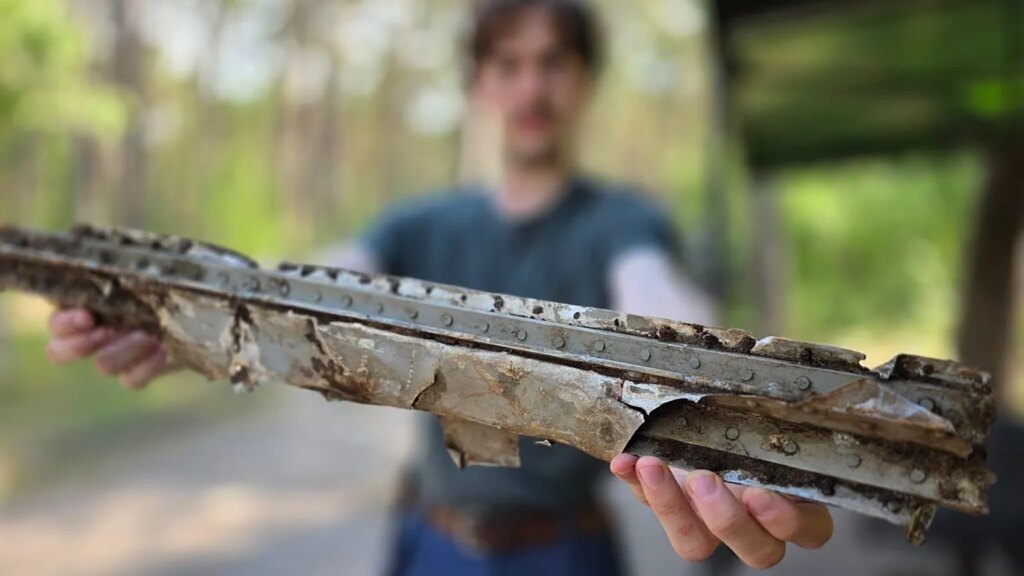
An unforeseen discovery during berry picking could illuminate Świnoujście’s World War II history: fragmented parts marked with RAF insignia imply a wartime aircraft rests beneath the ground.
What was supposed to be a routine stroll through the forest for berries turned extraordinary when a local resident of Świnoujście stumbled upon an artifact that might unravel a wartime enigma.
 ADVERTISEMENT
  ADVERTISEMENT
Close to the facilities of the Museum of Coastal Defence – Fort Gerhard, the individual noticed a strange hollow in the earth. Surrounding this depression were numerous metallic fragments that appeared organized rather than random debris. Among these remnants were sections of aluminium panels, parts of an aircraft’s frame, and scorched ammunition pieces.
One such fragment was entrusted to the museum team, marking the start of an investigation likely tracing back over eighty years to the Second World War.
«From the outset, it was clear this was no ordinary scrap metal. Characteristics such as the aluminium sheets, rivet patterns, remains of aircraft structure, and burnt ammunition hinted strongly at wreckage from an aircraft,» noted Wiktor Czeszewski from the Museum of Coastal Defence in Świnoujście.
Initial clues pointed toward the British air force
Ammunition remnants proved to be some of the most crucial discoveries. Early identification revealed calibre .303 British rounds—commonly employed in British Browning machine guns mounted on aircraft.
Such evidence suggested that these fragments could belong to a plane operated by Allied forces.
The decisive moment arrived when the pieces were cleaned more thoroughly. On a small copper tube, alphanumeric markings were revealed.
The engraving T7 served as a pivotal lead. British RAF technical guides specify this mark as indicating a specific type of seamless copper tubing applied in systems handling oil, fuel, gas, and other on-board functions.
Equally remarkable was the pipe’s end fitting, identified as an Avimo-type coupling—a high-pressure junction component used in British aircraft, notably associated with the iconic Rolls-Royce Merlin engines.
These engines powered many renowned RAF planes, including the Lancaster bombers.
A Lancaster near Świnoujście? History might be closing the loop
The museum team remains cautious regarding the exact identification of the aircraft. Definitive proof whether the discovered wreckage belongs to a Lancaster, Mosquito, or another model employing similar technology is still pending.
Nonetheless, a very intriguing lead has come to light.
The Museum of Coastal Defence already possesses a large segment, approximately five meters long, of a Lancaster bomber’s wing. This section was recovered from the Baltic Sea in 2009 by fishermen.
Of particular note, the recent discovery site lies merely about one kilometre away in a straight line from where that wing fragment was retrieved.
«It is conceivable that these remains originate from the same aircraft,» stated Piotr Piwowarczyk, director of the Museum of Coastal Defence – Fort Gerhard.
Previous thorough analysis of the wing fragment allowed researchers to identify three crew members by name. These airmen flew over the Szczecin and Police areas—locations that housed critical German industrial centers and port facilities—during the war’s final stages.
Whether the forest fragments truly belong to this aircraft is a question that will require time to resolve.
The forest guards its secret for now
The site of the discovery has been secured, with the Voivodeship Monument Conservator, the Międzyzdroje Forest District, and authorities responsible for war graves duly informed.
To deter visitors, souvenir seekers, or collectors, the area has not been marked with any signs.
The crash site distinctly shows unnatural ground formations, with a sizable piece of embedded aircraft structure visible beneath the surface.
«We anticipate that the main fuselage of the plane lies within this location,» explained Piotr Piwowarczyk.
This suggests that additional parts may be buried several meters underground. The possibility that remains of crew members may still rest beneath the soil cannot be excluded.
«Professional examination of the site is essential. We must consider the potential presence of crew remains underground,» the museum’s representatives emphasized.
Small tube, big historical tale
Major revelations often begin with modest artifacts. In this case, a small copper tube, once cleaned, revealed markings linked to British aviation technology.
Does the forest near Świnoujście conceal the wreckage of an Allied Lancaster? Will it be possible to identify the crew members’ names? Could the fragments found on land connect with the wing section recovered from the sea years ago?
Only further archaeological efforts and expert analysis will provide clarity.
One fact remains sure: this site’s history has just begun to disclose another chapter—and it all originated from a man’s forest stroll to gather berries, which led to uncovering traces of an aircraft from humanity’s most significant conflict.