
The dismissal of the reform-oriented defence minister sparks protests, compelling Zelenskyy to reconsider his wartime approach and concede to pressures from civil society and the military, while his office calls for patience.
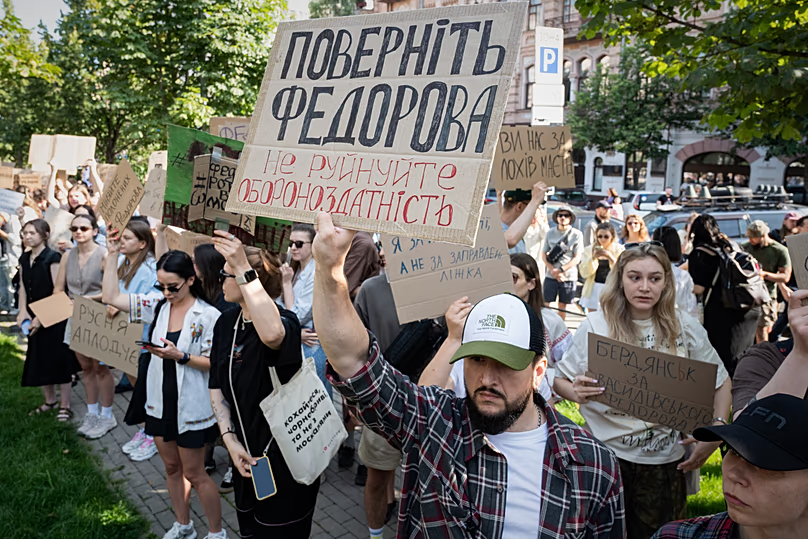
What started as a spontaneous outcry against Mykhailo Fedorov’s removal has escalated into widespread public dissent regarding Volodymyr Zelenskyy’s handling of the armed forces, with demonstrators demanding significant alterations in the top military leadership.
 ADVERTISEMENT
  ADVERTISEMENT
Zelenskyy is currently striving to manage a tense conflict between the reform-driven, technologically proficient former defence chief, backed by both the military and civil society, and the army commander central to Ukraine’s war operations.
A reshuffle misstep
On Sunday, 12 July, Zelenskyy revealed a comprehensive cabinet reshuffle. With countrywide elections suspended under martial law due to Moscow’s full-scale invasion, reorganising the cabinet remains his sole tool for political revitalization.
Speculation about a prime minister resignation had been ongoing for weeks; however, Euronews sources initially predicted the change would occur in late August or early autumn. Still, five days before the first anniversary of Yulia Svyrydenko’s government, she was removed from office.
The replacement of Svyrydenko and the rapid appointment of Sergii Koretskyi as Ukraine’s new prime minister barely drew public attention, while the defence sector provoked significant uproar.
On Thursday, parliament approved nearly a completely new wartime cabinet and Koretskyi’s nomination—a move largely regarded as sensible given his prior experience as chief executive of state energy company Naftogaz and his crisis-management roles at Ukrnafta and Ukrtatnafta.
Within parliament, Koretskyi pledged to prioritize defence, economic stability, and European Union integration.
Meanwhile, outside, thousands of protesters made evident that the true struggle over who controls the military—and how—had only just begun.
Scandal at the defence ministry
If the governmental changes fit Zelenskyy’s familiar approach of appointing technocrats to reinforce the wartime economy, the unrest in the defence ministry reveals a much more unstable situation.
Protests in Kyiv and multiple cities have entered their second day, showing no signs of abating, as crowds demand a major revamp of the top military leadership and vocalize discontent over the young defence minister’s dismissal.
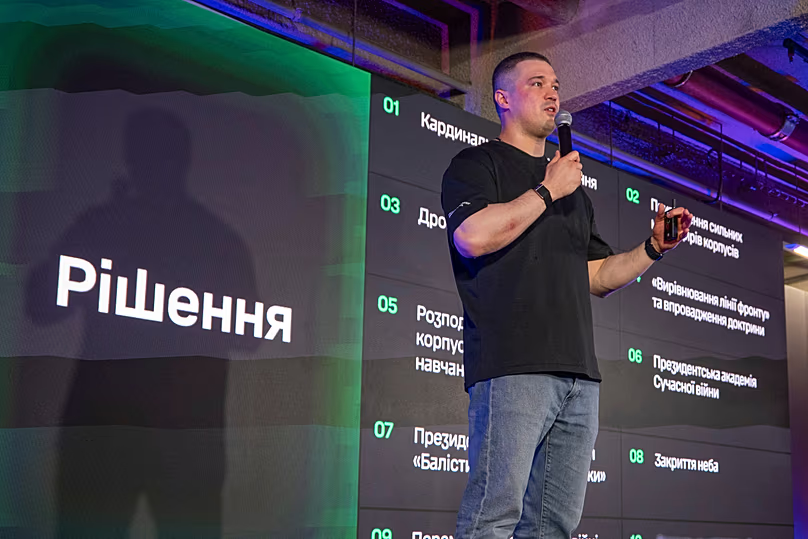
Mykhailo Fedorov, recognized as the symbol of a new generation of technology-driven reformers, held a bombshell press conference on Thursday following his firing, accusing commander-in-chief Oleksandr Syrskyi of blocking military reforms, sowing discord, and “dividing the nation”.
Fedorov disclosed that Zelenskyy had chosen to retain Syrskyi instead of him.
On Friday, presidential adviser Dmytro Lytvyn commended Fedorov’s conduct.
“It was an excellent press conference, and if government officials communicated this transparently and clearly more often, it would greatly ease the situation for everyone here,” Lytvyn said to reporters via the WhatsApp group.
Nevertheless, Lytvyn refrained from detailing the reasons behind Fedorov’s removal, citing instead “numerous sensitive issues.”
“Once all adjustments are finalized, we will provide a more detailed explanation,” he stated to journalists.
Presidential office remains silent
Since rumours about the reshuffle began circulating, the WhatsApp group of the president’s office became highly active, yet dozens of inquiries from Ukrainian and international media remained unanswered as the government changes proceeded.
Even the announcement of Fedorov’s dismissal was made by the minister himself rather than Zelenskyy, who authorized the decision.
On Thursday evening, Ukraine’s president named Yevhenii Khmara, head of Ukraine’s Security Service (SBU), as acting defence minister.
Addressing journalists in the presidential WhatsApp chat on Friday, adviser Lytvyn attempted to justify Khmara’s appointment and the disorderly transition.
“The current focus is on long- and mid-range strikes,” he noted, adding, “Khmara excels in this area.”
However, he declined to answer follow-up questions about the rationale for Fedorov’s removal, despite Fedorov being one of the key architects of Ukraine’s successful strike operations.
What lies ahead?
The last-minute decision to appoint an acting defence minister from the security services has intensified perceptions that Zelenskyy may be shielding himself and his administration from scrutiny, rather than addressing concerns about military strategy, mobilization, and frontline conditions.
In his effort to consolidate control over the defence system, Zelenskyy has trapped himself in a political dilemma.
He most likely did not foresee the extent of backlash following Fedorov’s dismissal and currently faces limited options.
Reinstating Fedorov could be interpreted as a personal concession and might exacerbate the discord with Syrskyi, the senior army commander, while moving forward with a new acting minister amid growing protests risks reinforcing the perception of a president disconnected from wartime public sentiment.
Protesters’ demands have now expanded beyond one popular minister’s fate to calls for a “complete overhaul” of the top military leadership.
Takeaways from last summer’s protests
For many, this week’s events outside the presidential office recall images from protests last summer.
In July 2025, Zelenskyy’s efforts to exert tighter control over the National Anti-Corruption Bureau of Ukraine (NABU) and the Specialized Anti-Corruption Prosecutor’s Office (SAPO) triggered the largest street demonstrations since the full-scale war began. Activists, anti-corruption groups, and ordinary citizens united against legislation they argued would undermine these agencies’ autonomy.
At that time, the EU issued a notably sharp criticism, warning of “a significant setback” for Ukraine’s EU accession efforts, while NABU and SAPO themselves publicly raised concerns.
Facing mounting pressure from civil society and European allies, Zelenskyy reversed course, submitting new legislation that restored “full guarantees of independence for anti-corruption bodies,” which parliament subsequently approved, reestablishing their autonomy.
Drawing from experience gained during the Maidan protests and decades of activism, Ukraine’s well-established civil society understands that persistent, organised advocacy—especially when supported by international partners—can compel the president to reconsider even the most controversial choices.
Currently, protesters have minimal incentive to disperse until their demands concerning Ukraine’s military and political leadership receive response.