


During the appellate proceedings, Le Pen rejected claims that the National Rally had an organized scheme to misappropriate European Parliament funds, insisting the party operated «in good faith.»
On Tuesday, a Paris appeals court sentenced France’s far-right leader Marine Le Pen to one year of house arrest connected to a false employment scandal involving the European Parliament, raising uncertainties about her potential presidential candidacy next April.
 ADVERTISEMENT
  ADVERTISEMENT
The court imposed a 45-month ban from public office on the three-time presidential hopeful, with 30 months suspended.
The remaining 15 months were anticipated to be retroactively applied from an earlier conviction by a lower court in March last year and hence to have expired, suggesting she might still qualify as a candidate.
However, the same court also issued a three-year detention sentence, suspending two years, resulting in a mandatory one-year house arrest term with electronic monitoring.
Le Pen, contesting the presidency for the third time, noted she would refrain from running against centrist President Emmanuel Macron if placed under house arrest, which would hinder her ability to campaign effectively.
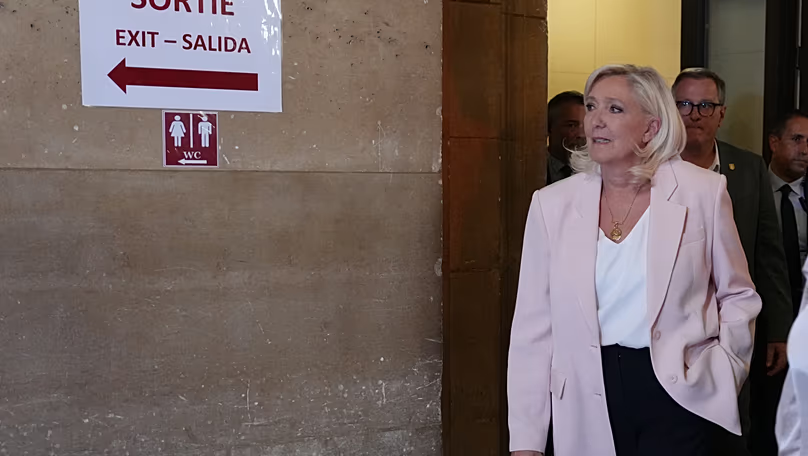
«A presidential contender must have full freedom of movement,» she stated during a televised interview last week.
«Relying on a magistrate’s permission to attend rallies is unacceptable.»
Le Pen is scheduled to declare her plans in a televised interview later Tuesday evening.
‘Witch hunt’
The initial trial last year convicted Le Pen, alongside 24 former European deputies, aides, and accountants, plus the anti-immigration party, for operating a scheme between 2004 and 2016 that utilized European Parliament funds to employ National Rally personnel in France.
The court sentenced Le Pen to a five-year prohibition from public office and four years in prison, the latter including a two-year suspension.
Le Pen described the case as a «witch hunt,» and following the verdict, some supporters issued death threats to the judges. Both Le Pen, her party, and ten others appealed the decision.
Throughout the appeal, she denied that the National Rally orchestrated a scheme to embezzle European Parliament resources, maintaining that her party acted «entirely in good faith.»

Nevertheless, prosecutors argued that Le Pen “professionalized” a mechanism to divert European Union funds, which was initially introduced more informally by her late father and party co-founder Jean-Marie Le Pen after she assumed leadership in 2011.
Recent polls generally indicate the far right will lead the first round of next year’s election, although opinions diverge considerably regarding the second round’s outcome.
Opinion polls
Polls frequently show that National Rally president Jordan Bardella achieves slightly higher support than Le Pen, yet opponents consider the seasoned politician a more formidable contender.
“This woman is very intelligent; her presence is no accident. Should she run for a fourth time, she will not be a candidate to underestimate,” remarked hard-left candidate Jean-Luc Mélenchon.
A May survey suggested Le Pen might win the runoff next year if she is permitted to run.
The Harris Interactive Toluna poll of over 1,700 registered voters projected her victory against Mélenchon as well as centrist former prime ministers Gabriel Attal and Edouard Philippe.
Other surveys, however, indicate Philippe, who is trying to attract right-wing voters, could prevail in a runoff against the far right.
Additional sources • AP, AFP