
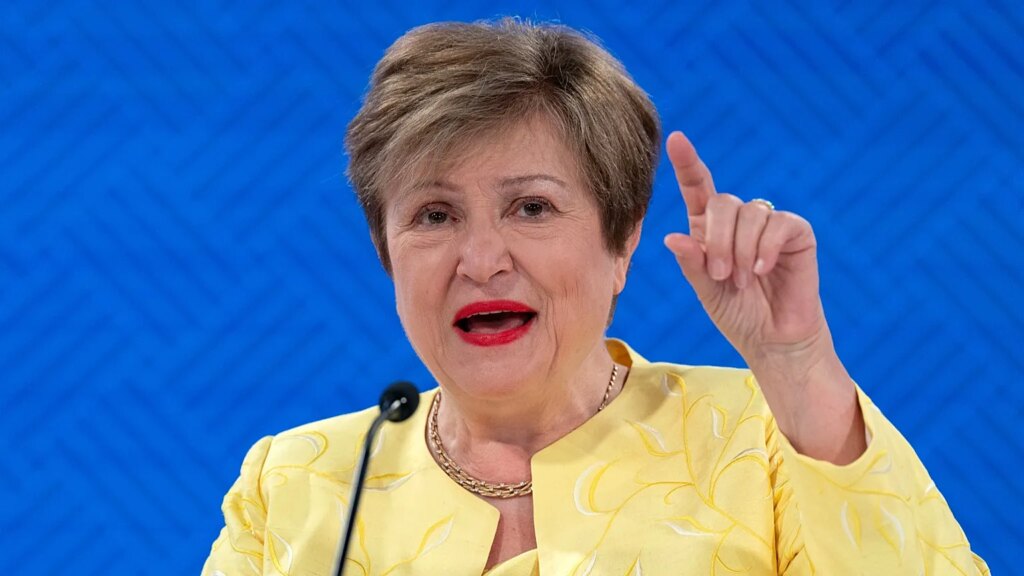
Although Russia has become one of the few beneficiaries from recent disruptions in the global oil market amid the Iran war, this advantage is insufficient to counterbalance the effects of sanctions and international isolation, the International Monetary Fund (IMF) managing director told Euronews.
Following two years of robust results fueled by a transition to a war-driven economy, Russia’s economic condition is deteriorating, according to IMF Managing Director Kristalina Georgieva in an interview with Euronews.
 ADVERTISEMENT
  ADVERTISEMENT
Even though the IMF increased its forecast for Russia’s growth in 2026 from 0.8% to 1.1% in its April report, Georgieva emphasized to Euronews that this figure does not capture the full extent of the economic decline.
“The rise in oil prices offers some relief to Russia,” Georgieva remarked, noting that the increase is insufficient to compensate for the broader damage to the economy.
“Their financial buffers have been drastically reduced,” she added, clarifying that the oil revenue surplus “seems to be allocated towards restoring reserves rather than boosting economic investments.”
“Economic growth has notably slowed, with projections now around 1%. Prior to the conflict, their potential growth rate was about 1.6%,” Georgieva highlighted.
The IMF managing director further stated to Euronews the importance of examining additional economic indicators to gain a clearer understanding of Russia’s current economic state.
“Inflation remains elevated, which aligns with interest rates standing at nearly 15%.”
Regarding Russia’s growth prospects, the IMF does not anticipate “a significant impact,” Georgieva observed. “This is a nation whose medium- and long-term outlook has worsened considerably.”
She identified three main reasons for the deteriorated outlook. The first is the loss of population.
“A country already facing demographic decline has now lost a substantial number of young people due to tragic circumstances,” Georgieva explained.
The second factor involves sanctions, particularly their severe effects on technological capabilities.
“In Russia’s oil and gas industry, we observe critical technological stagnation limiting expansion opportunities,” she noted.
The third reason is Russia’s diminished international standing.
“This decline results in numerous tangible and intangible setbacks. Consider the young Russians who might have formed connections with Europeans and others but were unable to because of the war,” Georgieva stated.
«Overall, Russia is coming out weakened,» she concluded.