
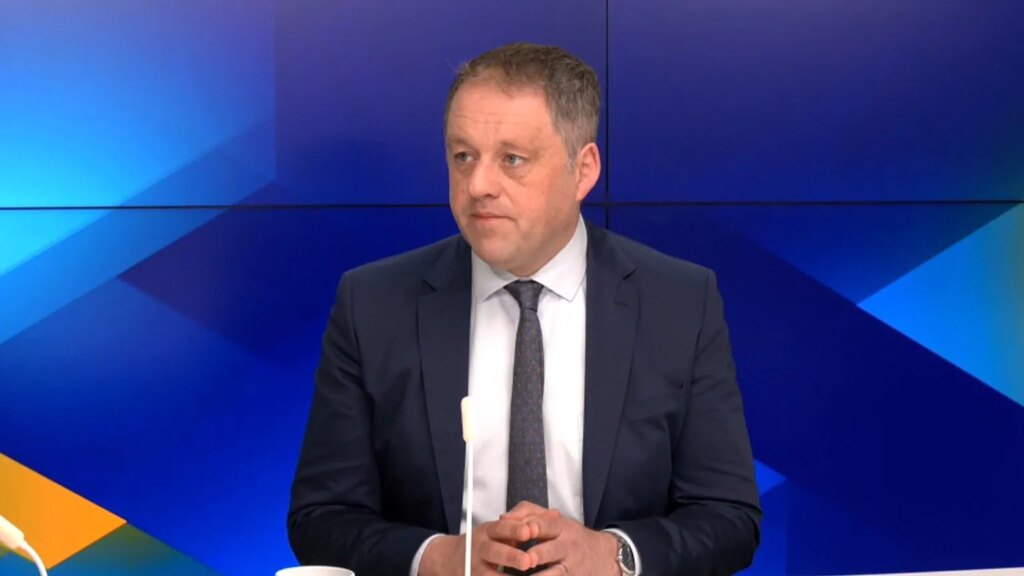
Thomas Byrne, Ireland’s Minister of State for European Affairs and Defence, emphasized that the European Union must maintain and increase its pressure on Russia through sanctions, military aid, and diplomatic strategies.
During a live broadcast on Euronews’ morning program Europe Today, Thomas Byrne highlighted that Ukraine continues to be “highly prominent and prioritized in the minds of Europeans.”
 ADVERTISEMENT
  ADVERTISEMENT
His remarks coincided with the gathering of EU defense ministers in Brussels, where the ongoing Russian invasion of Ukraine and conflicts in the Middle East are under discussion.
Byrne stated, “The key question revolves around the most effective ways to support Ukraine—be it supplying military equipment, implementing sanctions on Russia, engaging in peace negotiations, or pursuing the enlargement of the European Union.”
In July, Ireland will assume the rotating presidency of the Council of the European Union — a position set to place Dublin at the core of diplomatic efforts aimed at resolving the Ukraine war.
Despite rising debate among member states about the efficacy of sanctions, EU officials are preparing a 21st sanctions package against Russia.
“We have implemented 20 sanctions packages already,” Byrne told Europe Today. “These measures have significantly affected the Russian economy, though they have not yet ended the conflict. It remains essential to sustain pressure on Russia and its population to encourage opposition to Vladimir Putin’s actions.”
The possibility of engaging directly with Moscow has resurfaced amid fresh dialogues on potential peace talks. Byrne indicated Ireland’s readiness to endorse diplomatic exchanges if they help bring the war to a close.
“We have supported individual leaders reaching out to Vladimir Putin in the past,” he explained. “Facilitating such dialogue is important if it can contribute to ending the hostilities.”
Nevertheless, Byrne refrained from naming a special envoy to liaise directly with the Russian president, noting that it is “a matter for future consideration.”
The minister also acknowledged a recent breakthrough in Brussels concerning sanctions targeting Israeli settlers accused of violence in the occupied West Bank, made possible after Hungary’s new administration lifted its earlier objections.
“Hungary’s shift in stance is very welcome,” Byrne remarked. “There is now unanimous agreement on this issue within the European Council.”
He suggested that this political change in Budapest may have broader consequences for EU policy, particularly regarding Ukraine’s accession process.
“Until now, the Hungarian government has blocked the formal start of accession negotiations with Ukraine, and this is an outcome we hope to see reversed,” Byrne added.
Regarding Ireland’s decision to abstain from this year’s Eurovision Song Contest amid controversy over Israel’s participation, Byrne underscored that it was an independent choice made by Ireland’s public broadcaster RTÉ, not the government.
“Unlike Hungary, we do not interfere with the media in Ireland,” he affirmed. “The independence of RTÉ has been fundamental to our democracy for decades.”
The full interview can be viewed in the player above.