
The consequences of the conflicts in the Middle East and Ukraine resonate throughout Europe, with populations split over their nations’ political and military reactions.
According to recent Ipsos research, a significant number of Europeans express serious concern regarding the war in the Middle East, notably among Italians, French, and Dutch citizens.
 ADVERTISEMENT
  ADVERTISEMENT
In fact, 75% of Dutch participants reported being more anxious about the Middle East conflict than the wars in Ukraine and Gaza.
Close to 80% of French respondents fear the conflict might extend beyond the Middle East, while over 30% of Italians share similar apprehensions.
The economic impact is also a major concern among Europeans, with 65% of French citizens supporting initiatives to freeze or reduce fuel prices as a countermeasure to growing expenses.
Political affiliations influence the level of concern and backing for different policies.
In Italy, centrist voters affiliated with parties such as Forza Italia and Partito Democratico display heightened worries about potential conflict expansion compared to other voters.
Conversely, right-wing followers of parties like Fratelli d’Italia and Lega prioritize concerns about economic fallout and terrorism risks linked to the war.
Public opinion in the Netherlands remains split over the US-Israeli attacks on Iran.
Approximately 40% of Dutch respondents view these strikes negatively, whereas 21% support them. A considerable fraction remains neutral (25%) or undecided (15%).
Support for the attacks tends to be stronger among voters of right-wing conservative parties—Reformed Political Party, JA21, and Geert Wilders’ Freedom Party—while left-leaning and progressive party voters (GroenLinks-PvdA, Party for the Animals, Socialist Party, Democrats 66) generally oppose them.
What role should the government play in the Iran conflict?
Perspectives on how national governments are responding to the Iran war vary according to individuals’ political stances.
A narrow majority of French citizens endorse their government’s actions since the start of the Iran war, while 44% express disapproval.
Strong support is evident within the centrist groups, whereas disapproval dominates among supporters of the hard-left France Unbowed (65%) and the far-right National Rally (54%).
President Emmanuel Macron’s call to deploy the aircraft carrier Charles de Gaulle along with war frigates generates divided opinions among French respondents: 49% favor the move, viewing it as essential to defend France’s interests and allies.
This stance finds considerable backing particularly from centrists (78%), followed by Republicans party (LR) supporters (64%) and Socialists (57%).
In contrast, 50% oppose these deployments, fearing they might entangle France in the conflict. Opposition is especially strong among France Unbowed supporters (65%), National Rally (60%), and The Ecologists (53%).
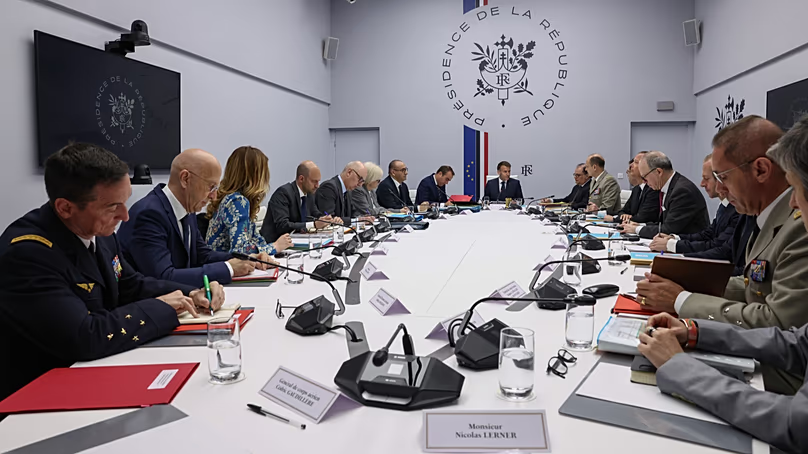
In Italy, 34% advocate for neutrality and mediation among parties, while 13% favor diplomatic support for the US and Israel, and 2% believe Italy should engage militarily.
Notably, 27% of Italian respondents did not specify the role Italy should assume in the conflict.
Finally, in the Netherlands, only 23% expressed approval of their government’s response.
The Ipsos study indicates that many Dutch citizens prefer the government to adopt a more critical stance toward Israel and the US (37%), whereas a smaller portion supports increasing aid to these nations (13%).