
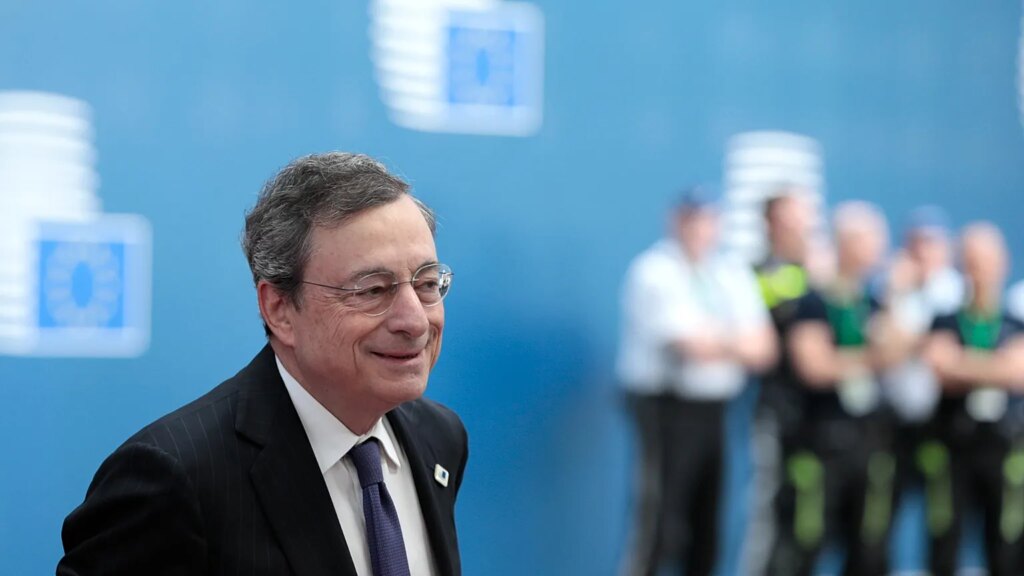
The ex-prime minister of Italy warned that the European Union faces the dangers of subjugation, fragmentation, and loss of industry simultaneously unless it unites more closely.
«Europe confronts the risk of subordination, division, and deindustrialization» unless it evolves into a «true federation,» stated Mario Draghi, former Prime Minister of Italy and President of the European Central Bank, during his address at the Belgian KU Leuven University on Monday.
Draghi emphasized that «power necessitates Europe advancing from a confederation to a federation,» since the existing global order has become «obsolete.»
In his speech, which accompanied the honorary degree he received from the institution, Draghi outlined the collapse of the previous global framework, tracing its deterioration back to China’s accession to the World Trade Organisation and the West’s commencement of trade relations with a nation «aiming to establish itself as a separate geopolitical pole.»
This development laid the groundwork for «the political backlash currently faced» and resulted in «a global environment marked by reduced trade and weaker regulatory frameworks» — challenging, yet not inherently threatening.
«The real danger lies in what fills that void,» Draghi warned, citing changes in the United States. «The US has enacted tariffs against Europe, undermines our territorial interests, and for the first time signals that it views European political disunity as advantageous.»
Conversely, he pointed out that China continues to dominate key segments of global supply lines, leveraging this advantage by inundating markets, restricting vital resources, and compelling others to absorb the costs of its economic imbalances.
«Pragmatic federalism»
Given the US’s approach of combining partnership with dominance, alongside China’s maintenance of its growth strategy by shifting costs abroad, Draghi argued that the EU must fundamentally reform its structure. He cautioned that merely uniting small countries does not inherently create a formidable bloc.
He highlighted that in fields where Europe has embraced federation — such as trade, competition policy, the single market, and monetary policy — the EU commands respect as a unified power capable of negotiating collectively.
As proof, he referenced the recently concluded trade deals with India and Latin America, which he described as successful.
«In domains where federation has not been achieved — defence, industrial policy, foreign affairs — Europe remains perceived as a loose coalition of mid-sized nations vulnerable to fragmentation and individual handling,» Draghi explained.
«A coalition coordinating actions remains a collection of sovereign states — each wielding veto power, each driven by its own interests, and susceptible to being isolated one by one.»
He characterized his proposal as «pragmatic federalism,» designed to break the deadlock without subordinating any member.
«Participation is voluntary. The door stays open to others, except those undermining shared goals. Achieving power need not come at the cost of our values,» Draghi stated, citing the euro as the «most effective instance,» wherein some members launched it initially and others joined later.
«Among those caught between the US and China, only Europeans have the possibility to emerge as a true power. The question is: will Europe remain just a vast market shaped by others’ priorities? Or will it take the necessary steps to become a singular power?»
«Europe that fails to defend its interests risks losing its core values in the long run.»