
In this newsletter: former French PM Dominique De Villepin responds to Iran protests; European NATO members consider reactions to Trump’s Greenland threats; and the EU-Mercosur free trade agreement risks intensifying political tensions in France.
Good morning from Brussels – and welcome to the inaugural 2026 edition of Europe Today.
Only 12 days into the year, the geopolitical scene has already been disrupted by a US president acting with growing boldness.
Trump has ordered the capture of Venezuela’s leader, threatened to claim Greenland from Denmark, and is pressuring Cuba into an oil agreement as part of his effort to oust rivals from the Western Hemisphere and reinforce his influence.
Meanwhile, concerns are rising over whether the intensifying anti-government demonstrations in Iran might provoke US intervention. Last night, Trump told reporters aboard Air Force One that he was contemplating “very strong” courses of action, with reports indicating senior officials will provide definitive options tomorrow.
Earlier today on our flagship morning program Europe Today, former French Prime Minister Dominique De Villepin urged Donald Trump to show restraint, arguing there are «informal methods to pressure the Islamic government» aiming to «stop the current events».
«Avoid intervention, increase diplomatic pressure, and attempt to create dialogue or use other available means to foster a new situation that allows the Iranian leadership to fully grasp the consequences of their behavior,» De Villepin told our lead anchor Méabh Mc Mahon. «Intervention risks generating chaos far worse than the present state.» Our lead story this morning includes the latest developments and insider reports from our Persian team.
European Union leaders find themselves mostly sidelined in the evolving global order, constrained by internal disagreements and a reluctance to upset Trump amidst a push for peace in Ukraine.
However, a significant breakthrough in the EU’s trade negotiations with South America’s Mercosur bloc has arrived at a critical juncture, offering the EU a chance to regain influence.
On Friday, EU countries endorsed the long-disputed EU-Mercosur free trade agreement after nearly 30 years of talks, serving as a timely message to Washington that rules-based international agreements remain relevant.
European Commission President Ursula von der Leyen and European Council President António Costa are scheduled to sign the accord next Saturday in Asunción, Paraguay, alongside foreign ministers from Mercosur members Argentina, Brazil, Paraguay, and Uruguay, as first reported by Euronews on Friday.
The deal represents more than simple trade liberalization. It signifies a considerable enhancement of the EU’s standing on the global stage and showcases its ability to diversify geo-economic relationships amid unsettled global dynamics.
France, which has been the most vocal opponent, still hopes to prevent the deal’s final ratification in the European Parliament, as President Macron and his government emerge unsettled from their inability to block it. Further details on the French political impact are below.

European leaders denounce Iran’s harsh suppression of protesters while Trump reviews potential responses
US President Donald Trump will receive a briefing tomorrow outlining possible responses to the widespread protests in Iran, which range from military action and sanctions against the regime to supporting anti-government groups, officials told the Wall Street Journal (WSJ).
«We are giving it serious consideration—the military is examining it closely. We have some very strong options,» Trump said a few hours ago. «I receive hourly updates, and a decision will be made soon.»
Meanwhile, Tehran has warned that US military facilities and Israel would become «legitimate targets» if Washington intervenes in support of protesters.
The WSJ also reports that no US forces have been mobilized yet for potential strikes, but discussions may include deploying Elon Musk-owned Starlink terminals to restore internet access.
The protest crackdown has caused at least 544 deaths according to activist groups, amid heightened repression by Iranian authorities. Verified videos have surfaced showing large demonstrations in multiple cities despite complete internet shutdowns since Thursday night.
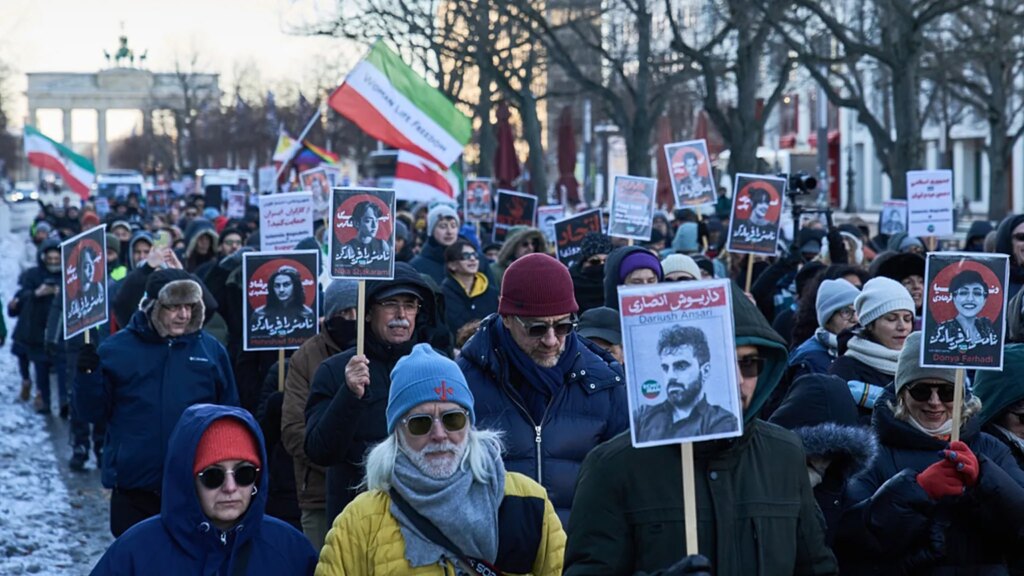
The protests represent one of the greatest challenges to supreme leader Ayatollah Ali Khamenei amid surging public frustration over soaring prices and economic instability. Across the weekend, solidarity demonstrations took place in France, Germany, the Netherlands, and the UK.
Experts speaking to Euronews’ Persian service note that the next hours will be «crucial» in determining whether this marks a turning point in Iran, revealing if protests will spread despite government suppression or be violently crushed.
Our Persian correspondents also highlight that interventions by Reza Pahlavi, the exiled son of Iran’s last monarch who appears to seek a role in a potential transition, are intensifying international interest despite his divisive nature. My colleague Omid Lahabi provides an in-depth analysis of Pahlavi and his political vision for Iran.
At the same time, European leaders have shown support for protestors while urging restraint from authorities. Commission President von der Leyen declared Saturday that the EU “unequivocally condemns the violent repression» of “legitimate demonstrators”.
Leaders of France, Germany, and the UK issued a joint statement urging Tehran to «exercise restraint» and «avoid violence».
European Parliament President Roberta Metsola emphasized that protestors need «more than just words,» proposing the EU blacklist the Islamic Revolutionary Guard Corps and expand sanctions on regime supporters. Brussels has so far resisted following the US in blacklisting the IRGC, citing the need for a court ruling within the bloc’s member states on terror accusations.
Follow the latest developments.
European countries consider NATO mission to Greenland amid Trump’s annexation threats
A coalition of European NATO allies, led by the UK and Germany, is reportedly exploring a military deployment to Greenland as a show of resistance against Trump’s threats to annex the territory, according to Bloomberg.
Sources familiar with the discussions mention Germany proposing a joint NATO initiative intended to safeguard the Arctic region.
This reflects growing unease among European governments about the ramifications of Trump’s annexation threats for the NATO alliance, which includes both the US and Denmark, the latter governing Greenland as an autonomous territory.
Danish Prime Minister Mette Frederiksen delivered stronger warnings yesterday, characterizing potential US actions in Greenland as a “defining moment” for Denmark and NATO.
“We stand at a crossroads; this is a defining moment,” Frederiksen said at a political event, confirming an upcoming meeting this week between US Secretary of State Marco Rubio and the foreign ministers of Denmark and Greenland.
Macron, overridden in Brussels on Mercosur deal, confronts increased domestic unrest
France is facing heightened political instability as Prime Minister Sébastien Lecornu’s government confronts two possible no-confidence motions following its failure to halt the EU-Mercosur trade deal’s approval in Brussels last Friday.
After weeks of intense farmers’ protests and widespread domestic political pressure, Macron opposed the Brussels-South America Mercosur agreement, yet the French government was unable to secure the blocking minority needed in the EU countries’ vote.
Lecornu replied to far-right criticisms Sunday by asserting the vote was not mere “posturing” but a firm refusal to “safeguard agriculture and food sovereignty,” underscoring concessions obtained by Paris, including early access to €45 billion from the Common Agricultural Policy and a retroactive pause on the EU carbon border tax on fertilizers.
Nonetheless, the government is placing its hopes on a last-ditch effort to derail the agreement when it faces a vote in the European Parliament, even though the deal is provisionally underway before that vote. “The European Parliament must now decide,” Lecornu stated.
Former French Prime Minister Dominique De Villepin told Europe Today this morning that there is «strong consensus in France across political parties to reject this deal, citing insufficient reciprocity.»
“France should have negotiated to improve the deal,» said De Villepin, who launched his own political party La France Humaniste last June.
Our trade correspondent Peggy Corlin notes that Macron was effectively sidelined at this crucial juncture for the EU, which has negotiated the deal for decades, marking a clear sign that his domestic challenges are undermining his influence in Brussels.
This follows European Commission President von der Leyen’s removal of influential French commissioner Thierry Breton and replacing him with a successor holding a narrower portfolio, reducing France’s leverage over EU policy.
Read Peggy’s complete analysis.
More from our newsrooms
‘I suggest they make a deal now before it is too late,’ says Trump amid Cuba threats | US President Donald Trump urged Cuba to finalize an oil agreement with the US, warning that Havana will soon stop receiving oil or funds from Venezuela—its longtime supplier and close ally. Malek Fouda reports.
US launches fresh retaliatory strikes against IS in Syria following deadly ambush | Large-scale strikes were launched in response to a December ambush that killed two US soldiers and one civilian interpreter. Read more.
Swiss ski bar owner admits basement service door locked during New Year fire | New evidence has emerged concerning the tragic fire at Le Constellation bar in Crans-Montana, which caused 40 deaths on New Year’s Eve, revealing a basement service door was locked from the inside. Read.
Also monitoring
- The European Court of Auditors will soon release its first two reports on the European Commission’s proposed 2028-2034 long-term budget. That concludes today’s edition. Peggy Corlin contributed to this newsletter. Remember to subscribe to receive Europe Today every weekday morning at 08.30 in your inbox.